








ARTICLES
Advance Search
Aquatic Health
Aquatic Health, Fitness & Safety
Around the Internet
Aquatic Culture
Aquatic Technology
Artful Endeavors
Celebrity Corner
Life Aquatic
Must-See Watershapes
People with Cameras
Watershapes in the Headlines
Art/Architectural History
Book & Media Reviews
Commentaries, Interviews & Profiles
Concrete Science
Environment
Fountains
Geotechnical
Join the Dialogue
Landscape, Plants, Hardscape & Decks
Lighter Side
Ripples
Test Your Knowledge
The Aquatic Quiz
Other Waterfeatures (from birdbaths to lakes)
Outdoor Living, Fire Features, Amenities & Lighting
Plants
Ponds, Streams & Waterfalls
Pools & Spas
Professional Watershaping
Structures (Editor's Notes)
Travelogues & History
Water Chemistry
WaterShapes TV
WaterShapes World Blog
Web Links
Around the Internet
Aquatic Culture
Aquatic Technology
Artful Endeavors
Celebrity Corner
Life Aquatic
Must-See Watershapes
People with Cameras
Watershapes in the Headlines
If there's one thought that permeates every page, every word and every photograph in this publication, it is this: The creation of something outstanding, something that stirs an emotional response, something that establishes an ongoing, extraordinary experience for clients and anyone else who sees our work all starts with the passion we have in our hearts for art and its intimate relationship to what we do as watershapers. That's a big concept. Really big. And I believe that unless you appreciate and (on some level) understand the raw power of artistic creation, then what you generate will seldom be

It'd be great if every project I was asked to tackle were about the complete environment - not only the planting plan, but also the watershapes, artworks, amenities and everything else a client might desire. That doesn't happen often enough, probably because my portfolio is much richer in planting plans than it is in watershapes. But from time to time I find clients who have faith in me and my abilities as a designer and give me total control. Late last year, I was fortunate enough to come across one such project. I had originally been brought in to

Through the years, more than a few watershaping professionals have asked me how to break through and start working with high-end clients. I respond by giving them the disappointing news that there is no magic key here: Serving the high end takes commitment, hard work and a willingness to focus your thinking on a distinct set of fundamentals that must take over and guide your work. Depending on the level at which you're currently functioning, getting to the high end may involve climbing a mountain or might simply be about making a series of

One Saturday during the summer of 2000, I sat down for breakfast in Santa Monica, Calif., with Suzanne and Ron Dirsmith. They had just published the first of what have now become several articles in WaterShapes and had flown in from Chicago to

Our firm has always focused on the creation of watershapes and landscapes for championship-level golf courses. It is work on an enormous scale in beautifully conceived settings, and the clients are extraordinarily demanding. On occasion, our work has reached beyond the links and into the grounds and homes that surround them. That makes sense, because the lion's share of our work on fairways, tees and greens runs parallel to development of adjacent luxury homes. This means that we often expend considerable energy in considering the views from future home sites and the ways our watershapes and landscapes visually interact with what are often

Even watershapers who don't perform daily tests of water quality in the systems they design and/or build will benefit from being familiar with the various methods available for water analysis, says Michael Gardner of Taylor Technologies. Such knowledge, he notes, helps in starting up new systems, formulating chemical-treatment regimens, calibrating automatic controllers or simply educating those who'll care for the watershapes you create.
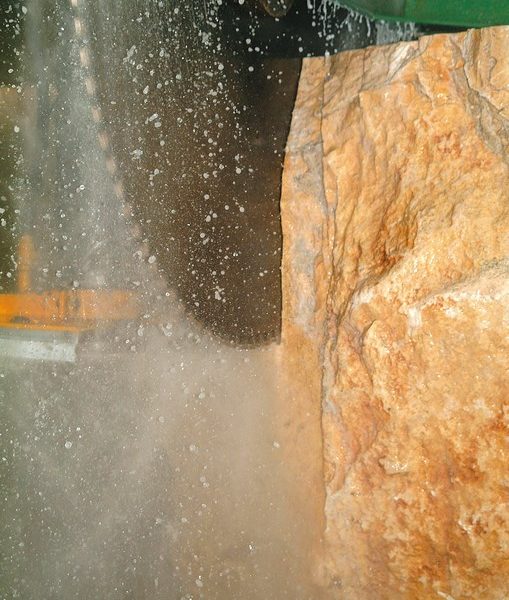
Natural stone is certainly the most time-honored of all building materials. From the pyramids of Egypt to the temples and civic buildings of ancient Greece and Rome; from the palaces and villas of the Renaissance to the most contemporary structures of our modern era, we see a material forged within the earth for millions of years that has been painstakingly quarried and shaped into myriad forms both functional and decorative. Even with the advent of cementitious components and a range of other manufactured substitutes, stone remains the material of choice in a great many applications. In fact, the range of natural stone materials available to designers and builders expands almost daily in response to the specific demands of watershapers and other designers and contractors - and there's no end in sight. Our company, tr stone, is a U.S. distribution facility owned and operated by one of the world's largest stone producers, Tureks, based in Afyon, Turkey. The best thing about the marketplace from the perspective of designers and builders is that high-quality stone is now available from a wide range of domestic and foreign sources in a number of distinctive

During a lifetime of driving up and down the part of Sunset Boulevard where it finally meets the Pacific Ocean, I'd often noticed the sign pointing to "Lake Shrine" but had never taken the time to stop and have a look. I suppose the "shrine" part of it made me think it was the exclusive preserve of adherents or members of the Self-Realization Fellowship - an organization I knew nothing about other than that their facility was in one of Los Angeles' most beautiful locations. I finally overcame my hesitation about visiting the Lake Shrine a couple years ago, when a friend told me it was a place where people of all faiths and religions were welcome to stroll, meditate and enjoy the tranquility of the setting. Curiosity overcame skepticism and I finally visited the place. What I found at the Lake Shrine was a serene, calm, meditative oasis of lush, beautiful gardens surrounding a lake. To this day many years later, the minute I drive through the entrance gate, I'm always swept up by sensations of serenity and peace - and have since

If you're uncomfortable with ultra-adventurous design schemes, you can stop reading this review right now. If, however, you find inspiration in projects that are completely original, then Diarmuid Gavin's Outer Spaces is an amazing and rewarding book. The 256-page text (DK Publishing, 2003) covers 25 mind-blowing projects by this award-winning Irish landscape architect and host of his own PBS series, The Home Front. Gavin has become something of an international celebrity with a reputation for creating what might loosely be termed "contemporary spaces" that use materials, shapes, plant materials and water in extraordinary and surprising ways. In this book (one of several he's published), he starts by
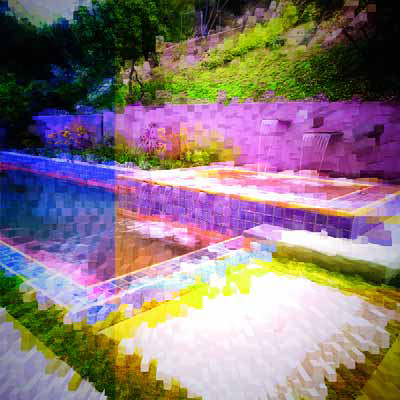
Few things are as important to the aesthetic impression made by swimming pools, spas and other watershapes as the colors you select to use in it and around them. Take tile as an example. Whether it's just a waterline detail, a complete interior finish or some elaborate mosaic pattern, it serves to draw the eye into a design. If the color and material selections work, the scene can become extraordinarily elegant and beautiful. If they don't, you can have a major eyesore on your hands. The amazing thing to me is how few watershapers ever really consider the importance