








reviews
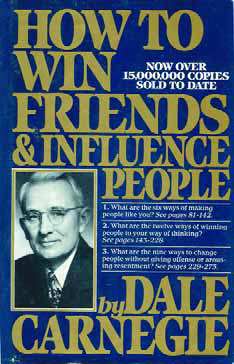
In this business, there's no avoiding the fact that you have to be able to work with people. That may seem an obvious point, but if you're like me and tend toward the shy side, stepping out of your shell to work with others is not always easy. I've always admired those with easy-going social skills, but I've never been one of them - and I know in this industry that I'm far from alone. In my case, I've found my way around my basic tendencies by taking advice I've found to be incredibly helpful in my work with clients as well as in my relationships with sub-contractors and fellow employees. That advice comes from one of the true classics of 20th-century American publishing, none other than Dale Carnegie's How to Win Friends and Influence People. If you're not familiar with this volume beyond its name, you might be impressed by the fact that Carnegie's seminal self-help book was first published in

If there's one thing we all know without any question, it's that nobody is getting any younger. In fact, if you read any of the demographic information available these days about the "graying" of the Baby Boom generation, it's clear that our entire country is becoming older en masse. During the past year, I've experienced for myself what this means to us in the watershaping trades in the form of a dramatic uptick in the number of clients, most of them elderly, who have approached our firm looking for swimming pools primarily for the purpose of aquatic aerobics and other forms of water exercise. For the most part, these prospects and clients have made it clear they would not otherwise be interested in purchasing a pool: They need it, they say, to pursue therapy for a range of physical conditions and ailments. With that trend in mind (and anticipating the needs of my own aging frame as well), I decided to

Back when I was first getting into the pool/spa industry, I clearly remember trying to find books that would help me get started. Boy, were the pickings slim. At that time 15 or so years ago, there were only a couple of books that focused on pool design, and neither one was particularly helpful (so I'll resist naming names). Fortunately, those days are long gone, and now we find ourselves with a good supply of periodicals and books that offer watershapers a wide array of great ideas. Recently, I felt a strong sense of déjà vu: I'd set out looking for information on outdoor kitchens and fireplaces and could find only a handful of basic and not entirely helpful publications - this despite the fact that it's no secret that outdoor cooking/dining areas (and their cousins, outdoor fire amenities) have become more and more popular in the last few years. It came as no surprise that
I've always been one those who finds useful parallels between business and sports. In fact, I think it's something that applies especially well in a field such as watershaping, where successful results require coordination of distinctly different activities unified by shared goals and objectives. For those reasons, High Five!: The Magic of Working Together by Ken Blanchard and Sheldon Bowles (Harper Collins, 2001) is superb fuel for watershapers - and anyone else who makes their living working in cooperation with others. I first discovered the book because of my son Trey's soccer career. He started when he was all of four years old, and I signed on as the coach. If any of you have ever watched four-year-old boys play

There are those in this business who are extremely adept at selling, and I'm definitely not one of them. I get by, but it's never been my long suit by any means. I've always admired the good salespeople I've met, and I fully accept the hard reality that to build a watershape at any level, one must sell it first. But I came up on the design/construction side of the watershaping business, and I've never found a clear way past the fact that, for me, sales has always been an area where I consistently have plenty of room for personal growth and improvement. I know that selling is important not only because it brings business through the door, but also because it sets the stage for everything that follows as a project progresses. As practiced by real professionals, I've observed that it's much more about

Good Bones I may be biased, but I think that James Van Sweden is the most important and certainly one of the most influential landscape architects working today. His work in suburban residential settings has influenced an entire generation of designers, and his signature use of ornamental grasses, stacked ledger walls and well-designed pathways can be seen in thousands of spaces across the country. Van Sweden's latest book (his third) is Architecture in the Garden (Random House, 2002), which is all about designing spaces that have, as he puts it, "good bones." What he means is that without a design that takes the architecture of the home, a site's characteristics and the
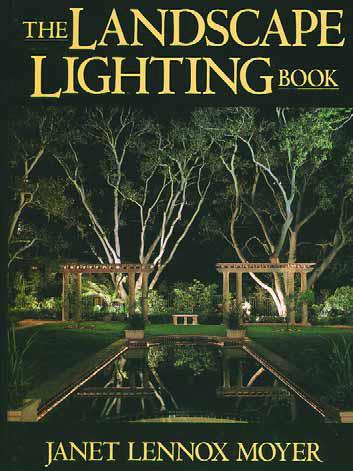
Janet Lennox Moyer's The Landscape Lighting Book (John Wiley & Sons, 1992) is quite simply one of the finest textbooks I've ever read. Indeed, when it comes to resources on the often-elusive topic of landscape lighting, it's hard to imagine a more comprehensive resource. Moyer is a lighting designer and instructor who has made a career of lighting the night with a flair that has earned her a tremendous reputation in the United Sates and abroad. (Her first contribution to WaterShapes, coincidentally, appears in this issue - click here.) In reading her 282-page, richly illustrated book, it's easy to see why she's become so successful: There is so much detail about design and such a wealth of specific

I don't know who first expressed it, but I've always welcomed the notion that "great designers are great thieves." That nugget rings so true because very few among us ever have completely original ideas and, in fact, the best designs are generally derivative of something that came before. To my mind, if some degree of larceny is part of our game as watershape designers, then one of the very best places to find borrowable ideas is a book entitled The Annotated Arch by the historian Carol Strickland (Andrews McMeel Publishing, 2001) - a wonderful and inspiring 180-page, beautifully illustrated book that offers a
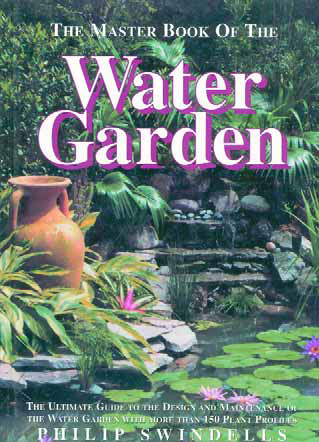
Experts in watergardening and pond enthusiasts of all stripes are quite quick to claim that their form of watershaping is the fastest-growing segment of the industry and trumpet a history that stretches, they say, to the Islamic world, Japan and Europe. I can't say whether they're right or wrong with their assertions, but it's my sense as someone who's been designing with water for many years that the current trend toward naturalistic ponds and streams is quite strong (and probably getting stronger) and that it's important for all of us professionals to approach the art and science of "living" watershapes in a deliberate and thoughtful way. To that end, I've examined many publications dedicated to watergardening - and I'd be lying if I said that I've been

The famous landscape architect Thomas Church was known to proclaim, "I have no style." What he meant was, rather than impose a style that was characteristically his on a project, he preferred to let the home, site and clients guide the stylistic details of his work. I've always admired Church and other designers who are willing and able to move comfortably across the style spectrum in accordance with the situation. This is certainly how I've chosen to approach my own design work, even when I find the huge range of possibilities a bit perplexing. To be able to work in such a malleable way, of course, you need to be familiar with an array of styles and comfortable with the nuances of classifications stretching from traditional to