








garden

A tremendous amount of synergy and teamwork went into the making of "The Ultimate Family Home." Initiated by Builder magazine (the official publication of the National Association of Home Builders) and Pardee Homes (the Los Angeles-based developer of the Nevada Trails neighborhood in which the home was built), the project unfolded as a partnership between the magazine and the developer's Las Vegas office along with Bassenian-Lagoni Architects (Newport Beach, Calif.), Color Design Art (Los Angeles) and Lifescapes International (the Newport Beach-based landscape-architecture firm). "The Ultimate Family Home" opened in January 2004 in conjunction with

When I first walked the four acres of wooded ravines of what would later be christened "The Garden of Wind and Pine" at the heart of the Garvan Woodland Gardens in Hot Springs, Ark., I was both delighted and daunted by the experience. The delight came in the site's sublime natural beauty, which reminded me of tromping through the woods as a child - an activity I enjoy to this day. As for my sense of unease, I don't know which was more significant: the expansiveness of the dry drainage ravines that were to be converted to ever-varying cascades and streams, or the omnipresence of ticks and poison ivy. When I made my first visit in the fall of 1999, the site was part of an undeveloped 210-acre woodland parcel on the shore of Lake Hamilton given to the Department of Landscape Architecture at the University of Arkansas in Fayetteville by Verna Garvan. She had long seen the peninsula as the ideal setting for a botanical garden and had spent two decades developing her vision, planting camellias and azaleas and a rose garden and commissioning a pavilion by the architect Fay Jones and his partner, Maurice Jennings. I had worked in Fayetteville before, crafting a

From the start, it's been a project that has taken its direction from the art, spirit and cultural heritage of the clients and has always been much more to me than just another opportunity to design an attractive backyard and swimming pool. I've always gravitated toward work that lets me treat spaces with a sense of spirituality and a respect for the energy and sanctity of nature that ultimately will resonate with clients beyond the purely visual and functional aspects of the design. Often, those qualities are expressed in subtle ways that I end up appreciating more than my clients, but in the case of the project seen here, there was a joy and ease to the work because the clients shared my sensibilities. As a result, the work

For more than two full years, this project was my personal and professional obsession. It all started in 1993, when my client, a wealthy recording-industry magnate, called on me to design the landscape for a property he'd just acquired in Bel Air, one of the most exclusive neighborhoods in Los Angeles. The Spanish Colonial-style home had been built in the 1920s and was in a sad state of disrepair. By the time I arrived, it had been gutted to the studs, and very nearly all of the hardscape and plantings around the house had been torn out as well. What he was offering me was a tantalizingly blank canvas in a most spectacular setting. In the two years that followed, not only would we
Let's continue the examination of soils we began last time, shifting our focus this time to fertilizers and the ways they can be used to tailor soil to the specific needs of the plants you and/or your clients have chosen. Fertilizing is important, because placing a plant in the ground and providing it with ample sunlight and adequate water in the proper location is only part of the battle. True, plants may thrive under those ambient conditions, but treat them to even minimal amounts of fertilizer and those same plants will show their gratitude with a beautiful display of foliage, blooms, fruit and other wonderful things. Fertilizers provide nutrients for plants that the soil and water alone cannot supply, and they come in hundreds of variations designed to

Great watershaping is, we believe, all about creating forms within a context. The thoughtful watershaper will survey all the key elements of a project while conjuring a mental picture that's as close to the architect's vision as possible - and then base the work that follows on a solid understanding of both the design and the setting. It's always most exciting when we're asked to consult with the designer about a project before the lot has been graded and the ideas are still flowing onto the sketchpad. In those cases where the designer and homeowner are all the same person and those initial discussions involve the designer's own living space, the nature of this interaction can truly be something special. At Pure Water Pools, we've had such a privilege on two occasions, both in working with Lynn Pries, a Newport Beach, Calif.-based interior designer who has spent much of her career creating high-end residences across the United States and Europe. These days, she mostly works on one project at a time, carefully selecting and purchasing a property herself and then seeing to every design detail, inside and out, from start to finish. So far, we've built

Water can be a central feature of any design, but in many cases it is just one element among many of equal (if not greater) importance. In the case of the project pictured here, the owners, a gentle and loving family, established and have maintained a vision of just the sort of warm and nurturing home and landscape they wanted, one in which the lives of family members and friends would be sustained, enriched and enlivened. Their vision (and their involvement with us) might have begun with the water, but it has since expanded to include
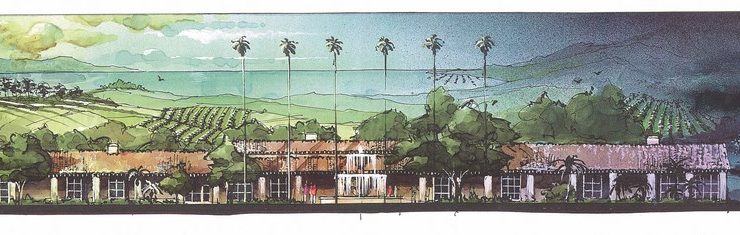
'Project of a lifetime" may not be enough to describe our work at Cima del Mundo. If you'll recall, the hilltop home had experienced many changes since its original construction in 1925, including service as a makeshift monastery as well as a stretch of years in which the property was abandoned and
Last time, we talked about planters, terracing and a couple other techniques for stabilizing slopes and making them look great as backdrops or foregrounds for hillside or hilltop watershapes. We left for this column the important discussion of what to plant in these spaces. In making these suggestions, I'll discuss soil-binding plants and other ground covers that contribute specific desirable qualities to landscape settings. My reasoning is simple: Although sod is a great ground cover and is certainly versatile, I believe that having a broader and more decorative
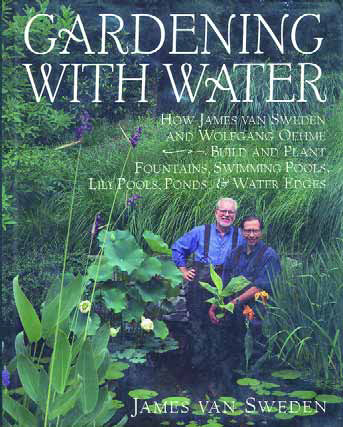
Without any hesitation at all, I can say that Gardening with Water by James Van Sweden (Random House, 1995) is one of the most influential books on design that I've ever read. It's currently out of print, but it's certainly worth a hunt and can still be found on the Internet and in many technical bookstores. All through its 206 beautifully illustrated pages, Van Sweden carefully details his approach to designing with water - an element he says should be used in some form in every garden design. Along the way, he covers his firm's use of swimming pools (natural and architectural) as well as birdbaths, fountains, small watergardens and large ponds. It's an important book from a tremendously influential designer. In fact,