







engineering

In Costa Rica, the people have a saying, pura vida, which in English roughly translates to "pure life." We also are known to say, cual es el apuro, which means, "What's the hurry?" Those two unofficial national slogans reflect the essence of life in this country, where relaxation, an appreciation of natural beauty, love of family and a peaceful spirit are defining characteristics for the society. But even in a place like Costa Rica, where the pace of life is slow, relaxed and easy, timing is still everything. About three years ago, it occurred to me that a variety of social and economic factors were creating a watershape market in Costa Rica in which a truly high-end, quality-oriented custom company could become quite successful. Those factors - Costa Rica's rising profile as
As watershapes have become increasingly complex, the need for reliable hydraulic designs that maximize efficiency and reliability is now more pressing than it’s ever been, says hydraulics expert Steve Gutai. With this installment of his ongoing series on hydraulics, he launches a sequence of articles that will explore principles behind the fluid mechanics and hydraulics of custom

In a word, the project pictured in these pages is about the power and value of collaboration. I was originally called in to consult on the planting design for a backyard in need of remodeling. A couple of months into the process, the clients informed me that they hated their existing pool and asked me if I knew of a pool contractor named Randy Beard, who had worked with them previously on another of their residences. I offered to contact Beard and discuss the project with him: We had known about each other for years, mostly through WaterShapes columns and articles, but to that point we'd never had the opportunity to work together. The clients had said they wanted to remove the spa from the pool and perhaps raise it to create a spillway into the pool. Beard and I quickly came to the same conclusion: Revamping the pool would neither be cost-effective nor would it achieve the outcome the clients desired. Pointed discussions and budget reviews led to the determination that the existing pool/spa combination should be abandoned in favor of something that worked better to generate a sense of space, greater functionality and enhanced aesthetic appeal. Although we didn't set out to tackle the project as a team, Beard and I wound up working hand in glove with a synergy that was valuable to both of us - especially in

As watershape designs become increasingly creative and complex, the demand for more precise methods of engineering their structures has grown as well. To meet that need, observe Ron Lacher and Aaron Cowen of Pool Engineering, experts like them are turning to advanced three-dimensional modeling technology - systems so sophisticated that they make it possible to develop plans for daring projects such as they one they describe here. It's easily the most sophisticated watershape structure we've ever engineered. The pool/spa combination, not yet built, will rise some 50 feet above grade on a cliff behind a home in the densely populated Hollywood Hills near downtown Los Angeles. As conceived, the vanishing-edge pool will sit a full ten feet below the spa in a complex monolithic structure. Supporting the entire affair will be

The latest generation of Las Vegas hotels and casinos offers an amazing showcase for pools, fountains and watershapes of every shape and size. In fact, for many such properties, the presence of these increasingly imaginative watershapes is crucial to defining their appeal for huge numbers of guests and visitors. As these properties and their watershapes have become more elaborate and unconventional, they've presented designers, engineers and builders with greater and greater technical challenges - many of them carried in the plain fact that water can inflict a great deal of damage on these facilities if it is not properly contained and controlled. In our end of the watershaping trades, the visual and sensory arms race has challenged the waterproofing industry to step up to the plate and manage the integrity of every nook and cranny of every vessel, be it wide or narrow, curved or straight, below-grade or

It's speculated that the exterior spaces at Playboy Mansion West must be the most photographed in the world. That's hard to quantify, of course, but it's certainly safe to say that since construction began in the 1970s, the home of publisher Hugh Hefner and its famous swimming pool and grotto have been used ceaselessly to promote his unique lifestyle. Indeed, the residence has attained near-mythic status as the world's most elaborate adult playground. For about 20 years, we had

Fifteen years ago, aquatic play attractions were found mainly in commercial waterparks in the form of large, multi-level, themed structures. Some smaller elements were found in the shallow ends of swimming pools, but they were generally limited to a few play apparatuses such as water umbrellas. Much has changed in recent years, and aquatic play systems are now featured in a greater variety of settings including city parks, recreation centers, resorts and a range of other recreational spaces. This trend did not burst forth overnight: For more than ten years, our firm and others have been helping things along by focusing attention on the value of concepts related to zero-depth aquatic play. We at Vortex Aquatic Structures in Montreal, for example, have designed our "Splashpads" to bring the joy and recreational value of aquatic play to almost any space. Among our objectives is bringing a measure of the commercial waterpark experience to places such as neighborhood parks, housing developments, campgrounds and other facilities, thereby allowing everyone within a community to experience

As watershapers, we occasionally are given the opportunity to interact with modern architecture in ways that enable us to generate genuine works of art. This trail linking some of today’s most expressive architecture to the reflective and auditory potential of water has been blazed by great designers including John Lautner, Ricardo Legorreta and Luis Barragan. They and their followers have thoroughly explored the geometries, materials and spatial relationships that make up the modern architectural dialogue between structures and water – and the results have often been breathtaking. Almost without exception, their success in these designs is a matter of context and the setting, and as one who has studied their projects for many years, I now have a clearer sense of the excitement they must have felt when things came together and everything about a project was just right. For the project pictured in these pages, a hilltop setting, the contemporary architecture of the home and willing clients set the stage for what is probably

When we think about the challenge of literally "shaping" a body of water, we must start by thinking about edges. The edge is the pond's DNA or blueprint. It tells us almost everything about the pond. Without being able to observe the edge, you can't discern whether it's a formal pond, lake or a sewage-treatment facility. It might be a beautiful water feature or an eyesore. The edges form our reference in defining the whole setting and are consequently of the utmost importance. We find this defining-edge concept at work in nature's own beaches, riverbanks and lakeshores, and it is a one that extends right through the heart of watergardening and all types of watershaping, whether architectural or naturalistic (or, as I commonly classify them, formal or informal). No matter the focus or intent of our designs, we must always consider what will be happening at the water's edge. This is the part that demands the most thought, skill, care and expenditure. The subject of edges is so massive that it will be considered here and in articles to come. For purposes of this discussion, we'll limit our look to the use of edges in informal pond settings and situations in which we are attempting to create the impression that the body of water in question was originally
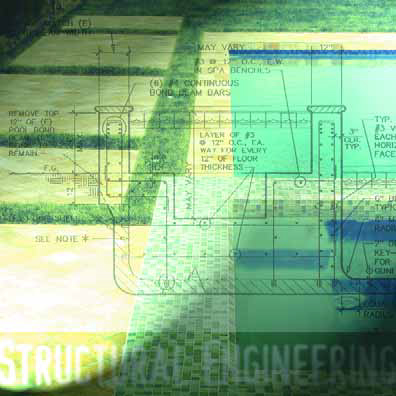
Let me make an important point: As interesting as some of the details I discuss in these columns may be, many of the more significant ones wouldn't have any substance or value to my clients without the contributions of one very important person: my friend Mark Smith of Tarzana, Calif., whose firm takes care of my structural engineering. I'd go so far to say that he and his staff are critically important external members of my design team - professionals who know more than I will ever know about steel, concrete, tension and compression. Every single project I design and build is fully, individually engineered, and I refuse to make any assumptions on my own about what might be