








engineering

In a real sense, I want to build antiques: My goal in designing and shaping water walls has always been to develop systems of beauty that will be around and appreciated decades or even centuries from now. Not only are they built to the highest standards of quality - as are many antiques - but they're also meant to hold running water year after year. I don't know who created the first water wall, but my best guess is that they've been produced in one form or another since the late 1960s or early '70s. I became aware of them in the early '80s, at which point a number of craftspeople were making them from stone, copper, and bronze. Some of these products aspired to be works of sculptural art, but for the most part I thought that the medium's artistic potential hadn't been fully explored or expressed. My idea at the time was to expand the concept with respect to shapes, sizes, materials and styles. I also wanted to check into the possibilities of combining
In a real sense, I want to build antiques: My goal in designing and shaping water walls has always been to develop systems of beauty that will be around and appreciated decades or even centuries from now. Not only are they built to the highest standards of quality - as are many antiques - but they're also meant to hold running water year after year. I don't know who created the first water wall, but my best guess is that they've been produced in one form or another since the late 1960s or early '70s. I became aware of them in the early '80s, at which point a number of craftspeople were making them from stone, copper, and bronze. Some of these products aspired to be works of sculptural art, but for the most part I thought that the medium's artistic potential hadn't been fully explored or expressed. My idea at the time was to expand the concept with respect to shapes, sizes, materials and styles. I also wanted to check into the possibilities of combining

It's a tale of two visions. One contingent in the family wanted a formal, architectural pool that would reflect the geometry of the home. The other wanted to borrow the natural look of the lake and rock formations that flowed down the sloping backyard. Such divergent themes are generally difficult to blend into a coherent design, but I managed to do it with a little help from some friends. The project, which involves placing a formal, geometric pool atop a formation of artificial rock that looms over a grotto and lagoon-like pool below, is still under construction at this writing. At this point, I'd have to say that the results should be just as spectacular as the design process was arduous. My company is based in Raleigh, N.C., which, although it is hardly a backwater, is not exactly at the epicenter of watershape design or construction expertise. To integrate this diverse clutch of elements, I felt a need to
It's a tale of two visions. One contingent in the family wanted a formal, architectural pool that would reflect the geometry of the home. The other wanted to borrow the natural look of the lake and rock formations that flowed down the sloping backyard. Such divergent themes are generally difficult to blend into a coherent design, but I managed to do it with a little help from some friends. The project, which involves placing a formal, geometric pool atop a formation of artificial rock that looms over a grotto and lagoon-like pool below, is still under construction at this writing. At this point, I'd have to say that the results should be just as spectacular as the design process was arduous. My company is based in Raleigh, N.C., which, although it is hardly a backwater, is not exactly at the epicenter of watershape design or construction expertise. To integrate this diverse clutch of elements, I felt a need to
The art of watershaping so often is all about the art of finishing. Certainly, every stage of any project is important, but the final steps leading to completion are what make most designs come to life. The project pictured here, which I've covered in five of my "Details" columns during the past couple years, has been an undertaking of extraordinary scale and mammoth complexity. As I mentioned frequently in those columns (November 2003, January and February 2004 and January and February 2005), the lion's share of the project management fell to my east coast partner and dear friend Kevin Fleming, who truly has endured a baptism of Tisherman-style fire as he
The art of watershaping so often is all about the art of finishing. Certainly, every stage of any project is important, but the final steps leading to completion are what make most designs come to life. The project pictured here, which I've covered in five of my "Details" columns during the past couple years, has been an undertaking of extraordinary scale and mammoth complexity. As I mentioned frequently in those columns (November 2003, January and February 2004 and January and February 2005), the lion's share of the project management fell to my east coast partner and dear friend Kevin Fleming, who truly has endured a baptism of Tisherman-style fire as he
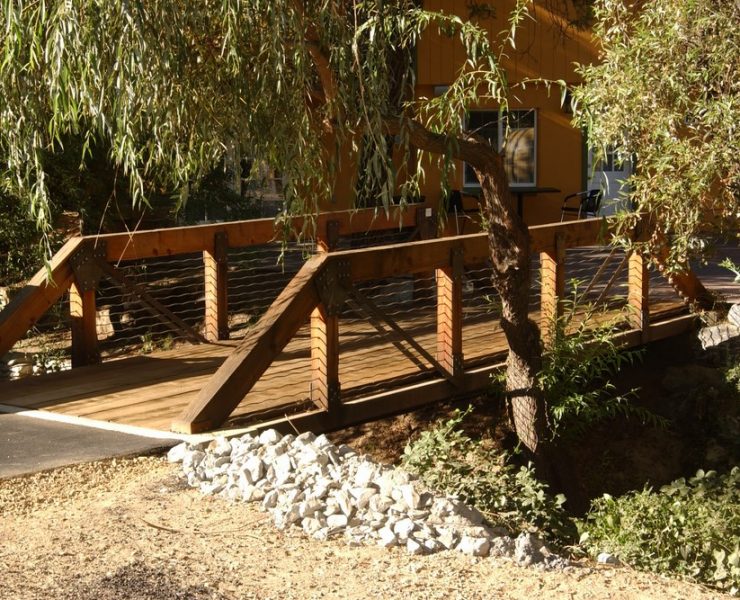
Bridges have been important to humanity for thousands of years. They've provided avenues of travel between disconnected spaces and have, as a result, been critical to commerce, settlement, warfare, travel and even poetry and literature. To this day, they are iconic in certain cities or regions (think Paris or New York), and there has always been a distinctly romantic air that accompanies their obvious utility. My relationship with bridges in general (and with wooden bridges in particular) began during my childhood near Nebraska's Niobrara River. The big, load-bearing structures crafted to span that river in the late-19th and early-20th centuries absolutely fascinated me. I'd spend hours climbing on those old structures and was amazed by the way they creaked as their tension and compression members supported truly formidable weights. At the same time, I came to value the presence of
Bridges have been important to humanity for thousands of years. They've provided avenues of travel between disconnected spaces and have, as a result, been critical to commerce, settlement, warfare, travel and even poetry and literature. To this day, they are iconic in certain cities or regions (think Paris or New York), and there has always been a distinctly romantic air that accompanies their obvious utility. My relationship with bridges in general (and with wooden bridges in particular) began during my childhood near Nebraska's Niobrara River. The big, load-bearing structures crafted to span that river in the late-19th and early-20th centuries absolutely fascinated me. I'd spend hours climbing on those old structures and was amazed by the way they creaked as their tension and compression members supported truly formidable weights. At the same time, I came to value the presence of

If ever there was an example of the power of simplicity, it's been the rise of what we call floating-granite-ball fountains. They've been around since the early 1990s and are now found in a range of commercial and even residential settings. I hadn't ever seen one when I joined HydroDramatics back in 1996, but I do know that soon after I started we began receiving a steady flow on inquiries about them - and it wasn't long before we received our first commission for a floating sphere for a major automobile manufacturer in Detroit. As has been the case every time a prospect has asked about one of these fountains since then, school administrators wanted
If ever there was an example of the power of simplicity, it's been the rise of what we call floating-granite-ball fountains. They've been around since the early 1990s and are now found in a range of commercial and even residential settings. I hadn't ever seen one when I joined HydroDramatics back in 1996, but I do know that soon after I started we began receiving a steady flow on inquiries about them - and it wasn't long before we received our first commission for a floating sphere for a major automobile manufacturer in Detroit. As has been the case every time a prospect has asked about one of these fountains since then, school administrators wanted