







engineering

I may be revealing a professional bias here, but ozone is fascinating stuff. In nature, it's among the most essential chemicals on the planet, existing most prominently as a gaseous component of our upper atmosphere. Formed there by sunlight's reaction with atmospheric oxygen, it collectively constitutes the famous Ozone Layer that protects us from the sun's ultraviolet rays and is crucial to the very existence of life on earth. Closer to the ground, ozone is widely used across a broad spectrum of applications. It's well known in the pool and spa market as a water sanitizer, for example, either as a chlorine alternative or an adjunct. It's also widely used in food processing and municipal drinking and wastewater treatment systems and plays key roles in the production of cosmetics and with air freshening and purification systems. For all that, one of the most interesting applications of ozone-generating systems in the past 20 years - and the subject of this article - is the use of ozone in the life-support systems for aquatic animals held in captivity or for

Think about what happens when rainwater falls on an impervious surface in a big outdoor parking lot studded by the occasional tree: The water dampens the surface, which instantly becomes saturated. Only a minute percentage of water that penetrates the trees' canopies to reach their curb-bound planters becomes available to the trees' roots. The rest almost immediately starts flowing to drain grates or perimeter drainage details and is lost to a stormwater-collection system. The trees are helped only marginally by the life-giving rain, and the water

Working in constrained spaces is entirely different from tackling projects that unfold in pastures where the only boundary might be a distant mountain or an ocean view. Indeed, in small areas that may be defined by fencing or walls or adjacent structures, the constrained field of view offers substantial aesthetic challenges to the designer in that every detail, each focal point, all material and color selections and every visual transition will be seen, basically forever, at very close range. When you're working small spaces, in other words, there's literally not much room for error. In this smaller context, each and every decision watershapers and clients make will subsequently be in direct view, and it's likely that each detail will take on special significance for the clients, positive or negative, as they live with the watershape over time. And on many occasions, what we're asked to start with as designers leaves much to be desired, including spaces already vexed by sensations of confinement, closeness or downright claustrophobia. To illustrate what I mean, let's take a look at two projects I recently completed in smallish yards for clients who wanted to

When you ask people about transparent building materials, most people immediately think of glass. Glass is certainly stronger than most people realize, but it has never been an ideal structural material because of its weight, brittleness and structural limitations. With our acrylic products, by contrast, architects and other designers have found a material with which they can create substantial transparent structures that are much lighter and more versatile than those made with glass – and with a structural strength more than double that of concrete. R-Cast acrylic (as we call it) is indeed an amazing material: Its uses span from the obvious pools, fountains or aquariums to awesome signage and seemingly impossible structures and lighting (to mention a few possibilities). Its combination of optical clarity with safety, strength, flexibility and UV resistance has allowed an increasing numbers of designers across a range of disciplines to embrace the material as never before. There are several firms that provide acrylic materials to the construction marketplace, with

When we first began collaborating on projects with top-flight architects, landscape architects and landscape designers several years ago, for the most part our role in terms of design was fairly limited: We'd receive requests for bids and proposals based on plans of varying detail, and our role was that of faithful installers of the design. On occasions, of course, we'd also refer our own prospective clients to those same designers, who would generate plans that we would in turn estimate and very often install. We still work that way, but as we've built our ties to these accomplished artists, we've become aware that our role in their projects has been growing, even to the point where we are now being asked in many situations to offer our own design ideas. We're also seeing that, when on-site decisions must be made, these designers are

I want to clear up a misconception: Although the programs my colleagues and I stage through Genesis 3 are easily associated with the "high end" and the work of several people associated with our programs may be said to exist at the cutting edge of watershape design, it is simply untrue that we are promoting construction standards that somehow go above and beyond what the rank-and-file industry should be practicing. When we talk about watershape "design" and "construction," it's important to understand that although those two things go hand in hand, they are completely separate considerations. Design is what makes pools and spas either ordinary or extraordinary and is about materials selection, shape, color, elevations, lighting, water effects and location in a setting - basically a whole range of

Working successfully with hydraulic systems requires two things: Understanding the definitions of the basic factors involved in hydraulic calculations and seeing how those values relate to and influence each other in the real world. The last installment in this series of articles focused on the relationship between flow and velocity with respect to water. The related concept we’ll explore this time takes our understanding of that key relationship a step farther by exploring a specific pair of additional relations summarized by

'I want the house to look as though it is floating on water." That was what architect Victor Canas told me when I was called out to visit this site on the northwestern coast of Costa Rica. It was a brilliant idea, certainly one that befitted the spectacular mountaintop setting and its breathtaking 360-degree views of rugged coastline, forest greenery and assorted perspectives to horizons in all directions. I had the advantage in this case of
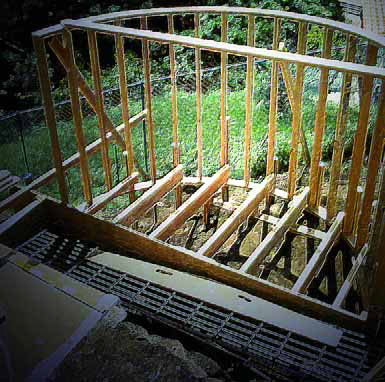
One of the things I've referred to repeatedly through the years is my interest in quality forming for watershapes. I look at it this way: If the job is about creating quality reinforced-concrete structures, then precisely controlling their dimensions and contours stands at the very heart of the art and craft of watershaping. And all I'm recommending here is simply following the lead of the experts who install building foundations and structural walls by using completely rigid materials and support frameworks. To drive that point home, I want to discuss the forming of one specific detail - and define a right way of getting it done. One of my trademarks is the fact that I build many pools that are
One of the things I've referred to repeatedly through the years is my interest in quality forming for watershapes. I look at it this way: If the job is about creating quality reinforced-concrete structures, then precisely controlling their dimensions and contours stands at the very heart of the art and craft of watershaping. And all I'm recommending here is simply following the lead of the experts who install building foundations and structural walls by using completely rigid materials and support frameworks. To drive that point home, I want to discuss the forming of one specific detail - and define a right way of getting it done. One of my trademarks is the fact that I build many pools that are