






ARTICLES
Advance Search
Aquatic Health
Aquatic Health, Fitness & Safety
Around the Internet
Aquatic Culture
Aquatic Technology
Artful Endeavors
Celebrity Corner
Life Aquatic
Must-See Watershapes
People with Cameras
Watershapes in the Headlines
Art/Architectural History
Book & Media Reviews
Commentaries, Interviews & Profiles
Concrete Science
Environment
Fountains
Geotechnical
Join the Dialogue
Landscape, Plants, Hardscape & Decks
Lighter Side
Ripples
Test Your Knowledge
The Aquatic Quiz
Other Waterfeatures (from birdbaths to lakes)
Outdoor Living, Fire Features, Amenities & Lighting
Plants
Ponds, Streams & Waterfalls
Pools & Spas
Professional Watershaping
Structures (Editor's Notes)
Travelogues & History
Water Chemistry
WaterShapes TV
WaterShapes World Blog
Web Links
Around the Internet
Aquatic Culture
Aquatic Technology
Artful Endeavors
Celebrity Corner
Life Aquatic
Must-See Watershapes
People with Cameras
Watershapes in the Headlines
There's little question, pool-construction industry has seen better days. The pandemic-driven buying frenzy and the backlogs it created are all gone, and builders are left to make their way in a dramatically depleted market defined by increasing material, labor and equipment costs. Builder Matthew Batista Naylor believes the path forward is paved with diversification and consumer choice.
Let’s stop pretending. The pool industry is in trouble. Permits are down. Builders are closing shop. And even the bigger names—companies I’ve worked with for years—are going under. We’ve entered a contraction phase, no question, and we need to be honest about what’s causing it, how we respond, and what future we can still build if we’re willing to change
COVID created a feeding frenzy. People were stuck at home and wanted to improve their space—build a dream backyard, finally dig that pool they always talked about. For many companies, business was booming. The problem? That demand was artificial, inflated by emotion, stimulus checks, and a sudden shift in lifestyle. Now we’re on the other side of it, and the cliff is now right in front of us.
Meanwhile, the cost of building pools has skyrocketed. The same equipment package that cost $7,200 a couple years ago now runs over $13,000. Add in higher gunite prices, increased labor costs, steel, plumbing, skyrocketing permit fees, insurance, and fuel, and the average pool that used to cost $65,000 now comes in closer to $110,000.
And here's the hard truth: most people can't afford that. Not now. Not with mortgage rates up, equity down, and home values correcting post-COVID. The market is telling us something, and the industry needs to listen.
ADAPTING TO SURVIVE
The current situation should give pause to professionals at all levels of the industry, starting at the top.
To the manufacturers: if you want builders to survive—and keep buying your product—you need to offer relief now, not in six months or next quarter. We need incentives today, not theories about loyalty points or backend rebates.
Give your pricing a reality check. One of you is going to blink and lower prices—and that’s who the market will rally around. Be the first. Because if you don’t? You’ll be selling premium pumps and LED lights to a shrinking pool of elite clients, while thousands of would-be builders and clients disappear from the landscape. The price increases we’ve seen are a major factor in the dark set of circumstances hurting the industry.
In the spirit of full disclosure, I admit that I’m still busy. I’ve got six figures in contracts signed just this month—but not because I’m only doing pools. I build outdoor spaces. Fire pits. Landscape lighting. Putting greens. Outdoor kitchens. Showers. Sculptures. And I’ve learned that many clients and potential clients still want to spend money on outdoor home improvements, but their comfort zone has shifted.
Yet, most pool companies are still advertising $65,000 pools that nobody can afford, and as pointed out above is an unrealistic price point to begin with. That’s the short game that leaving many builders and potential clients high and dry.
You want to survive? Then advertise fire pits. Offer design fees. Create infrastructure plans for future expansion. And be the one-stop shop that actually knows how to tie the whole environment together.
I always work to develop long-term client relationship built around long-term master plans for their home. In many situations, we build the space incrementally based on what the client wants and is willing/able to spend at any given time.
In most cases, we do wind up building the pool, but it’s often not the first in line.
INVEST IN YOURSELF
A lot of pool builders don’t know how to do anything but pools. That has to change. If you want to last, you need to think like an outdoor environment specialist. Know fences. Know lighting. Know sound. Know how to design an entire space, not just drop a shell in the ground and hope it sells.
This is your business. Own it! Diversify, modernize, and adapt.
Here’s the saddest part of all: just as a new generation is starting to enter this industry—people who love working with their hands, who care about design, who see the artistic side of our craft—we’re seeing opportunity dry up. If we don’t make this industry sustainable now, we will lose the future.
I charge for designs. I mentor younger staff. I show them that being a builder can be creative and rewarding and profitable—if you play it smart. But we need leadership. We need smarter companies. We need more educational opportunites, not just on high-end features, but on core business survival.
Because what’s happening now feels a lot like 2009. And if you weren’t around then, take it from me: those who didn’t adapt got buried.
BOTTOM LINES
This isn’t just about pools. It’s about our industry’s identity. We need to stop being reactive and start being proactive. If you're still holding out for the flood of new pool projects to return, you’ll be underwater soon—and not in the good way.
The answer isn’t to slash your prices. It’s to reframe your offerings. To work smarter. To diversify. To build relationships instead of just pouring concrete. And yes, to fight—for lower equipment costs, for fairer permit fees, for an industry that can actually support its own next generation.
I believe this is how we survive.
Matthew Batista Naylor is president and founder of Architectural Blue, a designer and builder of custom pools, spas, landscapes and other watershapes based in Palm Springs, Calif. He is also a professional musician/composer and an outspoken advocate for the homeless.
Bill Drakeley is passionate about shotcrete, and has spent his professional life becoming a leading authority on its proper use—a pursuit that has led him into a world of concrete that goes far beyond the comfortable confines of swimming pool construction.
...
A recent overseas trip took Jim McCloskey to a place he’s wanted to see for more than 20 years – basically ever since he worked on a WaterShapes article by Douglas Roth more than two decades ago on the wonders of the Japanese garden known as Katsura Rikyu.
...
When it comes to concrete curing, cutting corners today often leads to serious problems tomorrow. Observing proper curing practices is a hallmark of professional craftsmanship—and a commitment to delivering a quality product that homeowners can enjoy worry-free. As Scott Cohen explains, relying on homeowners to water their newly placed concrete can be a prescription for failure.
...
In the first installment of this two-part project Mario and Sherry Abaldo explained the scope and first stages of the work creating one of the most elaborate residential aquatic spaces of all time. Here they fill in many of the details that made this undertaking so remarkable.
...
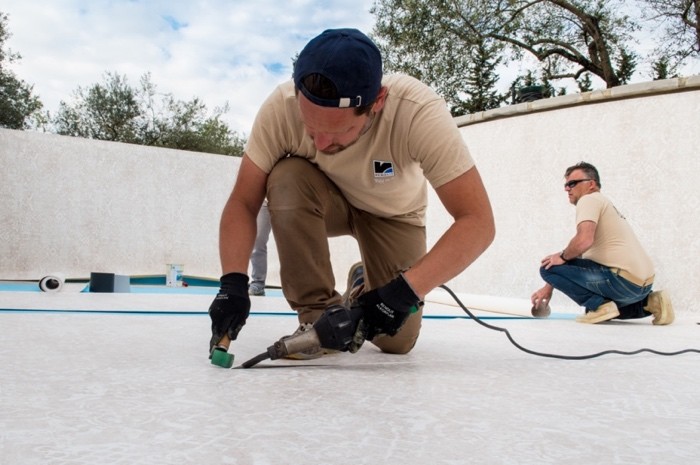
Renolit makes RENOLIT SOLID, a reinforced PVC membrane created to renovate and waterproof decks on both residential pools as well as in aquatic facilities. This 80-mil thick membrane upgrades decks to make them waterproof and slip-resistant for safety, the company says. A “solid” solution for common deck problems including cracks, chips, peeling paint and more. Provides long-term ease of maintenance.
Learn more here.
The ability to adapt to different project parameters and conditions can require patience and a balance between conformity and standing your ground. The project pictured here, explains Scott Cummings and Benjamin Lasseter, is as a perfect example of integrating a pool and landscape design with a challenging site and discerning project team members.
...
Kevin Cobabe takes great pride in creating equipment sets that not only look clean, but reflect an artisan touch in function and appearance. That’s why on all of his projects he finishes with a flare by painting the equipment pad plumbing, a step that protects the pipes and gives the work a professional look.
...
Andrew A. Pansini was a quiet giant of the pool and spa industry, steering Jandy Industries through decades of sustained growth and innovation with quiet dignity and fierce determination. He leaves behind a legacy of entrepreneurial success, philanthropic service and years coaching Little League Baseball.
...


Lost & Found Beneath the Waves