








A Song of Breezes
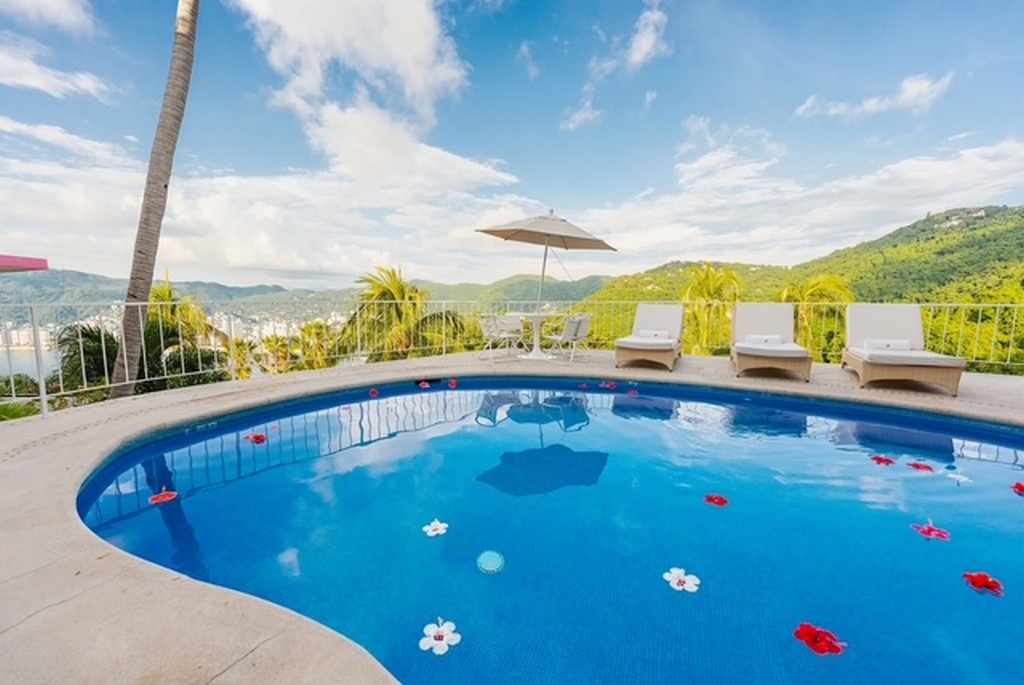
Inspired by the legendary luxury and lifestyle of Acapulco, and a Ringo Starr song immortalizing the resort mecca, JC Escudero, reflects on the history and legacy that fuels dreams of ocean breezes, frothy drinks and sunshine.
By JC Escudero
It’s wonderful the way great music and beautiful places conspire to create lasting impressions. I was recently reminded of this magical relationship.
Fade in: A beautiful seaside resort on a sunny day filled with joyful vacationers and revelers. Trumpets and cheerful guitars play in the background. And although it might seem like just another Mexican mariachi song, it doesn’t take long before a male voice—none other than Ringo Starr—starts singing in English:
Cross over the border,
We’ll take a sailing ship into the night.
A sea without horizons,
We’ll have each other’s love to hold us tight,
On a starless night.
Oh, las brisas…
The former Beatle composed the song in 1976 as a tribute to Acapulco, just as the city was enjoying what would unknowingly be its final golden years. And while the days when Acapulco’s beaches attracted everyone from Aristotle Onassis to Elizabeth Taylor are long gone, one end of the bay still preserves what is perhaps the best-kept emblem of that glamorous era—and Ringo’s original muse for the song: Las Brisas Hotel.
A PLACE FOR DREAMS
Located on a vast property of over 10 hectares of hillside, easily recognizable by its iconic white and pink color scheme, Las Brisas opened its doors in Acapulco in December 1954. By that time, the port was already well established on the international tourist map. Its bay was considered the most beautiful in the world. The Federal Board of Material Improvements in Acapulco (promoted by then-president Miguel Alemán) had significantly upgraded local infrastructure, and the number of people dreaming of vacationing there continued to grow.
Tourism (and money) flowed into Acapulco thanks to a new highway connecting the destination with Mexico City, as well as through the international airport, designed by Mario Pani and Enrique del Moral, which had just opened in 1952. And with the completion of the Costera Avenue three years earlier, investments began expanding beyond the traditional Caleta and Caletilla beaches, sparking new developments around the bay. Spanish entrepreneur Juan March set his sights on the western end of the bay.
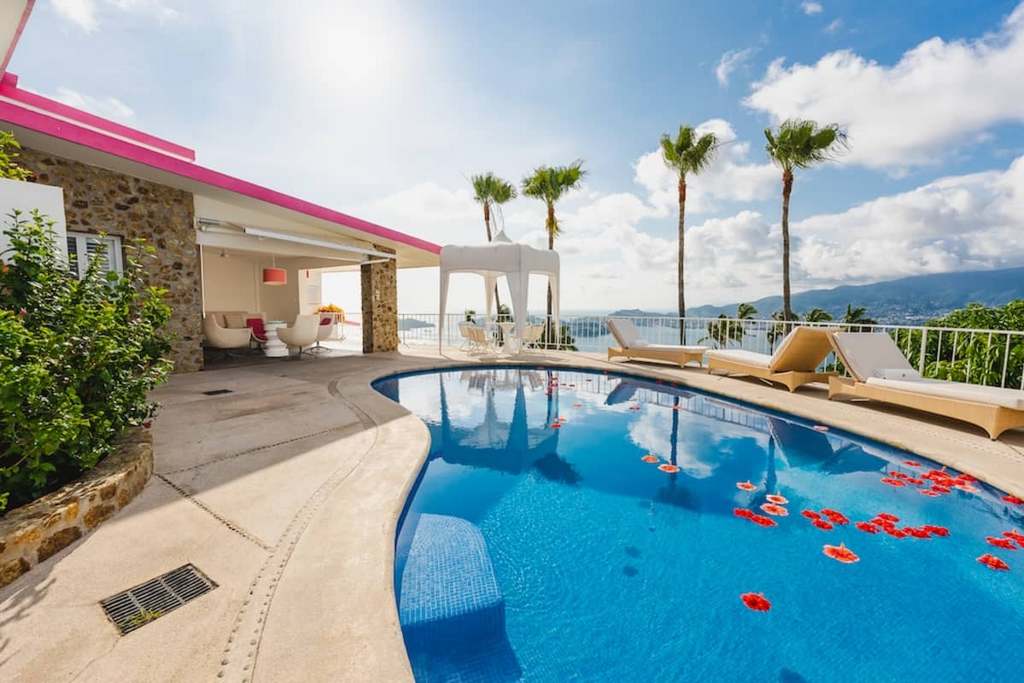
March purchased a 16-hectare property on the peninsula that separates the bays of Acapulco and Puerto Marqués. His vision was to create a luxury resort of 24 villas, each with its own private pool. To bring it to life, he hired architect Jorge Madrigal Solchaga. Having worked with Carlos Obregón Santacilia and already building a solid reputation in Acapulco designing vacation homes, Madrigal was a natural choice.
At a time when Mexico was thriving in the era known as the “Mexican Miracle,” many architects were embracing modernity through their designs. In Acapulco, alongside Félix Candela, Francisco Artigas, Frank Lloyd Wright, and duos like Pani and del Moral or Sordo Madaleno and Wiechers, many began creating homes, hotels, and social venues that reflected a new tropical modernism. Madrigal Solchaga designed the hotel’s villas as individual cottages that echoed the domestic architecture of mid-century California, blending structure with the natural landscape. Each villa was adapted to the sloping terrain and featured ocean views.
Taking inspiration from the city’s most important historical landmark—the Fort of San Diego—Las Brisas also incorporated elements from the fort’s architecture into its design.
A PINK AND GOLDEN AGE
By the 1950s, pink had become a popular color for tropical settings. But Las Brisas took it to another level. Everything—from poolside umbrellas to towels, from the cottage walls to the oxygen tanks for scuba divers—was decorated in pink and white stripes. Even the 266 jeeps transporting guests between restaurants, villas, the reception area, and the beach club were painted in the hotel’s signature colors, which by the way include a ginormous natural ocean water pool.
While the color scheme caused a stir, what truly catapulted Las Brisas to fame was its blend of luxury and privacy. Madrigal designed each cottage—330 of them and 250 with a private pool—to offer complete seclusion. Adding vegetation increased privacy and blocked noise, making it a very desirable stay for all the guests. Since guests couldn’t see others or be seen, it was ideal for high-profile visitors who had made Acapulco their secret retreat.
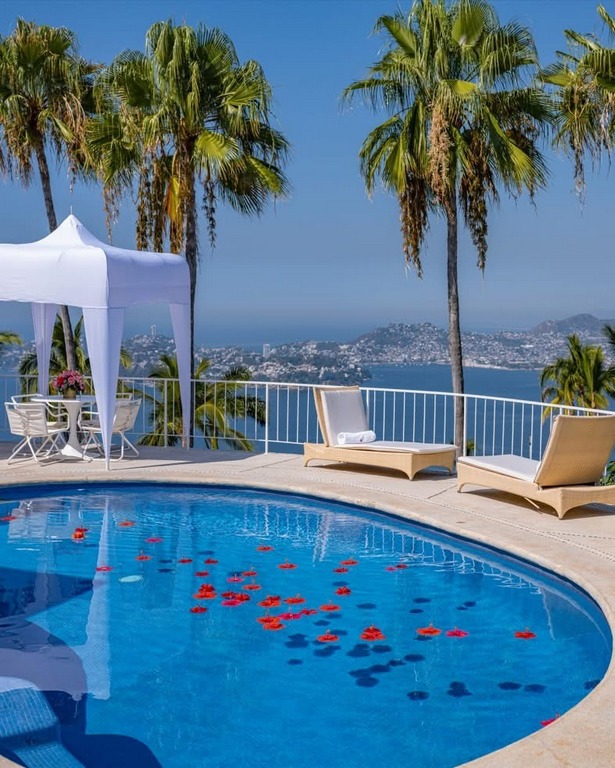
Nature added a very lush, flowery scenery to the site. Every day, a lovely girl appears to scatter hibiscus petals across one’s swimming pool. Pink carnations and gladioluses are flown in daily from Mexico City to help hype the image of a true lover’s hideaway.
Following the Cuban Revolution in 1959, Mexico’s popularity as the go-to beach destination for Americans skyrocketed. With the express support of President Alemán, Acapulco became the host of the World Film Festival Review—a film festival showcasing award-winning movies from around the globe. Every December from 1958 to 1969, the world’s movie elite would flock to Acapulco. During those years, Elizabeth Taylor, Mick Jagger, Roman Polanski, Jackie Kennedy, John Lennon, Yoko Ono, and even the Apollo 11 crew stayed at Las Brisas, which had by then expanded to nearly 300 villas.
With the rise of several (now legendary) nightclubs such as Tequila à Go-Go, Le Club, Le Jardin, and Baby-O, Acapulco gained a reputation as perhaps the most exclusive and entertaining beach destination on Earth. The hotel welcomed guests who were photographed by Slim Aarons, among them were Henry Kissinger, Gloria Gaynor, Dustin Hoffman, Lynda Carter, Rod Stewart, and even John Travolta throughout the 1970s.
Its success was so great that its investors took it one step further by creating a residential development under the same name near the hotel. Frank Sinatra and Howard Hughes quickly bought a home. Acapulco was living its golden age, and perched high in the hills, Las Brisas reigned over it all—literally and figuratively
THE LAST BASTION
However, the golden glow of Acapulco’s coast eventually began to fade. By the 1980s, the city started losing popularity, and the celebrities, royals, and jet-setters who had flocked there for decades stopped coming.
The situation became so dire that by the late ’80s, the hotel’s owners considered subdividing the iconic villas and selling them as a horizontal residential complex. However, although Acapulco never regained its former glory, a new strategic plan allowed Las Brisas to return to the list of the world’s top beach hotels in 1990. It’s still considered to this day as one of the top 10 wedding destinations, where thousands of newlyweds have turned in to romance at the hillside destination.
So while the days when Queen Juliana of the Netherlands’ yacht struggled (unsuccessfully) to enter the harbor are long gone, Las Brisas still stands proudly above the bay. Those who’ve seen Rio at night from the top of Sugar Loaf and others who’ve been mesmerized by the sight of the harbor at Hong Kong insist that the view from Las Brisas of Acapulco Bay wins hands down.
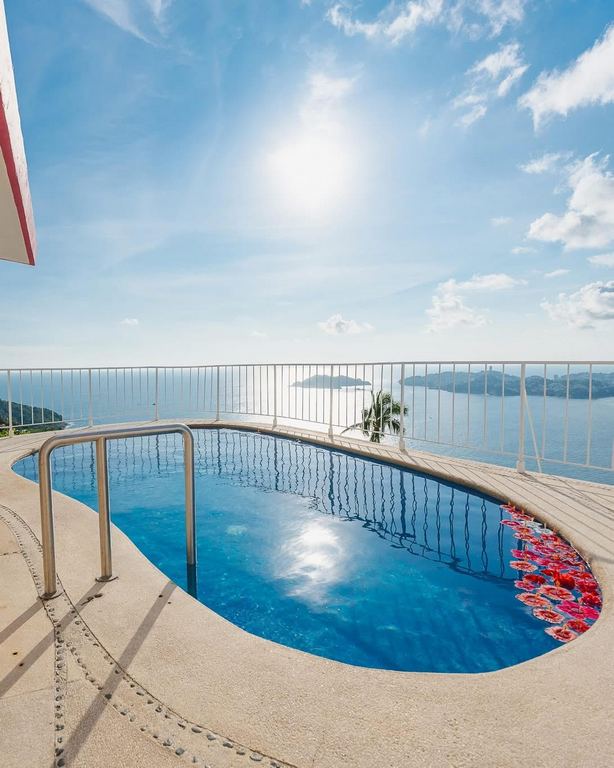
Hidden among its villas, pools, tulips, and pink-jeep-lined pathways is the Acapulco that once inspired Ringo Starr to sing:
Oh, las brisas,
Means the breeze will carry us like two birds in flight,
On a starless night.
Oh, penumbra,
Means the sunset that I see within your smile,
Is the dawn of your eyes.
Yo te amo,
Means I love you like I’ve never loved before.
THE LOVE LIVES ON
It’s true, much of this is a tribute to a place whose time has come and largely gone. Nonetheless, there is a useful takeaway from this historically dreamy discussion. The sense of luxury, fun and sunny indulgence that drove the design and ambiance of Las Brisas, lives on to this day in the work that watershapers do in our clients’ properties.
We are very much in the business of perpetuating that dream in the here and now. JC Escudero, IWI, is co-founder and chief executive officer of J Designs Pool & Spa, a custom design/build firm located in North Hollywood, CA. Born in Mexico City, a well-traveled international citizen, JC has been working in the pool indus