








Pacific Horizons

Steven V. DeBiasi has spent a career creating masterful landscape and watershape environments across the Pacific Ocean. Based in Honolulu with a business stretching island to island far west across the International Date Line, he shares the story of how he discovered success and adventure following distant waters.
By Steven V. DeBiasi
In some ways, my story is a lot like a stone skipping across the ocean—one thing leading to another, sometimes by mistake, and somehow landing exactly where it’s supposed to. Looking back, a lot of it happened without a grand plan, but I wouldn’t trade the path for anything.
I grew up in Noank, Connecticut—a small village within Groton, home to the massive Naval Submarine Base that anyone connected to the Navy would recognize instantly. They call it the “submarine capital of the world,” and for good reason. General Dynamics’ shipyard dominates the landscape and the local economy.
From my earliest memories, I was surrounded by the smell of salt air, the sound of ship horns, and the constant reminder that the ocean was more than just scenery—it was the heart of our community. From then until today, my journey remains bound to the water.
OCEAN TRADITIONS
My family’s roots stretched back to Naples, Italy. My grandfather and uncles immigrated in the early 1900s, arriving in a place that was then one of the largest shipbuilding centers on the East Coast. Back then, the real estate on the water wasn’t prime—it was cheap. You were buying among fishing and lobster shacks, and the air carried the smell of bait and fish. The wealthy lived up on the hill. My family bought on the water in a working-class enclave of immigrants.
By the time I came along, the old shipyard at the tip of the peninsula was abandoned. Rusted machinery sat idle, and the shoreline was littered with the hulks of wooden ships—some nearly 200 feet long, their bowsprits still jutting over the sand. At low tide, their skeletal frames reached out of the water like something from a ghost story. My friends and I would crawl over them, set lobster traps among the wrecks, and use our BB guns to take potshots at water rats. Not exactly the safest environment for unsupervised play, but we had a great time.
The place was a graveyard for vessels—remnants of an era when sail-powered freighters gave way to steel ships and, eventually, to decommissioned submarines. And just across the harbor, the Navy was building the latest nuclear-class subs—the cutting edge of marine engineering. In the space of a short boat ride, you could see a century’s worth of maritime technology.
I never seriously considered joining the Navy, but I was obviously drawn to the ocean. I toyed with the idea of becoming a tugboat operator or running a ferry across Long Island Sound—anything but a fisherman or lobsterman. I spent my summers lobstering with my uncle and working on charter boats, and in the winter, I learned to knit lobster pot nets and what it meant to work on the ocean. That’s a brutal life in the winter months, one of the most dangerous professions out there.
When we weren’t working, we were water skiing. Every lawn we mowed, every newspaper we delivered, every nickel we earned went into the gas tank so we could spend entire days on the water. Fishers Island Sound was our playground—sometimes we’d make the run out to Montauk or Orient Point, poking around the exclusive enclaves and coves.
I stayed in Noank through high school, but after graduation at nineteen, my trajectory shifted. A couple of older neighborhood kids I knew who were originally from Hawaii had moved back after graduation, and the seed they planted stuck with me. One dreary December in college—38 degrees, raining, and facing finals—I decided to make a move. I sold my Fender Stratocaster electric guitar for a plane ticket and flew to Hawaii over Christmas break.
That single decision changed everything.
DISTANT ISLES
It didn’t take long before decided to stay here forever. I took two jobs—parking cars at a famous Italian restaurant in Waikiki at night, and working as a landscape laborer during the day. It was grunt work—moving rocks, planting trees—but I caught the eye of an accomplished landscape architect named Jim Hubbard. I was fascinated by how he could take a pile of dirt and turn it into something beautiful. Over time, he recognized I had a good eye for design and began to trust me.
That was where my career started, and I’ve never looked back.
Hawaii is a special place for a lot of reasons. Geographically, it’s the most remote archipelago on the earth with a rich heritage of seafaring. Among its many unique characteristics, the natural landscape is unlike anywhere else. The plant palette is endless, the terrain dramatic. Ridges of solid basalt hold mountaintop estates with sweeping views. Down below, beachfront properties sit on pure sand or perch atop coral and lava cliffs.
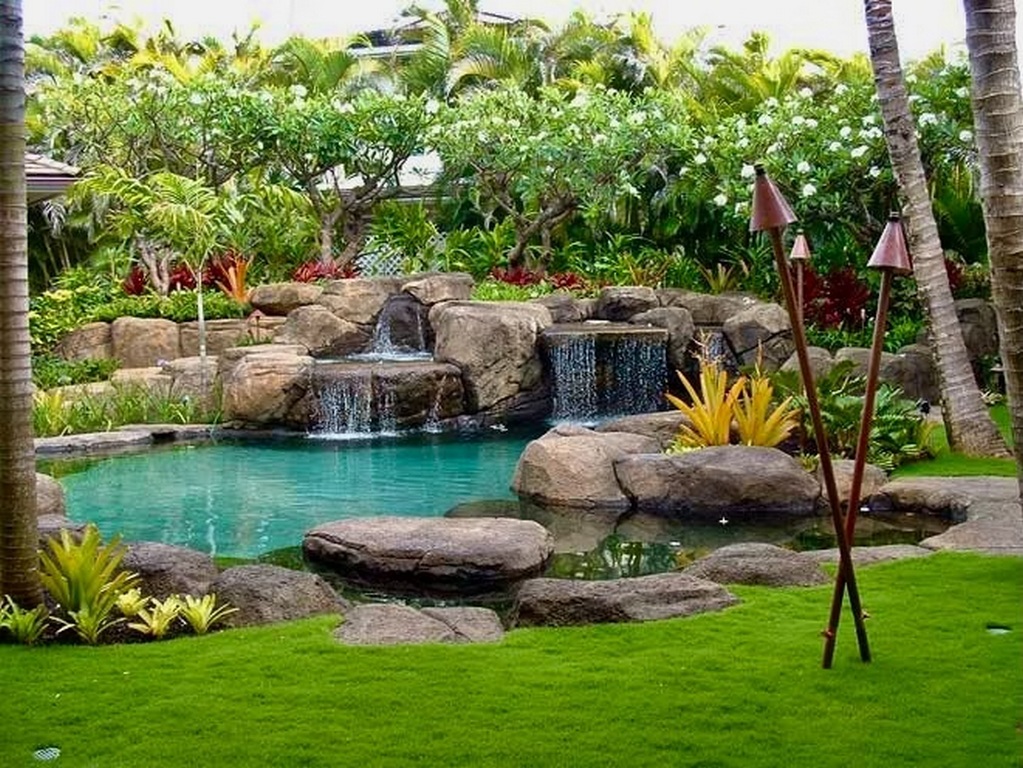
Hubbard’s clientele were Hawaii’s “old money” families, people whose names were woven into the islands’ history. In my first weeks, I was working on mountaintop and oceanfront estates for some of the most prominent landowners in the state. Hubbard was an artist in the truest sense—he rarely worked from formal plans. For most projects, he’d sketch on a napkin or build the vision in real time on site.
Sometimes, watching him move dirt around, I’d think, there’s no way this will ever work. But by the end, there it was—a masterpiece. I learned fast. And I noticed the contractors working alongside us on high-end pools and water features were making serious money.
Eventually, I struck out on my own, and Hubbard—graciously—began sending clients my way. My work spoke for itself, and word spread quickly. Forty years later, nearly every job I’ve taken has come through referrals.
LEARNING THE CRAFT
From then on, I’ve made it my business to learning everything I can about watershape design and construction. The thing about high-end water work is that it’s never just about the pool. Yes, there’s hydraulics, filtration, and waterproofing—get those wrong and nothing else matters. But the real magic happens when you understand water as a design element. In the right hands, it becomes light, movement, sound, reflection, and it makes people happy, as well as excited and relaxed, often all at the same time.
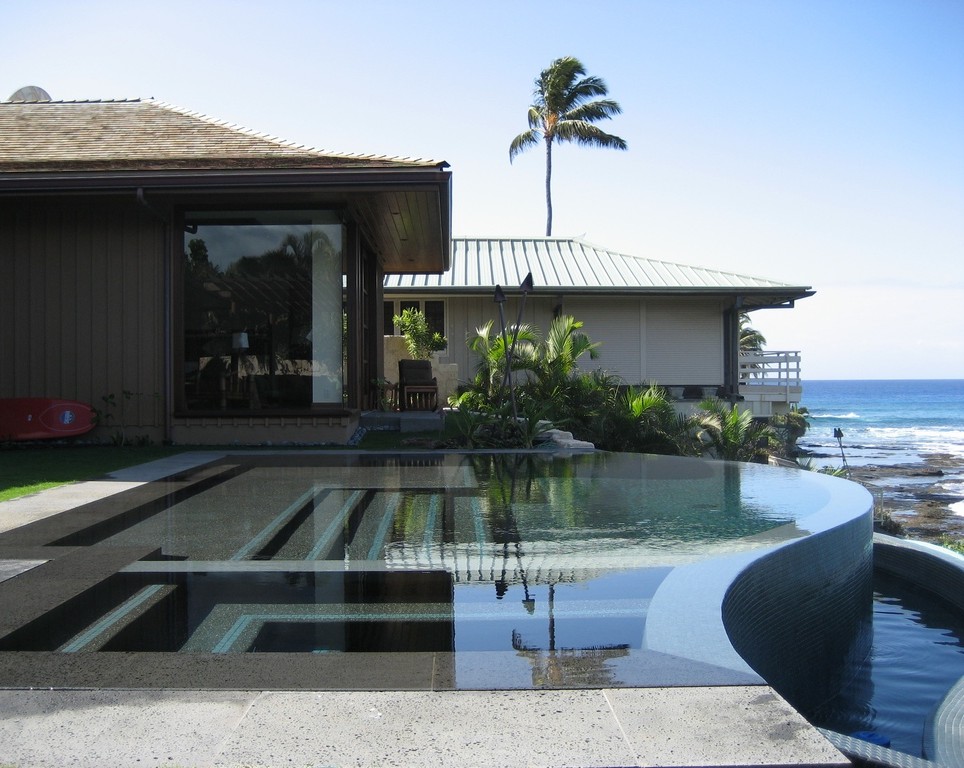
I’ve built vanishing edges that merge perfectly with the ocean beyond, so the water in the pool becomes part of the horizon. I’ve designed cascades that mimic the way rainwater runs off Hawaiian lava rock in a sudden storm. I’ve placed shallow reflecting pools where the wind and sky seem to paint them anew every day.
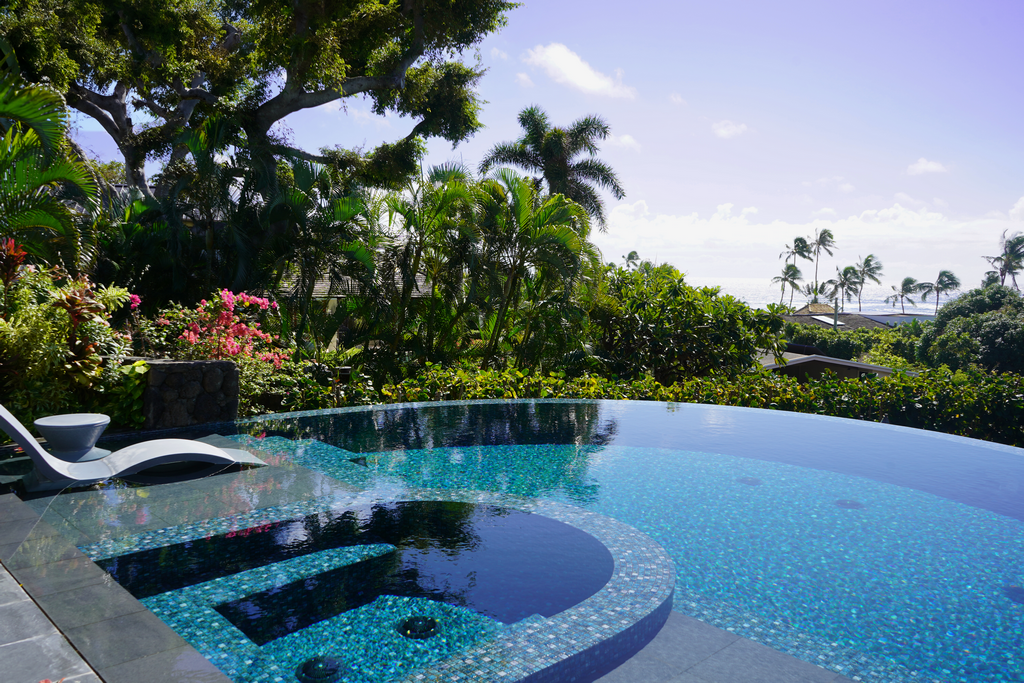
Technical precision is non-negotiable. I’ve seen plenty of projects where someone “eyeballed” the grades or underestimated water volume, and it shows—edges don’t flow evenly, pumps labor, water chemistry suffers. That’s not acceptable in my world. Every grade is shot with a laser, every system designed with exact calculations. It’s not overkill—it’s the difference between a pool that works for a season and one that works for decades.
Over time, I’ve realized my approach is less about building a “thing” and more about orchestrating an experience. The goal is to make it feel as if the water has always been there—that the pool, spa, or water feature belongs to the site in the same way the rocks and trees do. Or, conversely, the water is an integral architectural element harmonizing with the overall site design and concept.
ACROSS THE PACIFIC
By 1988, I had a small office in Honolulu, a couple of staff, and a few prominent projects under my belt from my time working with Hubbard. That’s when the phone rang with a call that would nudge me far beyond the familiar shores of Hawaii. On the other end was Richard Heaton, a pioneer in synthetic rock pool and water feature construction, who had collaborated with us on several projects.
“Steve,” he said, “how’d you like to go to Saipan for a job?”
I didn’t hesitate. “Sure! When do we leave?”
His reply: “Tomorrow.”
That’s when I asked the obvious follow-up — “Uh, where exactly is Saipan?” I’d apparently missed that geography lesson back in high school.
Saipan, it turned out, is in the Northern Mariana Islands — south of the middle of nowhere, as we liked to joke. The job was ambitious: transforming an old luxury hotel into a Hyatt Regency complete with a Regency Club wing, private pool, grotto, lush landscaping, and water features. The developer wanted one firm to handle everything, pools to palms, and Richard was pulling me in as his landscape partner.
We flew out the next day. The island was stunning — untouched in a way that made me think of what Hawaii must have been like fifty years earlier. The warm turquoise water, rugged coastline, and slow rhythm of life gave it a romantic, almost magnetic pull. The project didn’t pan out, but those two days planted a seed.
Before leaving, I made myself a promise: I will come back to these islands within a year.
It took me about eighteen months, but I kept that promise. I flew to Guam, the most populous island in the Marianas, under the pretense of “looking at a project” I didn’t actually have. The trip started rough: no rental cars available, hotels fully booked in Tumon Bay, and me ending up in a grim little motel that was so filthy I slept with my clothes on.
CHANCE ENCOUNTERS
The next morning, I wandered into a department store to buy a pen and notebook — the bare minimum for drumming up opportunity — and bumped into an old friend, Kathy, someone I knew from years earlier in Hawaii. She and her husband had moved to Guam for development work. She invited me to dinner where I would meet several prominent local businesspeople.
But my luck didn’t stop there. Later that same day I’d stumbled on the office of Ed Camacho, a Guam businessman I’d met once in Honolulu. That meeting led to a Rotary Club lunch where every person at the table — an attorney, a publisher, a car dealer, the head of Duty-Free Shoppers — invited me to their office. That was my introduction to Guam’s inner circle.
The very next day, I walked into the Contractors License Board on a whim and asked if I could apply for a Guam contractor’s license, and test the same day. No one had ever made such a request before, but after some back-and-forth, they let me take the test the next morning. I passed — with the Registrar grilling me personally on one of the missed questions — and walked out with my Guam contractor’s license.
A month later, I returned to find 27 cranes dotting the skyline. The place was turning into the Waikiki of Micronesia, and I was ready to ride the wave. A visit to Pacific Construction’s jobsite landed me in front of Belt Collins and Associates, the biggest landscape architecture firm in the Pacific. At first, they brushed me off — too small, too young — but six months later, when none of the major Hawaii contractors didn’t want to make the 3,800-mile trek, they called me back.
At 29 years old, I landed my first million-dollar contract: the Pacific Islands Club in Guam. I loaded a 40-foot container with equipment, put it on a boat, and headed over… only to arrive after a hurricane had wiped out the island’s supplies. I couldn’t even buy a shovel. Somehow, with borrowed tools and persistence, we got the job started— and from that project came the Hilton, the Hyatt, the Westin, the Marriott, the and a network of high-end international resorts across the Pacific.
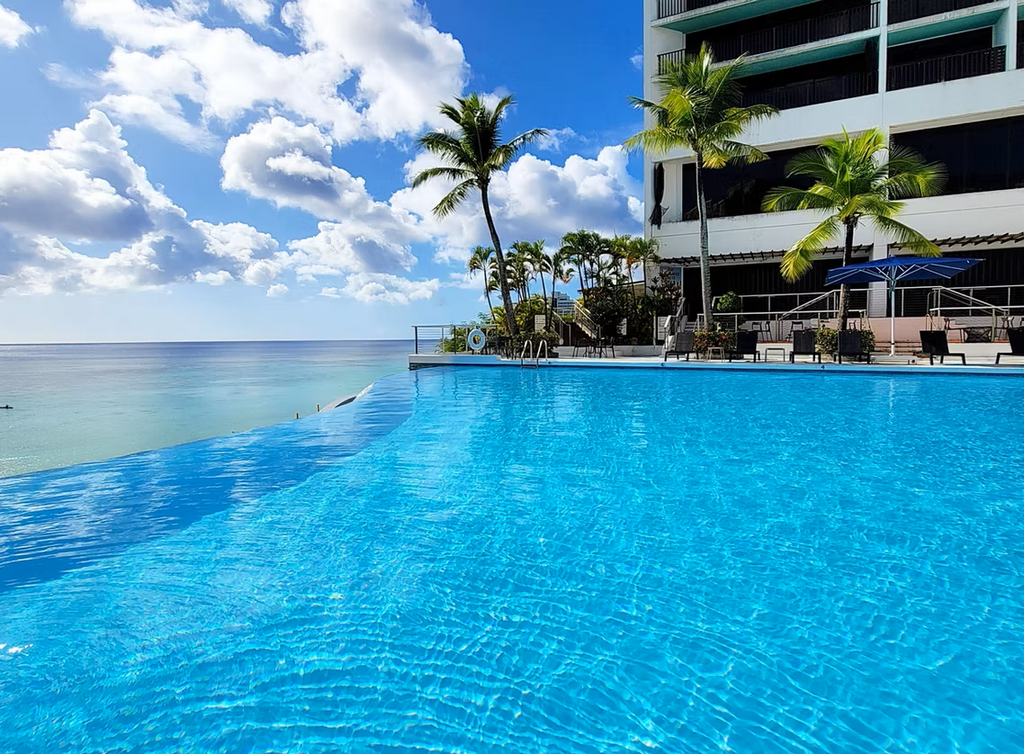
That foothold in Guam opened the door to Hong Kong, the Philippines, and beyond. What started as a cold call from a synthetic rock builder in 1988 had evolved into a multi-country operation. Guam wasn’t just an expansion — it was the launchpad for a truly international career.
STILL SEARCHING
Looking back, I think about that kid climbing over shipwrecks in Noank. The ocean was already teaching me—about power, resilience, patience. Water can destroy or it can sustain, and the line between the two is thin. My job is to work with it, not against it.
I’ve been in this business for more than four decades now. I’ve seen fads come and go, materials change, and technology revolutionize the way we design and build. But the essence hasn’t changed. It’s still about understanding the site, respecting the craft, and creating something that will outlast you.
Every project feels like dropping another stone into the water—sending out ripples you might never see the end of. And if I’ve learned anything, it’s that the best work comes when you follow those ripples where they lead.
Steven V. DeBiasi is president and CEO of DeBiasi Pacific, a custom landscape and watershaping firm based in Honolulu, HI.