








ARTICLES
Advance Search
Aquatic Health
Aquatic Health, Fitness & Safety
Around the Internet
Aquatic Culture
Aquatic Technology
Artful Endeavors
Celebrity Corner
Life Aquatic
Must-See Watershapes
People with Cameras
Watershapes in the Headlines
Art/Architectural History
Book & Media Reviews
Commentaries, Interviews & Profiles
Concrete Science
Environment
Fountains
Geotechnical
Join the Dialogue
Landscape, Plants, Hardscape & Decks
Lighter Side
Ripples
Test Your Knowledge
The Aquatic Quiz
Other Waterfeatures (from birdbaths to lakes)
Outdoor Living, Fire Features, Amenities & Lighting
Plants
Ponds, Streams & Waterfalls
Pools & Spas
Professional Watershaping
Structures (Editor's Notes)
Travelogues & History
Water Chemistry
WaterShapes TV
WaterShapes World Blog
Web Links
Around the Internet
Aquatic Culture
Aquatic Technology
Artful Endeavors
Celebrity Corner
Life Aquatic
Must-See Watershapes
People with Cameras
Watershapes in the Headlines

At a time when scores of American cities are still looking for ways to revive the faded glory of their urban cores, possible approaches are as visionary (and numerous) as can be. The process has resulted in new parks, major redevelopment, architectural restorations and a long list of other solutions - including the unique watershape commissioned by the city of White Plains, N.Y. A town with 54,000 full-time residents whose population swells to more than 200,000 during the day when office workers, shoppers and visitors come calling, White Plains made the decision to invest $4.5 million of public and private grant money in resurrecting a small downtown park. Appropriately named Renaissance Plaza, the park surrounds a state-of-the-art musical fountain unveiled in October 2003 for the specific purpose of luring people back to the downtown area - and it has worked. In fact, the plaza has become such a hub of activity that nearly 1,700 units of new residential housing are now under construction in its downtown neighborhood. URBAN OBJECTIVE First settled by British colonists who bought it from the Mohican tribe in 1683, this historically rich city located 25 miles north of Manhattan has truly been reborn, and it's with no small measure of

It may have been in the heart of the depression, but 1932 was a good year for American swimmers: The Olympic Games in Los Angeles saw Clarence "Buster" Crabbe win gold in the 400-meter freestyle in the then-world-record time of 4:48.2 and Helene Madison win gold medals in both the 100- and 400-meter freestyle events. U.S. swimmers claimed nine medals in all, in many cases besting swimmers from the powerful and heavily favored Japanese team. The competition was held in an eight lane, 50-meter pool positioned quite literally in the shadow of the Los Angeles Memorial Coliseum. Just as the names and records of those swimmers have faded across 70-plus years, so too had the swimming pool and its companion recreation pool. Although they had remained in near-continuous use for generations, the old vessels were supplanted when a modern swimming pool complex opened on the nearby campus of the University of Southern California in anticipation of the 1984 Los Angeles Olympiad. Early in 2003, we at Rowley International of Palos Verdes Estates, Calif., were asked to renovate the old facility's two swimming pools. The City of Los Angeles, along with support from the Amateur Athletic Federation (AAF), set a goal that didn't involve

One of the characteristics I've noticed among watershape designers is a tendency to stick with what works. Nowhere is this more pronounced than with the often-tricky issue of working with color: It's almost as if there's an unwritten rule that a very small palette of very familiar colors are all that is appropriate - especially for pools and spas! I believe that this lack of color creativity extends to some degree from familiarity with certain key products and their standard colors, be they tile, plaster or exposed-aggregate materials. To a much greater extent, however, I think the cause is a lack of basic education in color theory. I speak from experience on this subject, because for all of my

I recently received a call from a Wall Street Journal reporter who was doing a feature on preparing a home for sale. She told me she wanted a landscape designer's perspective on how homeowners should spend their money to get the most bang for the buck and really put me on the spot in the process: Her deadline was the following morning, and I had to do some fast thinking when her call came in at 8 pm. It immediately occurred to me that I always ask homeowners whether they are landscaping for
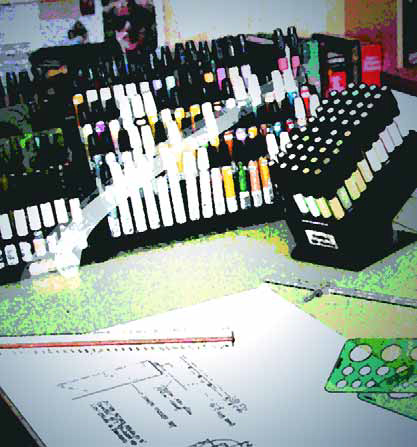
To my way of thinking, professional design work requires a professional workspace in which all of the necessary professional tools are available. In fact, for the designer creating custom watershapes, I see the space in which the work actually unfolds as being critical and cutting to the very heart of what it really means to be a "designer." I know that term is a loaded one, which is why I put it in quotation marks. After all, anyone can say that he or she is a designer, even if all they do is sit at a coffee table

It's amazing how many people I meet in the course of my day-to-day life who do not embrace the basic idea that the single most important part of doing business is how they interact with current and prospective clients. Way too often, I'll run into someone - usually an employee, but sometimes (and shockingly) a manager or owner - who just doesn't have a clue or really doesn't seem to care. This happens so often, in fact, that I find my patience growing shorter with the laziness, incompetence or downright rudeness I encounter. It's gotten to the point where I'm

When pursued as it should be, watershaping is all about creating a sensory experience. In fact, you could make the argument that watershapes appeal to

Have you ever wondered why watershapes are at the heart of so many venerable courtyards and plazas? In a modern context, we might start answering that question by thinking about the natural human fascination and connection with water and then conclude that, like us, those who built the public spaces of ancient Mesopotamia or Athens or Rome simply liked being in the presence of water for emotional and spiritual reasons. But the truth behind the prominent role of water in these spaces isn't as romantic as all that. Indeed, there's

Next to the water itself, concrete is the most important and widespread of materials used in watershaping. Not only is it instrumental in creating the structures that contain water as well as the substructures that support them, concrete is also the stuff of which faux-rock panels, pre-cast or poured-in-place coping, pavers, all manner of stamped or textured decks and poured-in-place or block walls are made. Despite its omnipresence, however, concrete remains one of the most misunderstood of all watershaping materials in this sense: Because it is so durable in basic structural applications, there's a tendency to

Composition of this article began with an e-mail I received a while ago from a colleague working in Australia. "What," he asked, "is the maximum allowable depth for a fountain in the United States?" As simple as it sounded, when I took the time to research the issue I found that there was a noticeable lack of definition. I took the next logical step and called various people I know in the watershaping industry and asked them the same question. Surprisingly enough, nobody could point me to any code, regulation or standard that defined what depth a waterfeature's pool could