







ARTICLES
Advance Search
Aquatic Health
Aquatic Health, Fitness & Safety
Around the Internet
Aquatic Culture
Aquatic Technology
Artful Endeavors
Celebrity Corner
Life Aquatic
Must-See Watershapes
People with Cameras
Watershapes in the Headlines
Art/Architectural History
Book & Media Reviews
Commentaries, Interviews & Profiles
Concrete Science
Environment
Fountains
Geotechnical
Join the Dialogue
Landscape, Plants, Hardscape & Decks
Lighter Side
Ripples
Test Your Knowledge
The Aquatic Quiz
Other Waterfeatures (from birdbaths to lakes)
Outdoor Living, Fire Features, Amenities & Lighting
Plants
Ponds, Streams & Waterfalls
Pools & Spas
Professional Watershaping
Structures (Editor's Notes)
Travelogues & History
Water Chemistry
WaterShapes TV
WaterShapes World Blog
Web Links
Around the Internet
Aquatic Culture
Aquatic Technology
Artful Endeavors
Celebrity Corner
Life Aquatic
Must-See Watershapes
People with Cameras
Watershapes in the Headlines

It's a rare project in which a watershaper has the opportunity to execute a complete design without compromise. In our Scottsdale, Ariz.-based business, we often work with upscale clients on custom pool and spa installations, and it seems that there's always some element or other in the design that ends up being altered or left out. It sometimes reaches the point where we start to feel as though the result, although it may be satisfying to the client, is not fully reflective of our talent, our vision or our best effort. The project pictured in these pages, however, is a dramatic exception to that rule. Although the clients were involved with general suggestions during the design process and construction project, when it came down to details of the plan, they let us go ahead and create an environment that fully reflected our creative vision. They'd seen one of our projects in a local "Street of Dreams" program in which area contractors were selected to build spec homes on the same street in a town just north of Scottdale called Troon. Once the row of home was completed, there were tours, awards and lots of media coverage - quite the high-profile affair. The clients had been in contact with four or five different pool builders in the area, but they'd

Most people I know have a favorite vacation spot, a favorite leisure-time activity and a favorite form of self-indulgence. In creating backyard environments for these folks, we as watershapers and landscape designers often find ourselves able to roll elements of one, two or all three of those "favorite things" up in a single package in ways that closely reflect our clients' passions and personalities. At my company, we strive to make a direct connection with those preferences by letting our prospective clients know that we want to enable them to vacation in their own backyards and come home to outdoor environments that epitomize the good life. In some cases, that means

I'm particularly interested in the behavior of water. To me as a sculptor, differing water flows and their textures are like "colors" to a painter: I find a color that holds meaning for me and then look for a structural form that can present it. To this extent, my artistic medium is the behavior of water and the means to make it behave. The sculpture in this case is water combined with a structure in steel, stone and equipment. The work is abstract: abstractions of feelings related to the movement of people, animals, fish and the flows of water in streams, rivers, rain - even the flow of numbers. As a result, I need metaphors and feelings to drive my creative expressions, then use water and other sculptural elements in much the same way a choreographer might use line and gesture to express a feeling or a composer will use chord changes and musical phrasing. My hope is that, in creating forms that are meaningful to me, other
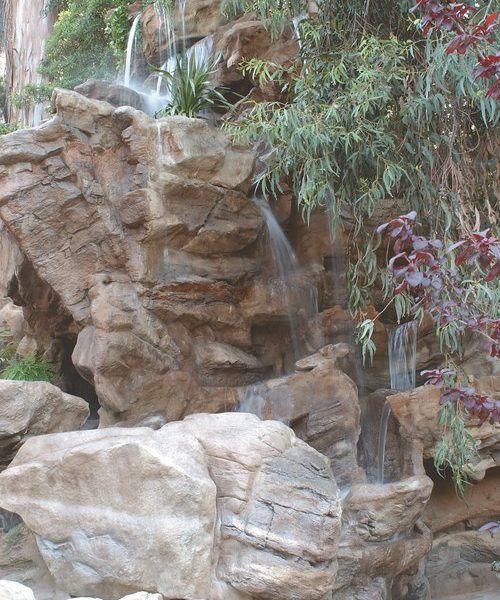
In designing and constructing naturalistic projects for residential clients, I keep two thoughts uppermost in mind: First, the only way to create a successful, natural-seeming illusion is to base my work on the observation and study of nature; second, the only way to build fun into such an environment is to fill it a child-like sense of wonder that draws old and young alike to the natural beauty. For the project pictured in these pages, those two thoughts were always front and center. The homeowner first contacted us about his desire to place a dramatic waterfall in front of some striking, 120-foot-tall eucalyptus trees. That vision soon expanded to include additional watershapes now woven through the majority of the steep, terraced, heavily wooded site. Some work had already started on a set of streams and a hillside pool by the time we became involved, but when the client became acquainted with our work and saw the sort of realistic, highly detailed projects we execute, he wanted us to pick up and take the entire project to completion. Built during the unusually wet winter southern California experienced this past year, the project was challenging in logistics, scope, variety and detail. Some of the practical challenges included hand-carrying 400-pound rock panels down 100 yards of steep, switch-back paths - and occasionally dodging rogue golf balls shanked over from the adjacent Bel Air Country Club. Despite such annoyances,

In my work as a landscape architect and designer/builder of mostly residential swimming pools, I concede that I've never really given much thought to the subject of maintenance. Sure, the watershapes I've designed have proper hydraulic and circulation systems as well as correctly sized filtration systems, the proper number of skimmers and so forth, but beyond that, the specifics of swimming pool care have been beyond my concern. So I've let the terminology of water chemistry, for example, become a foreign language to me, and I've never known much about things like water testing, pH or sanitizer residuals. Through the years, however, I've come to believe that this is not a situation for a designer/builder in which ignorance is bliss. This is partly because I now work for a firm that runs a retail store with a service department and I interact with those folks on a regular basis; but it's also because more and more of my design/installation clients are asking me
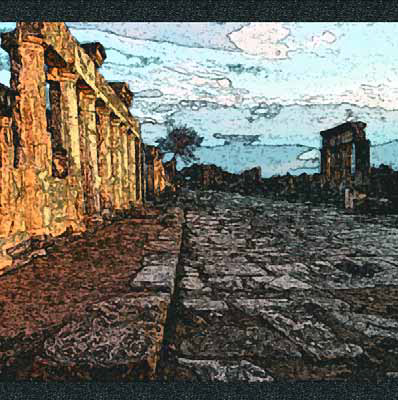
It's a truism that almost all contemporary works of art are derivative: The ideas have already been expressed in one way or another at some point in history, and all we can succeed in doing is to apply those enduring forms as creatively as we can. We can't invent the wheel, but we can redraw it, embellish it, place it in context and, in our own ways, improve upon it through the choices we make in using it. To be effective in that sort of downstream effort as watershapers, it is essential that we understand the nature and origins of the basic building blocks of aquatic design. For years, people have asked me where I get my ideas - pools raised out of the ground, the small spillways, the drain details, the modular deck treatments, the color usage and the use of reflection, to name just a few. "Through my design education" is the short answer, of course, but I can get more specific if we
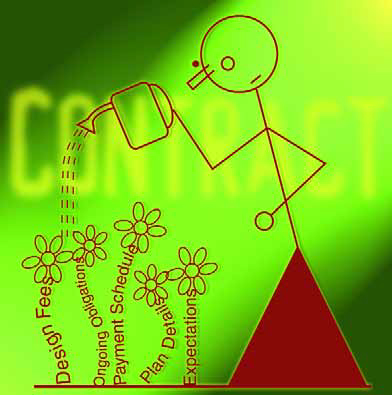
It'd be great if we all lived in a world where a handshake was sufficient to seal a deal and no legal documents were needed. Unfortunately, however, we live in a society in which contracts are a necessity for most of us in business. When I first started out, I took on jobs without signed contracts, and for the first few years I didn't run into any problems. As I moved into higher-dollar projects, however, I developed a quick appreciation for the value of a contract when a client refused to pay for my services as we'd verbally agreed he would. Although I realize there are people out there who run strong, successful businesses without a need for contracts and rarely run into problems, for most of us I believe it is a critical component of every job. The purpose of any contract is to

Most people I know enjoy being recognized for a job well done. From a simple pat on the back to the Nobel Prize, we get a sense of affirmation when our best efforts are seen and appreciated. Yes, there are those who see the work as its own reward. For most of us, however, recognition is a good thing, whether you prefer the warm-and-fuzzy side of being singled out for public praise or see the business advantage that comes along with recognition. Whether you're a film star brandishing an Oscar or a swimming pool contractor with an armload of design awards, there's an enhanced marketability that accrues to those with trophies on shelves and plaques on walls. For years, the pool/spa industry has

Watershapes of all kinds have come a long way in recent years, with elaborate, fully integrated and highly creative designs that were mostly unheard of in days gone by. For many of us, me included, exposure to "aquatic environments" (as they are now grandly known) began with the most familiar

It's often said nowadays that watershaping is the art of fitting our work into the surrounding environment. In many ways, what we do at Star Pools in Houston is a prime application of that powerful yet basic concept in the way we tackle both the opportunities and limitations of the residential settings we encounter. Houston is dotted by affluent neighborhoods teeming with homes in classic Mediterranean and Tuscan styles. Stately is a word often used to describe these homes, and because we've based our design philosophy firmly on the idea that the swimming pool and garden areas should look as though they were designed as part of the home itself, our work is largely a manifestation of