








construction
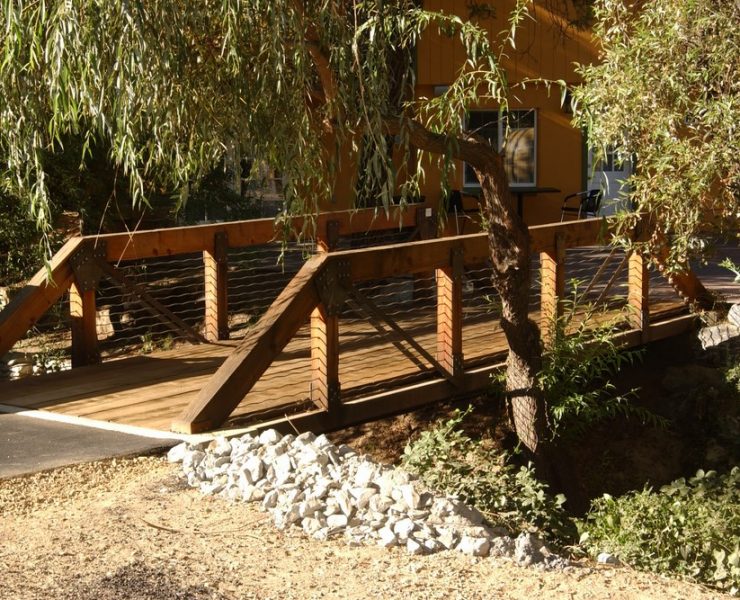
Bridges have been important to humanity for thousands of years. They've provided avenues of travel between disconnected spaces and have, as a result, been critical to commerce, settlement, warfare, travel and even poetry and literature. To this day, they are iconic in certain cities or regions (think Paris or New York), and there has always been a distinctly romantic air that accompanies their obvious utility. My relationship with bridges in general (and with wooden bridges in particular) began during my childhood near Nebraska's Niobrara River. The big, load-bearing structures crafted to span that river in the late-19th and early-20th centuries absolutely fascinated me. I'd spend hours climbing on those old structures and was amazed by the way they creaked as their tension and compression members supported truly formidable weights. At the same time, I came to value the presence of
Bridges have been important to humanity for thousands of years. They've provided avenues of travel between disconnected spaces and have, as a result, been critical to commerce, settlement, warfare, travel and even poetry and literature. To this day, they are iconic in certain cities or regions (think Paris or New York), and there has always been a distinctly romantic air that accompanies their obvious utility. My relationship with bridges in general (and with wooden bridges in particular) began during my childhood near Nebraska's Niobrara River. The big, load-bearing structures crafted to span that river in the late-19th and early-20th centuries absolutely fascinated me. I'd spend hours climbing on those old structures and was amazed by the way they creaked as their tension and compression members supported truly formidable weights. At the same time, I came to value the presence of

In Costa Rica, the people have a saying, pura vida, which in English roughly translates to "pure life." We also are known to say, cual es el apuro, which means, "What's the hurry?" Those two unofficial national slogans reflect the essence of life in this country, where relaxation, an appreciation of natural beauty, love of family and a peaceful spirit are defining characteristics for the society. But even in a place like Costa Rica, where the pace of life is slow, relaxed and easy, timing is still everything. About three years ago, it occurred to me that a variety of social and economic factors were creating a watershape market in Costa Rica in which a truly high-end, quality-oriented custom company could become quite successful. Those factors - Costa Rica's rising profile as

It's a fact: A great many of the ponds and lakes in the western United States are simply not part of nature's scheme. Whether used for water retention, landscape beautification, fishing or swimming, these artificial, man-made bodies of water are inclined (and in some cases doomed) to be troubled, usually because of fertilizer- and pesticide-laced runoff from surrounding developed areas. Indeed, some of these problem watershapes are filled with just about the worst water the environment has to offer. As our business has developed, a large portion of what we do has focused on setting things right in these troubled watershapes and

My last two "Details" should make it pretty clear that I'm more enthusiastic about tile than I am about any other surface material for watershapes. In October, we covered the use of color while focusing on tile, and in November there was a discussion of my favorite suppliers and their distinctions. This time, I'll bring the sequence to a conclusion by looking at the process of selecting tile and at the ways I blend tile mosaics. My enthusiasm extends from the fact that tile in watershapes is incredibly dynamic - so visually flexible, so durable and, if done well, so elegant. It can be used either as a
For years, conventional wisdom has held that many of the advances in watershape design incubate in the commercial realm and then slowly percolate over to the residential market as our clients ask for features they've seen on vacation and elsewhere. That paradigm holds up to this day in many ways, but what's less acknowledged and, I believe, more prevalent in today's market is an opposite trend in which commercial clients are requesting details that are more closely associated with residential pools. In fact, it's my observation that the

In a word, the project pictured in these pages is about the power and value of collaboration. I was originally called in to consult on the planting design for a backyard in need of remodeling. A couple of months into the process, the clients informed me that they hated their existing pool and asked me if I knew of a pool contractor named Randy Beard, who had worked with them previously on another of their residences. I offered to contact Beard and discuss the project with him: We had known about each other for years, mostly through WaterShapes columns and articles, but to that point we'd never had the opportunity to work together. The clients had said they wanted to remove the spa from the pool and perhaps raise it to create a spillway into the pool. Beard and I quickly came to the same conclusion: Revamping the pool would neither be cost-effective nor would it achieve the outcome the clients desired. Pointed discussions and budget reviews led to the determination that the existing pool/spa combination should be abandoned in favor of something that worked better to generate a sense of space, greater functionality and enhanced aesthetic appeal. Although we didn't set out to tackle the project as a team, Beard and I wound up working hand in glove with a synergy that was valuable to both of us - especially in

As watershape designs become increasingly creative and complex, the demand for more precise methods of engineering their structures has grown as well. To meet that need, observe Ron Lacher and Aaron Cowen of Pool Engineering, experts like them are turning to advanced three-dimensional modeling technology - systems so sophisticated that they make it possible to develop plans for daring projects such as they one they describe here. It's easily the most sophisticated watershape structure we've ever engineered. The pool/spa combination, not yet built, will rise some 50 feet above grade on a cliff behind a home in the densely populated Hollywood Hills near downtown Los Angeles. As conceived, the vanishing-edge pool will sit a full ten feet below the spa in a complex monolithic structure. Supporting the entire affair will be

The latest generation of Las Vegas hotels and casinos offers an amazing showcase for pools, fountains and watershapes of every shape and size. In fact, for many such properties, the presence of these increasingly imaginative watershapes is crucial to defining their appeal for huge numbers of guests and visitors. As these properties and their watershapes have become more elaborate and unconventional, they've presented designers, engineers and builders with greater and greater technical challenges - many of them carried in the plain fact that water can inflict a great deal of damage on these facilities if it is not properly contained and controlled. In our end of the watershaping trades, the visual and sensory arms race has challenged the waterproofing industry to step up to the plate and manage the integrity of every nook and cranny of every vessel, be it wide or narrow, curved or straight, below-grade or

It's speculated that the exterior spaces at Playboy Mansion West must be the most photographed in the world. That's hard to quantify, of course, but it's certainly safe to say that since construction began in the 1970s, the home of publisher Hugh Hefner and its famous swimming pool and grotto have been used ceaselessly to promote his unique lifestyle. Indeed, the residence has attained near-mythic status as the world's most elaborate adult playground. For about 20 years, we had