








construction
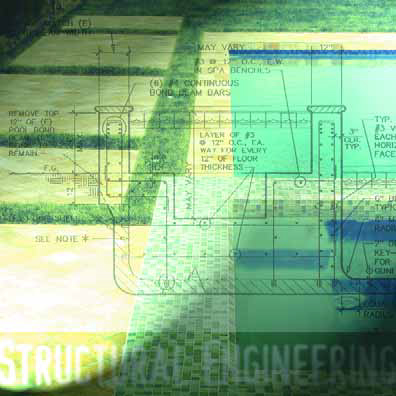
Let me make an important point: As interesting as some of the details I discuss in these columns may be, many of the more significant ones wouldn't have any substance or value to my clients without the contributions of one very important person: my friend Mark Smith of Tarzana, Calif., whose firm takes care of my structural engineering. I'd go so far to say that he and his staff are critically important external members of my design team - professionals who know more than I will ever know about steel, concrete, tension and compression. Every single project I design and build is fully, individually engineered, and I refuse to make any assumptions on my own about what might be

It's a rare project in which a watershaper has the opportunity to execute a complete design without compromise. In our Scottsdale, Ariz.-based business, we often work with upscale clients on custom pool and spa installations, and it seems that there's always some element or other in the design that ends up being altered or left out. It sometimes reaches the point where we start to feel as though the result, although it may be satisfying to the client, is not fully reflective of our talent, our vision or our best effort. The project pictured in these pages, however, is a dramatic exception to that rule. Although the clients were involved with general suggestions during the design process and construction project, when it came down to details of the plan, they let us go ahead and create an environment that fully reflected our creative vision. They'd seen one of our projects in a local "Street of Dreams" program in which area contractors were selected to build spec homes on the same street in a town just north of Scottdale called Troon. Once the row of home was completed, there were tours, awards and lots of media coverage - quite the high-profile affair. The clients had been in contact with four or five different pool builders in the area, but they'd

Most people I know have a favorite vacation spot, a favorite leisure-time activity and a favorite form of self-indulgence. In creating backyard environments for these folks, we as watershapers and landscape designers often find ourselves able to roll elements of one, two or all three of those "favorite things" up in a single package in ways that closely reflect our clients' passions and personalities. At my company, we strive to make a direct connection with those preferences by letting our prospective clients know that we want to enable them to vacation in their own backyards and come home to outdoor environments that epitomize the good life. In some cases, that means
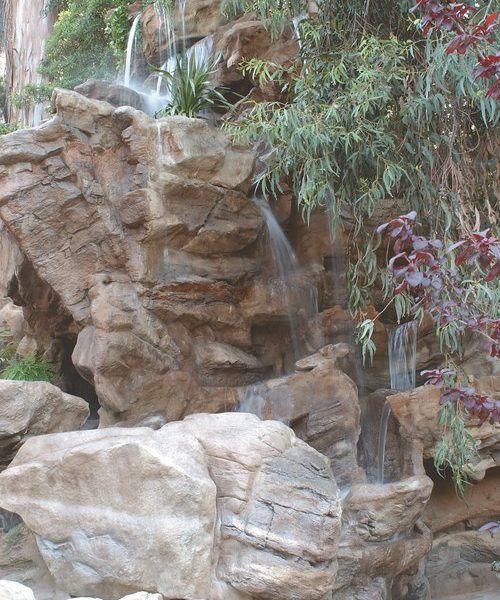
In designing and constructing naturalistic projects for residential clients, I keep two thoughts uppermost in mind: First, the only way to create a successful, natural-seeming illusion is to base my work on the observation and study of nature; second, the only way to build fun into such an environment is to fill it a child-like sense of wonder that draws old and young alike to the natural beauty. For the project pictured in these pages, those two thoughts were always front and center. The homeowner first contacted us about his desire to place a dramatic waterfall in front of some striking, 120-foot-tall eucalyptus trees. That vision soon expanded to include additional watershapes now woven through the majority of the steep, terraced, heavily wooded site. Some work had already started on a set of streams and a hillside pool by the time we became involved, but when the client became acquainted with our work and saw the sort of realistic, highly detailed projects we execute, he wanted us to pick up and take the entire project to completion. Built during the unusually wet winter southern California experienced this past year, the project was challenging in logistics, scope, variety and detail. Some of the practical challenges included hand-carrying 400-pound rock panels down 100 yards of steep, switch-back paths - and occasionally dodging rogue golf balls shanked over from the adjacent Bel Air Country Club. Despite such annoyances,

It's often said nowadays that watershaping is the art of fitting our work into the surrounding environment. In many ways, what we do at Star Pools in Houston is a prime application of that powerful yet basic concept in the way we tackle both the opportunities and limitations of the residential settings we encounter. Houston is dotted by affluent neighborhoods teeming with homes in classic Mediterranean and Tuscan styles. Stately is a word often used to describe these homes, and because we've based our design philosophy firmly on the idea that the swimming pool and garden areas should look as though they were designed as part of the home itself, our work is largely a manifestation of

Even though many swimming pools look similar in lots of fundamental ways, every one of them is actually quite unique. From soil and groundwater conditions or the specifics of their structural designs to the ways in which they have been installed, water-containing vessels of all shapes, types and sizes are, in fact, subject to a wide array of site- and workmanship-specific variables that can influence the way their concrete shells will perform through the years. When a watershape cracks, any number of things might have gone wrong. To the owner of a watershape, of course, such cracking is obviously a source of concern. The fix is often expensive, and it's not at all unusual for contractors to defend their work as a means of avoiding the necessity of paying to remedy the situation. This can leave the owner in a very difficult position in which experts must be called in to determine the true cause of the problem - and then he or she might be left alone to pressure the contractor who installed the vessel to take responsibility and

When I was a kid in Caltagirone, Sicily, everybody worked hard all the time - grueling manual labor in the fields and factories. By the time I was eight years old, I was already working with my father in a ceramic-sculpture foundry. I didn't do much more than sweep the floors, but I was around all sorts of craftspeople and began to see that there were some forms of hard work that were more fulfilling than others. So I began to think about becoming a painter. I took my first steps in that direction at 13. By the time I was 18, I'd opened a studio and was painting and sculpting on my own. In those days, the arts community was an exciting place where we shared ideas, fed on each others' energy and competed with each other for good commissions. I'm not ashamed to admit that I thought the established artists I hung out with were cool and powerful in their own ways - and that I wanted to be just like them. Given the specific nature of my art, it's not surprising that the great Italian masters heavily influenced my work right from the start, including Michelangelo, Raphael and especially Leonardo Da Vinci. They are my heroes, and I see the work I do as a modest continuation of the traditions they established. These artists taught me that great art is about passion and the desire to
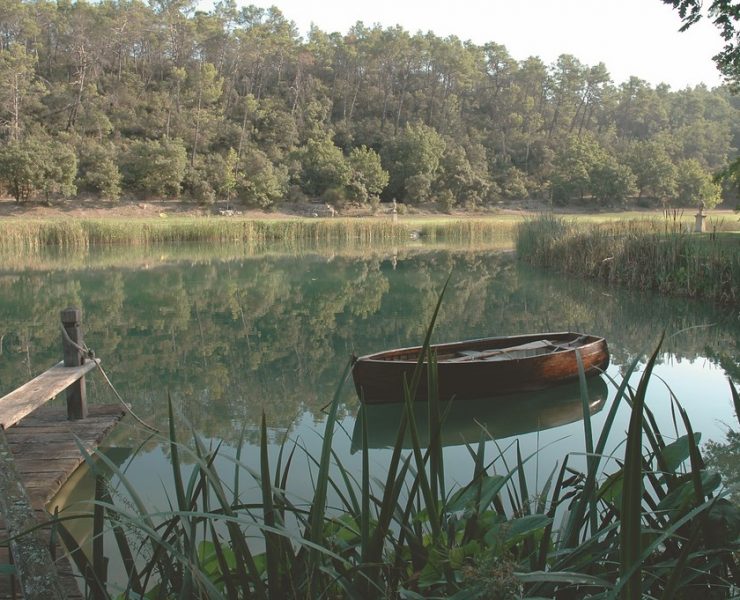
My journey in the company of water began when I was about seven years old, as soon as I was old enough to explore the countryside near my family's farm in Southern England. It was then that I fell in love with water - wading in streams, making dams out of small rocks, sticks and mud and watching the fish darting in clear pools. Much of my summer vacation was spent on a sun-peeled green punt gliding on a lake and staring down to the bottom at the aquatic plants and water creatures. It was a formative experience. My parents loved the water, too, and they always had some type of boat. I'll never forget how almost every one of those modest vessels leaked profusely. This gave all of us first-hand experience of enjoying the water as we developed a visceral appreciation of the importance of
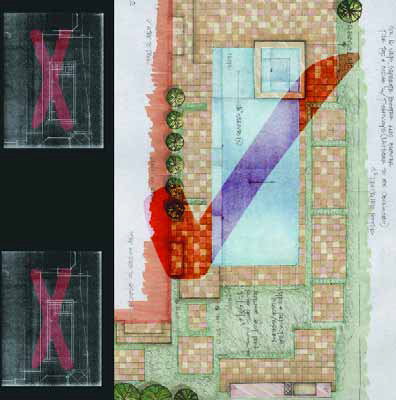
Where you've come from often has everything to do with where you're going. As a case in point, let me describe a project that had its origins all the way back at the very start of my work as a watershaper. My pool industry career began soon after I graduated from college. At the time, I was living in a garage in a rough part of Los Angeles and really wasn't sure what I wanted to do. I had studied ancient history, three-dimensional design and industrial design and had been accepted as a PhD candidate in pharmacology at the University of the Pacific. I was convinced I wanted to be a designer, but I wasn't sure which field I should enter. Then one day, at a time when I was about as broke as an organ grinder without a monkey, I answered an ad in the newspaper looking for

The Crown Fountain in Chicago's Millennium Park is an ingenious fusion of artistic vision and high-tech water effects in which sculptor Juame Plensa' s creative concepts were brought to life by an interdisciplinary team that included the waterfeature designers at Crystal Fountains. Here, Larry O'Hearn describes how the firm met the challenge and helped give Chicago's residents a defining landmark in glass, light, water and bright faces. In July last year, the city of Chicago unveiled its newest civic landmark: Millennium Park, a world-class artistic and architectural extravaganza in the heart of downtown. At a cost of more than $475 million and in a process that took more than six years to complete, the park transformed a lakefront space once marked by unsightly railroad tracks and ugly parking