








ARTICLES
Advance Search
Aquatic Health
Aquatic Health, Fitness & Safety
Around the Internet
Aquatic Culture
Aquatic Technology
Artful Endeavors
Celebrity Corner
Life Aquatic
Must-See Watershapes
People with Cameras
Watershapes in the Headlines
Art/Architectural History
Book & Media Reviews
Commentaries, Interviews & Profiles
Concrete Science
Environment
Fountains
Geotechnical
Join the Dialogue
Landscape, Plants, Hardscape & Decks
Lighter Side
Ripples
Test Your Knowledge
The Aquatic Quiz
Other Waterfeatures (from birdbaths to lakes)
Outdoor Living, Fire Features, Amenities & Lighting
Plants
Ponds, Streams & Waterfalls
Pools & Spas
Professional Watershaping
Structures (Editor's Notes)
Travelogues & History
Water Chemistry
WaterShapes TV
WaterShapes World Blog
Web Links
Around the Internet
Aquatic Culture
Aquatic Technology
Artful Endeavors
Celebrity Corner
Life Aquatic
Must-See Watershapes
People with Cameras
Watershapes in the Headlines

Some might say we're enduring the curse of living in interesting times; others might opine that the planet's just plain gone crazy. However you look at it, when you stop to consider what's been going on in the world, in our country and in the economy and how all of that relates to our watershaping corner of the universe, it's easy to see that important trends and even greater forces are constantly sweeping around us. So much is happening that it's often difficult to figure things out, but the most important observation I can make is that not all the news is gloomy - far from it. For a great many watershapers, in fact, business has thrived in recent times and expanded in new and exciting directions. That's so true for some that it's fair to say that there's been little or no time left for reflection. But I would argue that finding time to

Imagine how you'd feel if you couldn't move your body well enough to operate a wheelchair, let alone walk under your own power. Then imagine the feeling of liberation you would have in rising out of those physical confines and
The issue you hold in your hands marks the completion of WaterShapes' fifth year in print - a milestone that I can't believe is happening so soon. It doesn't seem all that long ago that

Long a fixture in San Francisco's Golden Gate Park, the Conservatory of Flowers is one of the most photographed structures in a city famous for picturesque beauty. At 125 years old, the facility is the oldest surviving public conservatory in the western hemisphere. Originally built in 1878 and then rebuilt after a devastating fire in 1883, it's also an architectural and engineering treasure - an extremely rare example of a prefabricated Victorian-era structure that had withstood the test of time. In 1995, however, a severe storm caused extensive damage and led city building officials to deem it unsafe for public use. Despite that decision, a dedicated group of paid staff and volunteers doggedly maintained and managed the site and its plants in a gallant effort to stave off further degradation, all with the hope that someday the Conservatory would be restored. They bit off no small challenge, as many of the facility's "botanical residents" are difficult and expensive to maintain - including a 100-year-old Philodendron with five-foot tall leaves that fills much of the space beneath the Conservatory's towering central glass dome. The ongoing campaign to save

Since the dawn of civilization, it has stood as the single most enduring of all artistic media: From representations of mythological characters and historic events to applications as purely architectural forms and fixtures, carved stone has been with us every step of the way. As modern observers, we treasure this heritage in the pyramids of Egypt and Mesoamerica. We see it in the Parthenon in Athens, in the Roman Colosseum and in India's Taj Mahal - every one of them among humankind's finest uses of carved stone in the creation of monuments and public buildings. As watershapers in particular, we stand in awe before the Trevi Fountain in Rome, the glorious waterworks of the Villa d'Este and the fountains of Versailles, three of history's most prominent examples of carved stone's use in conjunction with water. But you don't need to

For most watershape projects of above-average complexity, the clients - whether they are developers, architects, landscape architects or property owners - must choose how to execute their vision by deciding who they'll bring in to do the actual work with the water. In my 23 years in the watershaping trades (in service and maintenance, as an installer, with an equipment manufacturer and as a consultant), I've observed dramatically varied levels of expertise on the provider side of that equation. These days, in my work for EDAW, a national landscape architecture firm, I'm now on the specifier side of the equation and, in an interesting reversal, very often find myself explaining to designers in my own company what their options are for getting a watershape designed and built. In my lengthening career, I've seen the sets of strengths, backgrounds, abilities and limitations each category of service provider brings to the table - and seen clearly that an understanding of how all the pieces fit together is useful for everyone involved, from the property owner and specifier to the consultants, suppliers, contractors and subcontractors who get the job done. To build that understanding, let's pull apart the process of setting up a high-end watershape from start to finish and see how various roles intersect and interrelate. We'll focus on large commercial projects for purposes of illustration, but the fact is that the same principles apply just as well (if less formally) to sophisticated

It's striking and even awe-inspiring to observe the ways in which water can shape a desert. Probably the most spectacular example of this phenomenon to be found anywhere on the planet - and unquestionably the most prominent hydrological feature of Arizona's landscape - is the winding course the Colorado River takes through the Grand Canyon it created. The terrain surrounding Pointe South Mountain Resort in Phoenix is another special creation that draws much of its character and interest from the presence of

The Delicate Art of Dancing with Porcupines by Bob Phillips (Regal Books, 1989) may have one of the most unusual titles I've ever seen, but fortunately the quirky name didn't stop from picking it up several years ago. At this point, I've read it multiple times and have taken to presenting it quite often as a gift to friends and associates. I like it so well myself because the text applies in practical and profound ways to my work as a watershape designer. I share it with others because it has had something to say about every aspect of my life and can do the same for them, too. A widely published marriage and family counselor, Phillips is best known for this small book (just 160 pages) in which he examines in wonderfully clear and concise detail what he calls "social style." The idea is that people generally fall into categories having to do with
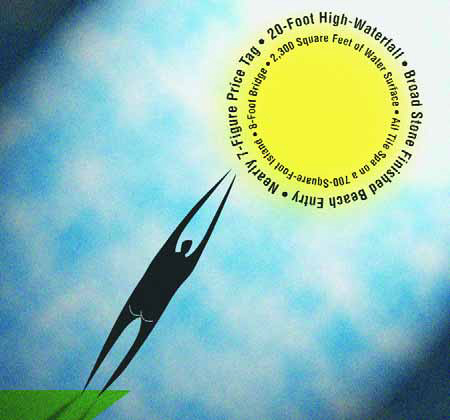
The renovation project I've been discussing for the past couple of issues will be on hold for a few weeks as we await the arrival of a shipment of custom tile from Italy. We'll pick up with that project once work resumes. In the meantime, let's begin coverage of what would have been the next project for "Details" - discussions that will carry us through a good part of the year to come. Everything about this Pennsylvania watershape has been impressive, right from the start. Simply put, it's one of the biggest and most elaborate projects I've ever tackled. As designed, the watershape will
In all my years as a landscape designer, I've always told my clients that nobody can know ahead of time how a plant will adapt to or behave in any given situation. "Each place on this earth has its own microclimate," I tell them. "Trying to foresee how a plant will grow is like trying to predict when the earth will end." Most plants, of course, really are somewhat predictable when you place them in a client's yard. As long as you pay attention and use those that are typically considered to be noninvasive, for example, you're generally safe in planting them and needn't spend time worrying about their futures. By contrast, plants that are considered invasive - whether it's all the time or only some of the time - should, under any and every circumstance, be