








ARTICLES
Advance Search
Aquatic Health
Aquatic Health, Fitness & Safety
Around the Internet
Aquatic Culture
Aquatic Technology
Artful Endeavors
Celebrity Corner
Life Aquatic
Must-See Watershapes
People with Cameras
Watershapes in the Headlines
Art/Architectural History
Book & Media Reviews
Commentaries, Interviews & Profiles
Concrete Science
Environment
Fountains
Geotechnical
Join the Dialogue
Landscape, Plants, Hardscape & Decks
Lighter Side
Ripples
Test Your Knowledge
The Aquatic Quiz
Other Waterfeatures (from birdbaths to lakes)
Outdoor Living, Fire Features, Amenities & Lighting
Plants
Ponds, Streams & Waterfalls
Pools & Spas
Professional Watershaping
Structures (Editor's Notes)
Travelogues & History
Water Chemistry
WaterShapes TV
WaterShapes World Blog
Web Links
Around the Internet
Aquatic Culture
Aquatic Technology
Artful Endeavors
Celebrity Corner
Life Aquatic
Must-See Watershapes
People with Cameras
Watershapes in the Headlines

Just as few sounds blend so beautifully or evoke such sensations of peace and calm as the sweet tones of birds singing along with the relaxing music of moving water, I'd also have to say that few sights in nature delight the eye more than watching migrating robins queuing up for a bath, hummingbirds darting through a mist or a bold vireo "plunge bathing" in a rippling pool. For most of my life, I've been inspired to observe the beauty and freedom of birds and am among those who have spent hours in the wild hoping to catch a glimpse of a

Back in February's WaterShapes, I stepped a bit beyond the usual in discussing Harvests of Joy by Robert Mondavi, noting that I'd read the book based on a recommendation from fellow WaterShapes columnist Brian Van Bower. I also mentioned that the book was one of the most important I've come across in recent years. This time around, I'd like to review another of Brian's recommended books - one he suggested during a seminar I recently attended and which has also proved to be wonderfully useful and extremely influential: Samurai Selling: The Ancient Art of Service in Sales by Chuck Laughlin and Karen Sage with Marc Bockmon (St. Martin Press, 1993). Until I read this book, my sense of what Samurai were all about was based on no more than warrior movies and video games. What I learned instead is that Samurai based their lives entirely on a concept of service (of which warfare was only a small part). The authors use the philosophy of the Samurai to define

Tucked into a small cove in the mountains behind La Quinta in California's lower Coachella Valley, The Quarry Golf Club is hidden, ultra-private and basically unknown to all but members of the golfing elite and the wealthy few who play the course. First conceived by entrepreneur Bill Morrow and designed by renowned golf course architect Tom Fazio, the course is a prime example of just how beautiful golf courses can be - and of how critical a role landscaping and watershapes can play in defining their character and aesthetics. Our challenge was to embroider the course's 18 PGA-sanctioned, championship-caliber holes with

For the most part, the designers and builders of pools, spas and other watershapes visualize their projects in full sun, install them during daylight hours and seldom (if ever) see them after the sun goes down. That's both a problem and a shame, and it's reflected in the fact that the run of projects you encounter by mainline pool-industry folks - and, to a lesser extent, by people from the landscape trades - tend to treat the lighting of exterior spaces as an afterthought if it's really thought about at all. In fact, I'll go so far as to say that
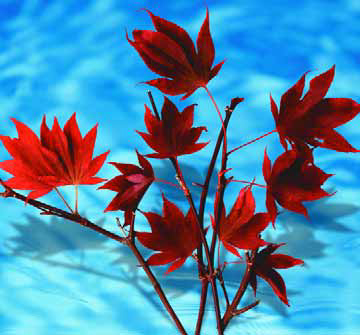
If I could point to one plant that will consistently stand out in just about any garden, it would have to be the maple. Virtually no Asian-style garden would be complete without one, and they fit beautifully into gardens of many other styles as well. I particularly like pairing maples with watershapes because of their tendency to soften the edges of typical hardscapes and the way they are reflected by the water. When placed well, a specimen or single maple can indeed be a key

As I discussed in the June installment of this column, the construction of a backyard watershape environment requires careful and clear coordination - and sensitivity to the fact that watching the process unfold can be unpleasant or even traumatic for your clients. Without a doubt, the key to managing the process so that your clients don't become unhappy requires purposeful, up-front communication that sets realistic expectations for how the project will progress - and when. Similarly, you should also set up expectations for the inevitable

Earlier this year, I was treated to a guided tour of The Quarry Golf Club in La Quinta, Calif., by landscape architect Ken Alperstein. Although I had seen pictures of the course and was also
When you look at this project in finished form, there's no way to see the months of struggle or the overall level of difficulty that went into its creation. You don't see the fact, for example, that we discovered while excavating the courtyard that the house itself was in imminent danger of collapsing. You don't see that the narrow access way buckled when we first started working, or the ugly trauma of the broken septic tank. You can't see the continuous changes in thought, direction and design that went into the deck, or the tremendous time and effort required to make the

It's a little too easy to lose sight of what holds the most meaning our work as watershapers - even when it's out there in plain view. In fact, if we're to be honest in assessing the palette of finish materials we use, I think most of us would have to concede that these products can become so familiar that thinking creatively about the full spectrum of their possibilities is something that often falls by the wayside. I believe we should be on guard against

The fire came swiftly, sweeping through the dry, late-summer undergrowth, and the land was quickly blackened and denuded. A month later, the rains came, hard and lashing, and rivulets of water ran down the hillside. Torrents of mud and stone ground away the soil and washed out the base of a tree that happened to be in the way. The tree fell. Branches became splinters on the ground. The noise the tree had made as it fell was intense: a cracking and groaning sound followed by crackles as limbs snapped against still-standing trees. Now it lay there, its roots all but pulled from the ground.Ten years passed, and as the tree's bark rotted, small saplings had begun to grow from its base. The creek ran close by, gurgling and never-ending, its water wending its way among the rocks and other fallen trees toward the ocean just half a mile away. This tree would serve a purpose in its death: In my work as a sculptor, I seek out