







waterfall

Clear, polished water in well-designed, well-built lakes, ponds and streams: What better way to communicate a powerful message about the value of the properties that surround them? In a commercial setting, for example, clear water in a meandering string of ponds will readily translate into office space filled with happy tenants, while the murky-water alternative could be just the eyesore that holds down the image and limits the facility's financial success. The same principle works for watershapes at apartment complexes, where unseemly streams will almost certainly draw complaints from unhappy residents while cool, translucent water will become a point of pride and source of relaxation for tenants who otherwise might reflexively hold their noses as they pass by. Or consider the private estate where ponds are meant for swimming: Without question, these waters must have a crystalline clarity that attests to the water's safety and potential for recreation. Delivering this level of water quality is more and more a part of

Long a fixture in San Francisco's Golden Gate Park, the Conservatory of Flowers is one of the most photographed structures in a city famous for picturesque beauty. At 125 years old, the facility is the oldest surviving public conservatory in the western hemisphere. Originally built in 1878 and then rebuilt after a devastating fire in 1883, it's also an architectural and engineering treasure - an extremely rare example of a prefabricated Victorian-era structure that had withstood the test of time. In 1995, however, a severe storm caused extensive damage and led city building officials to deem it unsafe for public use. Despite that decision, a dedicated group of paid staff and volunteers doggedly maintained and managed the site and its plants in a gallant effort to stave off further degradation, all with the hope that someday the Conservatory would be restored. They bit off no small challenge, as many of the facility's "botanical residents" are difficult and expensive to maintain - including a 100-year-old Philodendron with five-foot tall leaves that fills much of the space beneath the Conservatory's towering central glass dome. The ongoing campaign to save
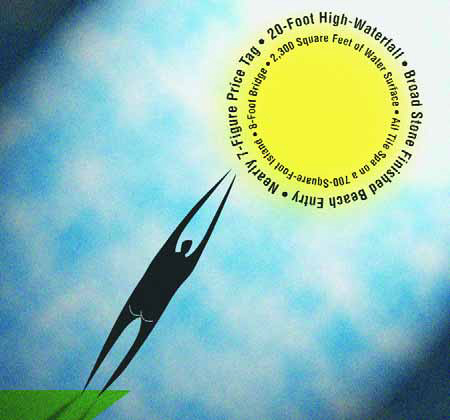
The renovation project I've been discussing for the past couple of issues will be on hold for a few weeks as we await the arrival of a shipment of custom tile from Italy. We'll pick up with that project once work resumes. In the meantime, let's begin coverage of what would have been the next project for "Details" - discussions that will carry us through a good part of the year to come. Everything about this Pennsylvania watershape has been impressive, right from the start. Simply put, it's one of the biggest and most elaborate projects I've ever tackled. As designed, the watershape will

Graced by an abundance of beautiful, natural streams, cascades, rivers and lakes spread across spectacular native landscapes, Utah is a dream location for watershapers. Not only is there a rising demand for crafted streams, ponds and cascades that look like they really belong, but the state itself is also a genuine design laboratory. Indeed, I send our crews out into the "wild" periodically to do nothing more than hike up and down local watercourses to see how Mother Nature does things. These waterways are

From pools, spas and fountains to streams, ponds and waterparks, effective watershaping is largely about the plumbing that makes these systems work. If you see things that way, says hydraulics expert Steve Gutai, there's nothing more fundamental to success than making proper connections in the system's plumbing lines, first time, every time, and piping joints that will bear up under pressure for the long haul.

Just as few sounds blend so beautifully or evoke such sensations of peace and calm as the sweet tones of birds singing along with the relaxing music of moving water, I'd also have to say that few sights in nature delight the eye more than watching migrating robins queuing up for a bath, hummingbirds darting through a mist or a bold vireo "plunge bathing" in a rippling pool. For most of my life, I've been inspired to observe the beauty and freedom of birds and am among those who have spent hours in the wild hoping to catch a glimpse of a

Tucked into a small cove in the mountains behind La Quinta in California's lower Coachella Valley, The Quarry Golf Club is hidden, ultra-private and basically unknown to all but members of the golfing elite and the wealthy few who play the course. First conceived by entrepreneur Bill Morrow and designed by renowned golf course architect Tom Fazio, the course is a prime example of just how beautiful golf courses can be - and of how critical a role landscaping and watershapes can play in defining their character and aesthetics. Our challenge was to embroider the course's 18 PGA-sanctioned, championship-caliber holes with

The avant-garde composer John Cage once said, “Art exists to make us aware of the very life we’re living.” I’ve always loved that statement because, as someone working to create works of art, the experiences of my own life have naturally been transferred into the way I’ve chosen to express myself – and, I hope, have enabled me to succeed in bringing other people to an awareness of experiences in their own lives. For me, water is the key in these transferences: Even though I’m probably more often described as a sculptor of natural stone rather than as a watershaper, the dialogues I have with the materials I use and with those who observe the outcomes have always begun with the way I work with water. I grew up in the Midwest on the banks of the Mississippi. As a child, I lingered on the untamed shores of the creeks, streams and rivers that laced across an otherwise developed and thoroughly mechanized landscape. I would read or draw, stroll idly along a stream, or spend hours building a raft or dam. This was well before I’d begun to think about my relationship with water in any sort of artistic way, but there’s no question that those experiences remain at the heart of my passion for working within this

The process of designing a watershape or garden usually requires the designer to answer a number of questions - the vast majority of them having to do with seeing the water and the landscape. Indeed, from considerations of color and scale to managing views and ensuring visual interest within the space, much of the designer's skill is ultimately experienced by clients and visitors with their eyes. But what if your client is blind or wheelchair-bound or both? How do you design for them? What colors do you use in your planting design? Would you even care about color? How will they move through the space and what experiences will await them? What would be the most important sensory evocation - sound, fragrance or texture? These are the sorts of special questions we asked ourselves after being approached by clients who had the desire to create a sensory garden for visually impaired and physically handicapped people. The experience shed a whole new light on the power of non-visual aesthetics and prompted me to

One advantage of building pools in the affluent Chicago suburb of Lake Forest is that many of our prospects have seen inspiring landscapes, pools and waterfeatures in neighboring backyards or at quality resorts around the world - and, as a result, come to the design process with plenty of ideas. With all of that experience and thoughtful exposure to the possibilities of water, quite often they're already visualizing the way they want their backyards to look. Such was certainly the case with the project seen in this article: The homeowner came to us with an armload of photographs and knew exactly what she wanted from the outset. And the canvas for her imagination was plenty big, with a backyard measuring more than two acres and including a