








restoration

It may have been in the heart of the depression, but 1932 was a good year for American swimmers: The Olympic Games in Los Angeles saw Clarence "Buster" Crabbe win gold in the 400-meter freestyle in the then-world-record time of 4:48.2 and Helene Madison win gold medals in both the 100- and 400-meter freestyle events. U.S. swimmers claimed nine medals in all, in many cases besting swimmers from the powerful and heavily favored Japanese team. The competition was held in an eight lane, 50-meter pool positioned quite literally in the shadow of the Los Angeles Memorial Coliseum. Just as the names and records of those swimmers have faded across 70-plus years, so too had the swimming pool and its companion recreation pool. Although they had remained in near-continuous use for generations, the old vessels were supplanted when a modern swimming pool complex opened on the nearby campus of the University of Southern California in anticipation of the 1984 Los Angeles Olympiad. Early in 2003, we at Rowley International of Palos Verdes Estates, Calif., were asked to renovate the old facility's two swimming pools. The City of Los Angeles, along with support from the Amateur Athletic Federation (AAF), set a goal that didn't involve

To residents of St. Louis, Forest Park is a civic treasure on the order of New York's Central Park - which, locals are quick to point out, is smaller than their favorite park by 500 acres. Established in 1876 at the heart of the city, Forest Park has a similarly grand and glorious history, including service as the site of the renowned 1904 Louisiana Purchase Exposition & World's Fair, which drew more than 20 million visitors from across the globe. Through the years, the park's 1,370 acres have become "home" to such major attractions as the world-famous Saint Louis Zoo as well as the city's art museum, science center, planetarium, history museum and The Muny, the nation's largest outdoor theatre. Forest Park is also home to the
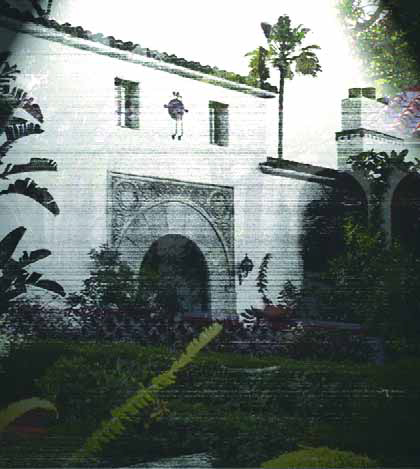
Here in America, our idea of history goes back only so far. That's particularly true in southern California, where "older" architecture is anything before about 1960 and very few structures date to a time before 1920. But it's also the case for most of the rest of the country with reference to architecture: We don't have the "ancient" structures that still set the tone and architectural vocabulary the way they do in Europe, Asia and other places. For those who prefer modern or contemporary styles, this lack of history may be irrelevant. For those who feel an affinity to older styles, however, there's a tendency to cringe every time an older house is torn down to
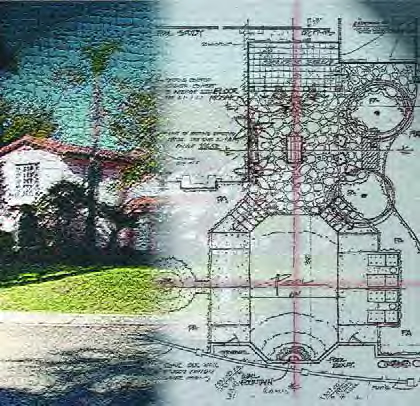
I was hired recently to work on a substantial restoration project in a prominent Los Angeles neighborhood. I'd worked previously with the architect on a large estate, and he had referred me to the homeowners. After a couple of meetings, we determined we were all a good fit, and I was hired to design the exterior spaces of the home in collaboration with the architect, the contractor and the decorator. About a month into the project, the interior decorator was let go in favor of a restoration specialist. By that time, it was clear that many of the design decisions being made were not in keeping with

Long a fixture in San Francisco's Golden Gate Park, the Conservatory of Flowers is one of the most photographed structures in a city famous for picturesque beauty. At 125 years old, the facility is the oldest surviving public conservatory in the western hemisphere. Originally built in 1878 and then rebuilt after a devastating fire in 1883, it's also an architectural and engineering treasure - an extremely rare example of a prefabricated Victorian-era structure that had withstood the test of time. In 1995, however, a severe storm caused extensive damage and led city building officials to deem it unsafe for public use. Despite that decision, a dedicated group of paid staff and volunteers doggedly maintained and managed the site and its plants in a gallant effort to stave off further degradation, all with the hope that someday the Conservatory would be restored. They bit off no small challenge, as many of the facility's "botanical residents" are difficult and expensive to maintain - including a 100-year-old Philodendron with five-foot tall leaves that fills much of the space beneath the Conservatory's towering central glass dome. The ongoing campaign to save

For more than two full years, this project was my personal and professional obsession. It all started in 1993, when my client, a wealthy recording-industry magnate, called on me to design the landscape for a property he'd just acquired in Bel Air, one of the most exclusive neighborhoods in Los Angeles. The Spanish Colonial-style home had been built in the 1920s and was in a sad state of disrepair. By the time I arrived, it had been gutted to the studs, and very nearly all of the hardscape and plantings around the house had been torn out as well. What he was offering me was a tantalizingly blank canvas in a most spectacular setting. In the two years that followed, not only would we

It's truly a diamond in the rough: a huge, sparkling blue pool set in the middle of nowhere in a country that is probably best known for being the gateway between two grand oceans. For a time before I arrived on the scene, however, the enormous rectangular swimming pool at Palabra de Vida, a Christian missionary camp in Chame, Panama, was anything but shimmering. The mission operates a camp for the region's underprivileged children, who visit the facility in shifts that stretch across several months each year. There are times when
It's a grand watershape built at a time and place when "grand" was in fashion in so many ways. Ever since 1940, when the Raleigh Hotel and its beautiful swimming pool opened to the public for the first time, the establishment has made a statement about the sun-drenched glory of a prime South Florida location as well as the glamour of an era gone by. Designed and built by renowned architect L. Murray Dixon, the hotel and pool are located in South Beach, Miami's famed Art Deco district. The pool's curvaceous shape and modern styling reflected the hotel's architecture and the aspirations of the times. As the '40s wore on, it would become a swimming pool that was perfectly in sync with the world around it. When Miami boomed in the years following World War II, the hotel did, too. Vacationers and snowbirds from the great cities of the Northeast arrived in droves, looking for a new kind of excitement and an entirely different sort of glamour of the kind that featured

With just a few weeks to go before our work was to begin, I took my wife Denise to visit the historic pool at the Biltmore Hotel in Coral Gables. I wanted to take a long look at what was (and may always be) the largest re-plastering job I'd ever landed. As I stood at the edge of what can truly be described as a huge pool, I actually thought for the first time in my career that I'd bitten off more than I could chew: The surface of the massive U-shaped pool was in terrible shape and dragged down the hotel's otherwise beautiful decor and landscaping. Yes, it was the kind of prestige job I'd always wanted, but it only took a few minutes for the enormity of what I had undertaken to