







engineering
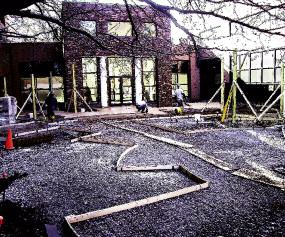
Have you ever noticed how often the costliest part of a project turns out to be something that will ultimately be hidden from view? This happens quite frequently in projects involving any sort of slope, where the piers and grade beams beneath swimming pools, for example, can cost far more than the rest of the overall project. In my own work, I’ve noticed this budgetary quirk most frequently when it comes to retaining walls, where providing the foundation they need to withstand the forces applied by a slope can be startlingly extensive and expensive. It’s not what you’d call glamorous work, but it certainly is important – and will vanish completely from view. Most often, we’re called on to build these walls when

For professionals who tirelessly commit themselves to excellence in all aspects of their work, challenging projects are the butter on the bread. At Drakeley Swimming Pool Co. of Bethlehem, Conn., we truly enjoy jobs with higher-than-usual degrees of difficulty because they generally involve us with clients who have strong ideas about what they want, force us to develop solutions to unique and interesting problems and see us perform on a level that invariably makes us proud. As we see it, these jobs are the reward we get for years of focusing on doing our absolute best. True, these projects can be tough, but we’ve found that by sticking to our “quality without compromise” philosophy, we’ve managed to thrive through tough times and have always earned our share of interesting commissions. It’s proof of the old adage that good things follow hard work, even in a soft economy. That was certainly
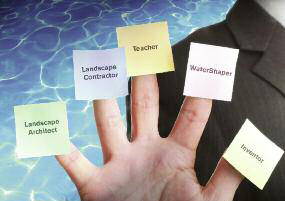
Looking beyond standard modes of operation is nothing new for watershapers: It’s how many of us grow professionally. In my case, for example, I’ve moved in a variety of different directions in my career, and I’ve found that each of these endeavors has added substance and insight to both my business and professional acumen. Some experiences are more valuable than others, of course, but I’ve always found something positive and a few times have watched my business transform and grow before my eyes. Looking back, it’s been quite a journey. I began my career more than 20 years ago with

Every time I open a landscape trade magazine, I’m bombarded by ads from just about every paver manufacturer on the planet. From the newest faux-stone concrete pavers and ADA-compliant bricks to granite, flagstone, mica and other slab species, we have more choices than ever before for our projects. Some professionals approach this wealth of possibilities and play it safe – not caring so much about what’s the latest and greatest but focusing instead on what’s most familiar and time-tested and being interested in little more than providing clients with surfaces that can safely be walked on. Fortunately, however, there are lots of us who take a different view, putting care and thought into the materials we select for our walkways, patios and terraces and working closely with our clients to make certain the resulting surfaces meet their needs. In other words, there’s
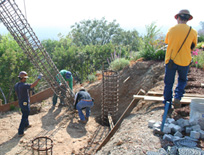
Through the past several years, I've witnessed a debate among people in the watershaping industry about whether every construction project should require soils and geology reports as part of every design and engineering process. Most of my colleagues who work in the custom, quality-oriented end of the business will
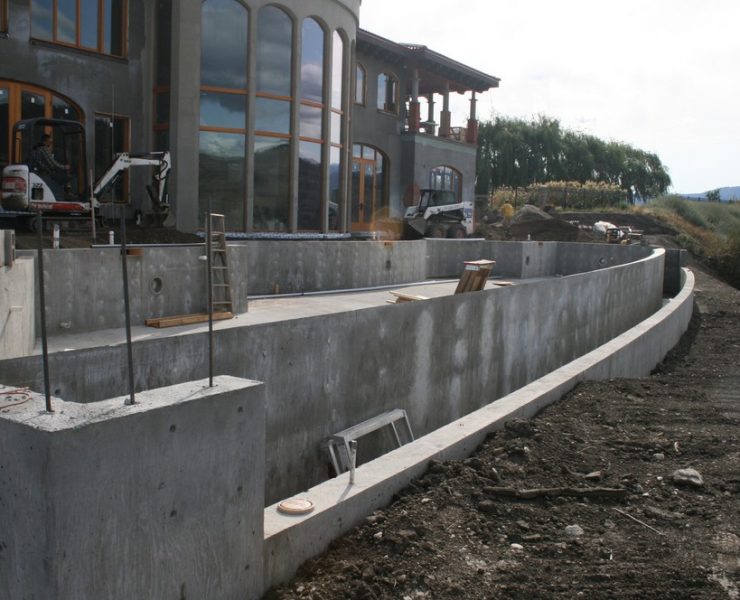
One of the great things about watershaping is how the work can lead you to unexpected places where you sometimes encounter vastly different ways of doing things. In the past few years, for instance, my design work has led me to design a number of projects in the great open spaces of western Canada – many of which have been built by Gene Brown of Valley Pools in Kelowna, British Columbia. Working with this true professional has taught me a great deal about the precision and power that comes in using poured-in-place concrete as a medium and, as a result, has greatly influenced my thinking about how watershapers everywhere should strive to elevate their own standards of construction. My northward migration began with small steps. In fact, I started off with Valley Pools simply as a consultant for hydraulic and mechanical issues, exchanging plans with Brown and helping him ensure the functionality of some of the more complex systems he found himself doing. At first, I did little more than flesh out the plans mechanically, but I couldn’t help noticing that he was finding some interesting projects – and also observed that he was one of those watershapers who had completely dedicated himself to excellence in all facets of the work. Our usual exchanges were set aside, however, when one day he sent me a set of plans that had been produced by an architect in collaboration with

Boston’s Big Dig was essentially a Big Fix. Officially known as the Central Artery Tunnel Project, it served to repair damage done to the heart of the city by the Interstate Highway program during the 1950s and ’60s. In Boston’s case, the federal government had stepped in and inserted a primary traffic artery through what had been a downtrodden area near the waterfront. Its intentions may have been good, but I-93 ran north to south and separated the city’s historic downtown area from its storied waterfront – a disastrous decision that did little more than create decades’ worth of traffic nightmares. Ultimately, it also required remediation on a scale seldom seen in the course of human history. Planning for the project began in 1982, initiating what would become

Last month, we began our discussion of a large pond, stream and waterfall system for a historic upper Midwest estate found on the forested shore of a scenic lake. As related there, the project was to include three major ponds and a series of complex waterfall structures connected by streams rising close to the top of the gently sloping property. To sum up, the space we were working with measured approximately 300 feet wide and 800 feet long – a large section of a 35-acre estate marked by scores of mature trees that largely governed the watershapes’ configurations. Moreover, as there were no natural rock formations or outcroppings on site, we faced the need to

With watershapes, sometimes the most straightforward forms work out best. That was definitely the case with this project, a swimming pool I designed and built for a beach club near my home in Guanacaste, Costa Rica. The club is part of an overall resort property known as Reserva Conchal, an utterly spectacular spread covering 2,500 acres on scenic Playa Conchal on our country’s north Pacific coast. I first became involved with the resort’s owners about ten years ago, when they were completing their first phase and I helped them solve some problems with a pool that had been built by another firm. Since then, as the owners’ master plan has gradually unfolded, I’ve worked with them on a number of pools in various spots around the huge property, including watershapes for various condominiums and other facilities. My involvement with their newly constructed club has been, by far, the most

{Multithumb} When second-generation metalworker and sculptor Kris Kesler wanted to take his custom waterfeatures to a higher, more artistic level, he took off his welding mask and picked up a computer mouse. It’s been liberating, he says, enabling him to design everything from simple scuppers to hurricane-proof fountains and take care of the details that make them work on screen before he puts his hands in gloves and goes at it with hammer and tongs. Growing up in a family of industrial and commercial fabricators, I was steeped from an early age in traditional metalworking techniques – hammering, planishing, leather-sandbag shaping and my favorite, torch welding. Learning at my father’s knee in his commercial steelwork factory led me to admire the artistry of craftspeople as they transformed raw hunks of metal into functional and often beautiful works of art. The power of that experience has always stuck with me. Later in life, when I decided to launch my own water- and fire-feature company, I was excited to get back behind the welding mask and