







engineering

As part of their work in crafting custom pools for high-end clients in the Washington, D.C., area, Bill Bennett and Walt Williams are often called on to find creative solutions to substantial design challenges. For two recent indoor projects, for example, both clients wanted to be able to transform their indoor pool areas into dry spaces suitable for large gatherings – but they wanted to do it without resorting to either automatic solid covers or moveable floors. It was quite a coincidence: Within the span of just a few weeks, we at Alpine Pool & Design (Annandale, Va.) became involved in not one, but two highly unusual projects that offered us the exact same challenge. Both were indoor swimming pools for well-to-do clients living in the vicinity of our nation's capital. Both were rectangles, with each one situated beautifully within magnificent surroundings. Finally, both enabled us to work with our good friend and long-time professional associate Kevin Ruddy of Omega Pool Structures (Toms River, N.J.) Ruddy is something of a guru when it comes to indoor pools, and as builders as well as designers we appreciate the care and detail he puts into his drawings, plans and construction documents. From experience, we know that

Any number of the projects we've worked on through the years have given us at Root Design Company (Austin, Texas) the sense of pride and satisfaction that comes with doing the big jobs well. Only a handful, however, rise to another level and foster a sense of accomplishment, thereby making what we do both fun and entirely special. The project covered here is one of those amazing exceptions. It came to us through the architect, Arthur Andersson of Andersson-Wise Architects (also based in Austin), which is well known locally for its daring contemporary homes and commercial structures. In this case, the architect had suspended a modern home on a steep slope overlooking Lake Austin. It had a distinctly bare-bones, utilitarian look about it, distinguished mainly by an unusual, inverted-butterfly roofline. His ideas about the swimming pool were ambitious, to say the least. The drawings called for an elevated, cantilevered lap pool constructed entirely of clear panels – a bold statement that would simultaneously harmonize with the stark simplicity of the house itself. The slope on which this was to happen was quite severe, meaning the home itself is

When my family started in the pool and spa service business some 25 years ago, it didn’t take us long to recognize that there was very little available to us by way of education about water chemistry – or, for that matter, about most of the other skills involved in maintaining pools, spas and other waterfeatures. That didn’t make much sense to us, even then. After all, how could an industry devoted to the health, safety and comfort of millions of people function without addressing the need for standardized approaches to water maintenance or

It’s frequently tough to figure out how a person ever finds his or her way into a specific line of work. In my case, for example, I more or less fell into the faux-rock trade, never imagining that what seemed like a blind stumble would ultimately unlock my imagination in a whole range of unexpected ways. It all started when I was working in the oil industry in Alaska in the 1980s. When petroleum prices dropped, I was out of work and moved back to my home town of Tucson, Ariz., where I was hired as a laborer by the Larson Company, which was among the trailblazing firms starting to work in faux rock. I began by mixing concrete and did my fair share of grunt work. As luck would have it, I began showing some artistic promise and in a relatively short time found myself working on major projects and learning the process literally from the ground up. After a couple of hard years, I became a superintendent, a promotion that led to my involvement in major overseas projects, including aquariums in Tokyo and Osaka, Japan, as well as an extended stay in Italy. These were wonderful, formative experiences, but eventually I struck out on my own and

More than three years ago, I was approached by a talented landscape architect (and good friend) to look at project with an interesting twist: the celebration of the agricultural history of a well-known California city. I’ve long been fascinated by history and have taught the history of art and architecture in a variety of settings, so when Lance Walker (then principal at The Collaborative West, San Clemente, Calif.) called me, I was keenly motivated to hear more about his plan to pay homage to those who had jump-started a major modern community by harnessing a natural watercourse to
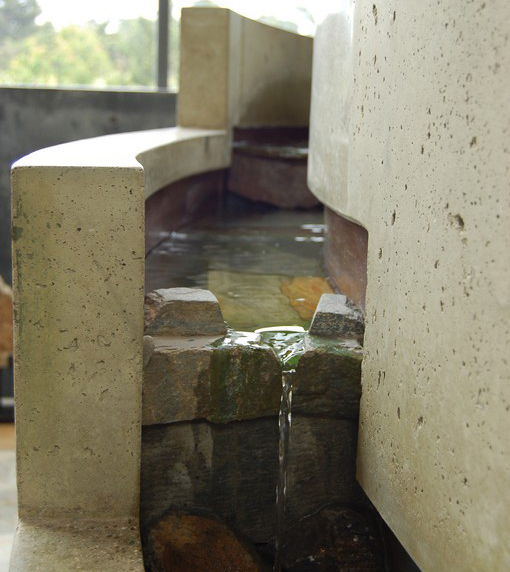
By Fu-Tung Cheng I’ve never been entirely comfortable with the term “decorative concrete.” To me, the pairing of the words has always implied that one merely applies material over a substrate in the way a baker might apply icing to decorate a cake. Instead, I see concrete as inherently profound. More than appliqué, it is a medium that has long been used functionally as well as expressively. In my own case, I feel far more creatively engaged in my work when I merge my thinking about those dual potentials of function and art. Historically, in fact, I believe that when the two become an inseparable one, we recognize and celebrate these works as rising to the level of great design. In my own case, I began using concrete as an expressive medium a few decades back, when I was among the pioneers in designing and installing concrete countertops in contemporary kitchens. As both designer and builder, by the year 2000 I had

When these clients decided that they wanted to have a swimming pool, they knew above all else that they did not want another box of blue water. By contrast, as avid patrons of Disney World, the Princeton, N.J., homeowners had decided that their pool should be what they called “Disney natural” – not as completely naturalistic as a real pond, but natural enough so that they and their children could suspend disbelief and pretend that they were swimming in a pond. Before we came on the scene, the clients had

Part I: Setting the Course Theatrical vitality has to do with structuring stories and creating dramatic narratives that establish sensations of expectation, surprise and reward. It also involves the development of sympathetic, interesting characters as well as engagement in “the moment” – the feeling that a special and wonderful entertainment experience is unfolding before the audience in a specific time and place. Mastering all of that is a tall order under ordinary circumstances, so you can imagine how we felt in trying to help make it happen on the exposed, unpredictable stern deck of Oasis of the Seas – a prestigious ship that currently claims the title of world’s largest cruise liner. Fluidity – a Los Angeles-based water design studio – pursues unique, progressive projects for an international clientele that includes architects, landscape architects, civic institutions and real estate developers. Through the years, we’d had considerable experience with theatrical

Decorative-concrete artist Tommy T. Cook has built a reputation for being able to create almost anything from concrete using an array of highly refined and boldly artful processes. In this feature, he demonstrates a portion of that skill by describing how he uses the gargantuan Gunnera plant to craft watershapes in which replicas of the plant’s outsized leaves serve as uniquely natural fountain basins and spillways. Ask anyone who’s tried and it’s almost certain you’ll hear that replicating nature isn’t easy. That hasn’t stopped artists throughout history from trying, however, or from making natural forms an influential source of artistic imagination and ambition. The great thing about using nature for inspiration is that it’s all around us and all we need to do to draw on it is open our eyes, make good choices and decide how what we see can be used in our creative endeavors. In my case, I’d worked in decorative concrete for a long time before nature crawled under my skin. It began when

There’s no denying the difficulty of building a high-quality inground pool, but the welcome fact is that the earth can conceal a range of little imperfections, from small leaks to minor structural defects. When you build a pool or some other watershape above grade as an integral component of a multi-story building, however, everything you do is magnified because the work is always exposed. Essentially, you lose the margin for error that might be possible with an inground installation. This past spring, work was completed on two high-rise watershapes our firm engineered as part of L.A. Live, a multi-purpose, entertainment-oriented complex situated near the Staples Center and the Los Angeles Convention Center in downtown Los Angeles. The pool/spa combinations were placed on the fourth and twenty-sixth floors, and although they have simple rectangular forms, they represent the absolute