








drawing

'To my way of thinking,' wrote David Tisherman to open his Details column in August 2004, 'professional design work requires a professional workspace in which all of the necessary professional tools are available. 'In fact, for the designer creating custom watershapes, I see the space in which the work actually unfolds as being critical and cutting to the very heart of what it really means to be a "designer." I know that
'I can be quite outspoken,' declared David Tisherman in opening his Details column in the November/December 2001 issue of WaterShapes. 'Here's the unvarnished truth: No more than a hundred pool builders out there can legitimately call themselves designers, . . . while only a handful design at the very highest level.' 'Almost always, the difference between these top-level designers and

I grew up in my father's pool business - a successful design/build firm based in Henderson, Nev. Even in high school, I was consciously preparing myself to get involved on the design side of things and had signed up for a drafting class to start developing the requisite drawing skills. But something big was happening in the late 1990s: I was all set for my drafting class and had equipped myself with the tools I'd need
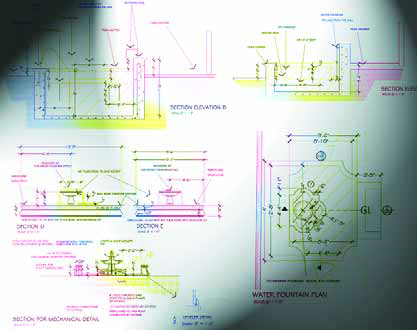
What happens when you take a large group of landscape architecture students and, for a solid week, rigorously school them in the fundamentals of watershaping? You might be surprised: Even though that seems like a short span, my charges took to watershaping like fish to water when I introduced them to the subject this past spring - and the results were both remarkable and inspiring. As their instructor, I witnessed not only their keen interest but also saw ample evidence that they were applying highly refined design processes and quality design productions in their watershape-related coursework. So despite what some skeptics have been telling me for years, you actually can
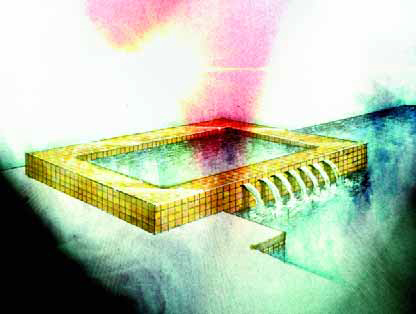
Last time, I described (at great length, as you may have noticed) what happens in the time between my initial phone conversation with clients and a point just ahead of my formal presentation of a design. It's an involved process that uses all of the information I've gleaned from my clients about what they want, what they think they need and what they ultimately expect to have in their backyard environments. It's about understanding the underlying circumstances, deciding what should be done and, finally, assembling all of that insight into a
Last time, I described (at great length, as you may have noticed) what happens in the time between my initial phone conversation with clients and a point just ahead of my formal presentation of a design. It's an involved process that uses all of the information I've gleaned from my clients about what they want, what they think they need and what they ultimately expect to have in their backyard environments. It's about understanding the underlying circumstances, deciding what should be done and, finally, assembling all of that insight into a

When I sit down with clients for our first face-to-face meeting, we discuss a range of issues that will guide me when I return to my studio and get down to designing a watershape and surrounding areas for them. We'll talk about colors, materials, the location of the pool, their preferences in art, the way they entertain and, perhaps most important of all, how they plan to use their backyard and swimming pool. Let's focus on that last point: When we talk about how a pool is going to be used, what I really want to know is how it will be used on a daily or weekly basis (for swimming, exercise, play or simply as a visual), not how it's going to be used once or twice each year when they throw a big pool party. My thought is that these clients will
When I sit down with clients for our first face-to-face meeting, we discuss a range of issues that will guide me when I return to my studio and get down to designing a watershape and surrounding areas for them. We'll talk about colors, materials, the location of the pool, their preferences in art, the way they entertain and, perhaps most important of all, how they plan to use their backyard and swimming pool. Let's focus on that last point: When we talk about how a pool is going to be used, what I really want to know is how it will be used on a daily or weekly basis (for swimming, exercise, play or simply as a visual), not how it's going to be used once or twice each year when they throw a big pool party. My thought is that these clients will
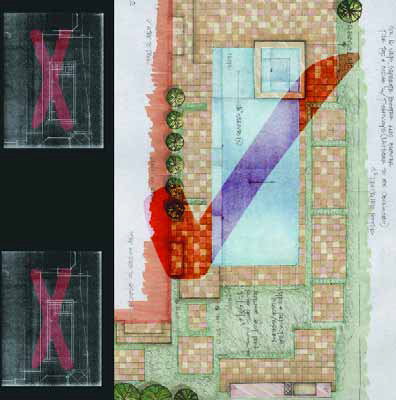
Where you've come from often has everything to do with where you're going. As a case in point, let me describe a project that had its origins all the way back at the very start of my work as a watershaper. My pool industry career began soon after I graduated from college. At the time, I was living in a garage in a rough part of Los Angeles and really wasn't sure what I wanted to do. I had studied ancient history, three-dimensional design and industrial design and had been accepted as a PhD candidate in pharmacology at the University of the Pacific. I was convinced I wanted to be a designer, but I wasn't sure which field I should enter. Then one day, at a time when I was about as broke as an organ grinder without a monkey, I answered an ad in the newspaper looking for



The Currency of Beauty