








drawing
I've never been big on trade shows and conferences. For years I have resisted them in the belief that they were mostly for those who had time to attend them and craved the camaraderie and social opportunities they offered. I've always looked at the programs and have seen that there's usually been something to learn during these events, but I brushed off the possibility of attending because I always thought I could get most of what I needed by working and paying attention to books and magazines. Also, there was always the issue that, as the sole provider in a one-person operation, spending so many days away from my clients and prospects would prove
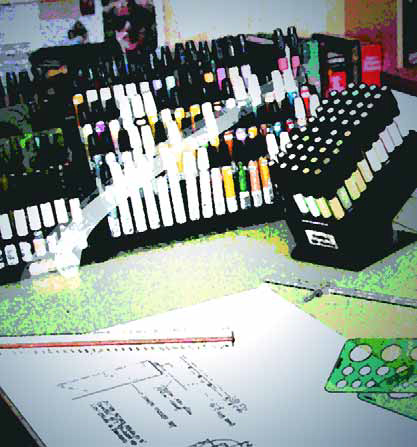
To my way of thinking, professional design work requires a professional workspace in which all of the necessary professional tools are available. In fact, for the designer creating custom watershapes, I see the space in which the work actually unfolds as being critical and cutting to the very heart of what it really means to be a "designer." I know that term is a loaded one, which is why I put it in quotation marks. After all, anyone can say that he or she is a designer, even if all they do is sit at a coffee table
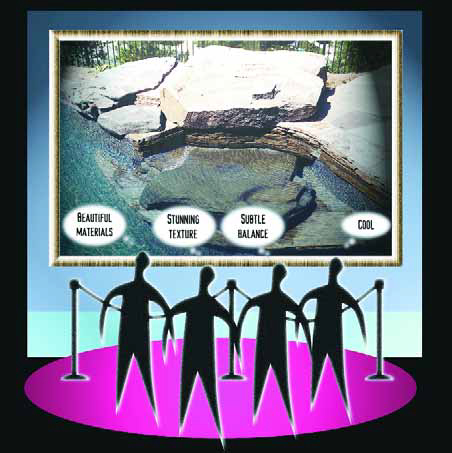
In one way or another, visual acceptance is what makes our world go around. Think about the clothes we wear, the cars we admire, the foods we eat - not to mention interior design, home and office furnishings, landscapes and watershapes. So much of our response to these and other features of our environment is based on the visual. It may sometimes be a shallow response, but human beings tend to like things that look good, even if they don't completely understand why some things are visually appealing and others are not. Design education teaches us that

For many people in the watershaping trades, client relationships begin with selling and never really advance beyond that stage. For me, however, it's not about selling per se; instead, it's about creating a sense of collaboration and building a foundation of mutual trust and understanding. In fact, the work I do in establishing these creative relationships with my clients may well be the most important "detail" of all. In a sense, watershaping isn't a job to me. It's my passion, which explains why I'm so obsessed with

People who know me are aware of the fact that I can be quite outspoken. They know I've been extremely critical of the pool and spa industry and have made it my crusade to argue that, as an industry, we need to elevate our game. My particular concern lately has to do with the areas of design and presentation. Before I get started, please note that what I'm about to say is directed mainly to readers who come to WaterShapes through what is traditionally labeled as the pool and spa industry. (To be sure, this information should also be of interest to those of you who come to watershaping from the landscape industry because it
I remember several years ago, back before it was really fashionable to build completely naturalistic pools, that I decided this was exactly what I wanted to do. This was in the very early 80s, when you'd see maybe some rocks on the bond beam or a waterfall on the end of the pool - but that was about as natural as it got back then. My new idea was to create environments that were completely natural, stem to stern. I tried presenting the concept to a number of potential clients, explaining how we could do things like angle the top of the pool and install rocks all around the edge and create natural

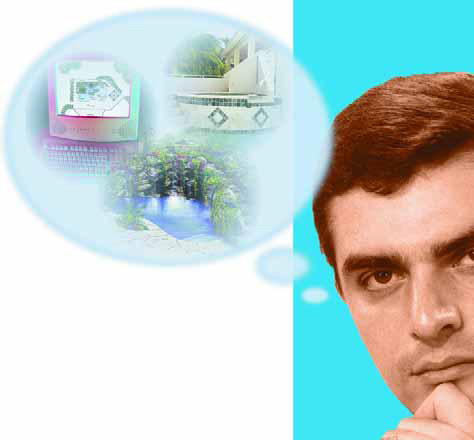
As watershapers, we can look at the rest of the architectural world and see that every other genre is benefiting more than we are from computers. Bridge builders and skyscraper architects use computers to do everything from the simulated testing of three-dimensional structural models to the generation of detailed blueprints to be used on site. Even the designers of modest housing developments are now using computers to conduct 3-D virtual tours for prospective homebuyers and in specifying floor plans and

Long before the Bobcats show up, most watershape designers will have used some sort of two-dimensional artwork to excavate their customers' imaginations. Perhaps it starts with old photographs in a portfolio, but it almost always ends up with new drawings that encourage precise, detailed communication between designer and client in a way that can never be fully achieved with verbal descriptions or written proposals. If done with appropriate detail and skill, a drawing gives designer and client the opportunity to explore the