








construction

Everything about this job was big: the budget, the number of watershapes, the upscale location and, especially, the customer's expectations. The owners, Town Realty of Milwaukee, envisioned their five watershapes as the key amenities for a new condominium development in Cocoa Beach, Fla., a signature element that would woo potential buyers who visited the 124-unit vacation complex. To reach that goal, their project team gathered aquatic experts from all over the Sunshine State to create the plans and specifications, supervise the bidding process, oversee construction and

By repeating something from one place in the yard to another, you tie everything together - and expand upon an idea that has already worked somewhere else in that yard. With landscaping, this doesn't always have to mean plants. When you find something that works and you like it, why not stick with it? Last month, I told you how we turned a small wasteland into an indoor oasis for one of my clients. When we were finished with the project, the clients were
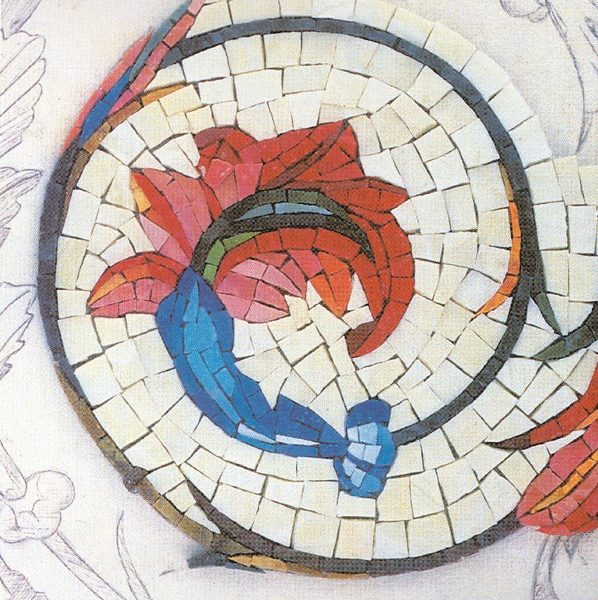
It's an art form that connects modern craftspeople to those of the distant past. In fact, the roots of mosaic tiling can be traced to Mesopotamia in the third millennium B.C., where temple walls were decorated with simple earthenware fragments. Centuries later, the ancient Greeks decorated their courtyards with large and small pebble mosaics, and sophisticated examples of mosaic work are found later in everything from Turkish mosques to Italian basilicas. The Romans, however, probably pushed mosaics about as far as any culture could in the first few centuries A.D. They adorned baths, pools, spas, floors and walls of important buildings as well as humbler residences with intricate mosaics made up of ceramic, stone, glass and marble. Recent years may have seen a revival of this ancient artistic technique, but as can be seen in the accompanying photographs, what many of today's designers are doing with classic forms is a real step forward - a departure from tradition that has made today's mosaics a thoroughly modern form of
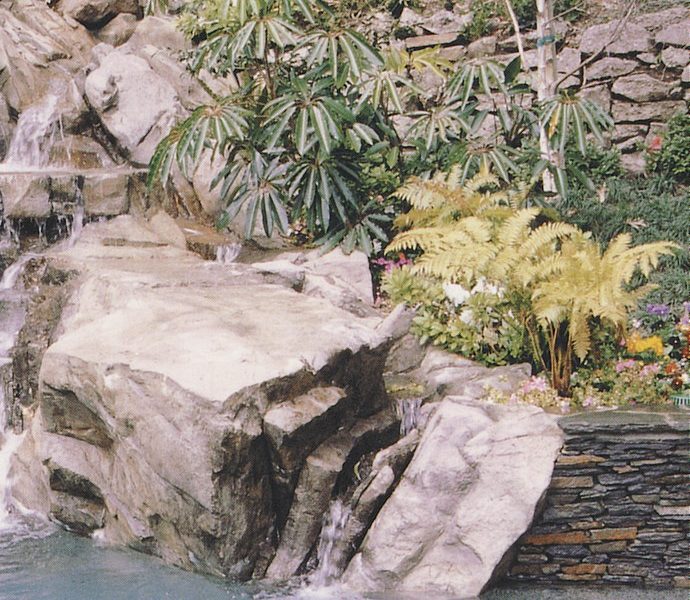
The most important use of faux rock is to make a geological statement - to provide an important accent or focal point in a landscape where none exists. My goal is to create rock formations that complement and enhance the natural setting and fit in harmoniously with their surroundings. That's a point builders who use artificial rock sometimes fail to grasp. They'll execute an ambitious scheme with lots of interesting, well-crafted rockwork, but it ultimately looks unnatural because the rocks they've created have no logical relationship to any indigenous formations or anything else in the surrounding space. I approach things in a different way - one that embraces the site and all of its features. I select, form and install faux rocks that, together, create interesting and beautiful statements in the overall landscape design. As I work, I make my installations to stand up to the question, "Is this rock formation

What do you do with a space that seems too small for a watershape and too small for plantings? The answer: Think small. You don't have to compromise on style or substance, but simply by thinking on a smaller scale, you'll open up a lot of possibilities you might not have considered. About three years ago, for example, I was brought in on a job to do a quick fix for a very small but prominent area of a client's yard. The homeowner wanted to completely rework the entire property, but it was clear there was a lot of other work to do first. The quick fix went very well and the clients were pleased, so they asked me to

Back in 1987 and particularly in California and Florida, the surfacing industry found itself in the middle of an unfortunate wave of plaster failures. Some people blamed the material, others blamed application techniques - and traces of the debate continue to this day. The situation was truly desperate in some areas, so much so that it drove many plasterers to seek new materials and techniques - anything to escape the cycle of negativity. Our firm in San Diego, for example, moved early and became the first in our county to apply exposed-aggregate finishes. Today, more than 80% of
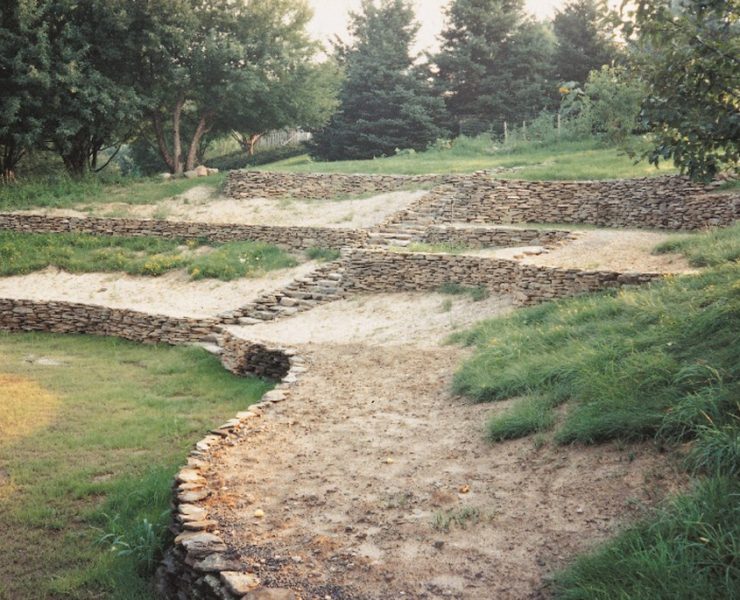
Retaining walls are used for one simple reason: to hold something back. Whether you need to terrace down to a lower yard, hold up a house on a hillside lot or provide a level area for watershape installation, these walls are indispensable when you lack the room needed to grade a sloped area gradually. Of course, this notion of holding back the forces of ground movement is no small challenge, and proper engineering and construction are critical. Do the job well, and a retaining wall will hold up indefinitely. But if you cut corners or

In conceptual terms, interactive fountains are really nothing new. In fact, fountains have featured water effects and sequencing lights since the turn of the 20th Century. What's emerged lately is a perception that these "dancing" waters are great sources of fun - a means for children to get soaked and for adults to stay dry and enjoy the show. This resurgence of interest has led designers and manufacturers to apply the knowledge and mechanics of the past in creating effects that delight the eye, capture the imagination and bring fun to

Not every upscale pool contractor has to be working with his or her own designs to be successful in building beautiful pools. Our company, for instance, has established its reputation by excelling at making the ideas of others come to life. Examples of this can be found in the work we did at One Ford Road, a development where we were asked to follow through on designs prepared by three of Southern California's best-known landscape architects. We've found here and elsewhere that when you work with highly creative people (including those who designed the pools, spas and waterfeatures pictured on these pages), the process can be truly rewarding, exciting and even



Designing a New Paradigm