







construction

As a designer, I've always sought out exceptional finish materials to use in my projects. My background is in fine arts, and I've worked in the design/build business for years, creating high-end exterior and interior spaces and taking pride in finding surfacing products that excite my clients and beautify the work. Operating in south Florida, however, I kept running into so many limitations on what was available that it had the effect of limiting my creativity. Natural stone can be hard to come by in adequate supply where I live, for instance, and as much as I like tile, it doesn't fill the bill for every job. Anything's available at a price, of course, but even

The resort opened in 1994 with completion of Phase I of a program that emerged once developer and entrepreneur Sol Kerzner bought the property from Merv Griffin in 1992. Phase II saw another round of construction that was opened to the public in 1998 - and ever since, Atlantis, Paradise Island, Bahamas, has been known around the world as a prime vacation spot for couples and families. The original pre-1992 property consisted of three buildings that had been built about 30 years previously along with one swimming pool and 27 tennis courts. Today, the facility occupies about 70% of Paradise Island's 826 acres on the northern edge of Nassau and is the unabashed expression of
The resort opened in 1994 with completion of Phase I of a program that emerged once developer and entrepreneur Sol Kerzner bought the property from Merv Griffin in 1992. Phase II saw another round of construction that was opened to the public in 1998 - and ever since, Atlantis, Paradise Island, Bahamas, has been known around the world as a prime vacation spot for couples and families. The original pre-1992 property consisted of three buildings that had been built about 30 years previously along with one swimming pool and 27 tennis courts. Today, the facility occupies about 70% of Paradise Island's 826 acres on the northern edge of Nassau and is the unabashed expression of

Water moving in all sorts of different directions (but always in controlled ways) is a hallmark of one our favorite designers, architect David Tardiff. We've built the watershapes for many of his projects, and we've particularly enjoyed those that put both his vigor and special subtlety on display. Time and again, his designs have challenged us technically while rewarding our clients with results that always seem to leave them proud, amazed and thoroughly satisfied. As we've discussed in our previous WaterShapes articles, a large part of our business is about executing watershapes for architects and landscape architects in the backyards of mostly affluent clients in southern California's Orange County. Each designer has his or her own creative style and sensibility, leaving us to adapt the work we do to their "idea sets" while lending our years of practical experience in engineering and construction to the process. In working this way, we find that everyone comes out a winner: The designer creates work that is based in reality; we stretch and expand our skills to realize truly spectacular design concepts; and most important, clients gain refined spaces that hit the mark with respect to both functionality and aesthetics. The two projects we'll visit on these pages are

Finding ways to blend the angular rhythms of modern architecture with the sweeping splendors of nature constitutes one of the more difficult challenges faced by today's watershapers. In the case of the project pictured on these pages, we were contacted in 2002 about an enormous, modern-style home on Mercer Island overlooking the shore of Lake Washington, right near Seattle. The property was being remodeled, and the owners wanted a set of watershapes that would enhance the beauty of the two-acre estate while more convincingly integrating the geometry of the structure with its woodsy lakefront setting. The solution: a set of watershapes that start near the house with perfect geometric forms that stick to the architect's original design, then moves down the hillside through various transitional stages to a pond feature that looks like part of
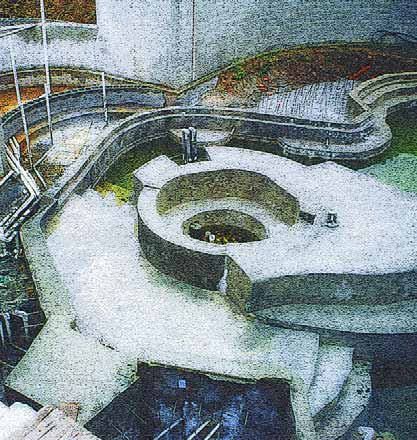
The project I've been working on in the hills outside Hanover, Pa., has just about every feature, bell and whistle one can imagine. That inclusiveness of detail at every level has translated to an unusually intricate construction process, as I mentioned last time in discussing the excavation, forming, plumbing and steel phases. Now we get to the gunite. Where a garden-variety backyard pool involves placement of maybe 30 to 50 yards of concrete and some larger projects may run in the 50-to-70-yard range (and where most of mine tend to fall in the 90-to-130 yard range) - this project needed two gunite rigs shooting for two solid days, 12 to 13 hours each day. The pool shell alone (excluding the waterfall, the grotto and several other features we'll get into later) required a staggering 300 yards of concrete. That's about

The combination of concrete and steel is the currency of most modern construction, and there's a simple economic explanation for that fact: The affordability and availability of the basic ingredients of cement, aggregate, water and rebar have made their combination viable for use in countries the world over. Used together, especially when the cementitious product comes in the form of pneumatically applied concrete, reinforced concrete is incredibly flexible and can be used to create almost any shape we might imagine. And in the case of pneumatic application, those shapes can largely be created without the use of traditional concrete forms. Indeed, it's a construction matrix that can be used in such a way that the contours of the soil dictate the shape of the structure, giving the watershaper almost unlimited flexibility. It's even fair to say that

Clear, polished water in well-designed, well-built lakes, ponds and streams: What better way to communicate a powerful message about the value of the properties that surround them? In a commercial setting, for example, clear water in a meandering string of ponds will readily translate into office space filled with happy tenants, while the murky-water alternative could be just the eyesore that holds down the image and limits the facility's financial success. The same principle works for watershapes at apartment complexes, where unseemly streams will almost certainly draw complaints from unhappy residents while cool, translucent water will become a point of pride and source of relaxation for tenants who otherwise might reflexively hold their noses as they pass by. Or consider the private estate where ponds are meant for swimming: Without question, these waters must have a crystalline clarity that attests to the water's safety and potential for recreation. Delivering this level of water quality is more and more a part of

Founded in 1634, Boston Common is the oldest public park in America - a significant and historic public place. It is familiar to us as Bostonians, of course, but we've also been privileged as a firm to have worked there before, when we renovated the park's main watershape, the Frog Pond, to serve as a splash pool in summer and as an ice-skating rink in winter. During the pond renovation, we learned that tackling projects in such storied surroundings can be a tall order. For example, we had to place all of the pond's chillers and pumping equipment underground to mask any obvious intrusion on the 17th-century space. As we approached a second major project - this time the renovation of the park's playground - we knew going in that those who hired us were keenly sensitive to the nature of the place and came armed with preconceptions about colors, images and what would be "appropriate" for the setting. To keep things moving, we worked very closely with the city's Historic Commission in establishing the color palette, procuring artwork and developing an overall plan that would result in a space that was attractive and safe for children and suited to the surroundings. To be sure, the negotiations were intense as we

Designing structures to surround indoor pools offers the watershaper the fundamental challenge of creating an interior space that needs all the functional characteristics of an exterior one. That's so mainly because ordinary residential structures aren't made to enclose anything that even remotely approaches the moisture levels encountered when an indoor pool is surrounded and separated from the open air. This leads to consideration of the air-handing, temperature-control and humidity-related issues covered in another article on this subject (click here), but it almost always leads as well to a need to