








construction
Watershaping advanced by leaps and bounds from 1999 through 2004 – a journey of artistry…

Watershaping advanced by leaps and bounds from 1999 through 2004 – a journey of artistry…

Watershaping advanced by leaps and bounds from 1999 through 2004 – a journey of artistry…

Watershaping advanced by leaps and bounds from 1999 through 2004 – a journey of artistry…

Watershaping advanced by leaps and bounds from 1999 through 2004 – a journey of artistry…

So often, design comes down to an ability to see patterns. I first learned this from my mother, a dressmaker who had an uncanny ability to look at garments for which there were no sewing patterns and then sit down and make them from scratch. I seem to have inherited this talent, taking in a barren landscape and quickly visualizing how it will look with plants, rocks and water. For this, I am happily in her debt. Not everyone comes across such a gift by birth, but I believe that the ability to visualize is something most any watershaper can develop through experience and by taking the time to learn the "language" of any

I've been playing with clay for a long time - ever since 1968, when I took my first ceramics class in high school. Clay has captured my imagination mainly with its flexibility: I can carve it, build with it and even color it. For years, I've sculpted pieces of tile out of stoneware and porcelain clay. The individual pieces are then combined to create mosaic compositions, which, among other things, means that I'm able to create works of art that can go just about anywhere and are especially at home in and around water. Now, more than 30 years into working with this wonderful medium as a potter, then as an art student in the United States and Italy and especially in

Finishing up a project of any size is all about the details. From the final touches on the artificial rockwork and the placing and adjusting of lights to the fine tuning of the circulation system and signing off on the equipment room, the art of fine watershaping ultimately boils down to applying the same stringent standards for excellence that you bring to the beginning and middle of the project straight through to the end. Of course, it's virtually impossible to complete a project of this magnitude without

Recently, I've been involved in the early stages of a project that has lent new meaning to the phrase, "seeing is believing." It came up as a result of a call from an agent for a well-heeled client who was interested in having me design and build a residential swimming pool in the Dallas/Fort Worth area. When I arrived in Texas, I was met by the owner's agent, David, and by Marcus Bowen, a landscape architect who was part of the large project team, which, I would learn, included architects, a landscape architect, an interior designer, a lighting designer, various engineers, numerous
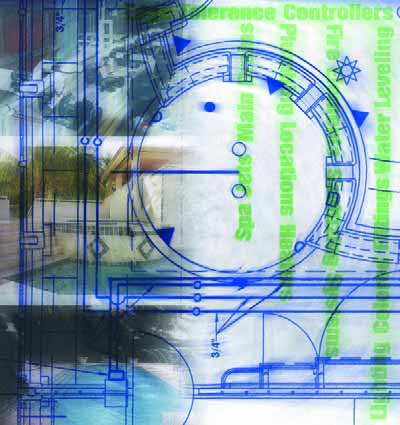
I operate under the hopeful assumption that all professional watershapers know that detailed, quality construction plans are crucial to the success of any project. Too often, however, I get the unsettling feeling that some contractors in the watershaping trades see plan documents mainly as a means of securing a construction permit. Such a bare-minimum approach can lead to an endless array of problems that can be summed up simply: Plans lacking in detail leave way too many issues to chance and inevitably lead to mistakes. And because we all work in a field where things are quite literally