







construction

All projects come to an end, of course, but there are times when the inevitable takes its own, sweet time. The project featured here, for example, took more than six years from the time I first met the clients until we wrapped things up. Unlike some projects that take a long time because of ongoing problems, change orders and difficult challenges, this one was very much a labor of love from start to finish. Sure, there were some tough spots, but for the most part, this was one of those jobs that we watershapers and landscape professionals can only hope will come along from time to time - projects we don't mind extending through a period of years. This one had everything going for it, starting with great clients who had the resources to do something special as well as playful, fun-loving personalities that made the process exciting and rewarding. Then there was the property: an acre of ocean-view hillside in Brentwood, Calif., with mature trees and a big, Cape Cod-style house that was going through extensive remodeling during the time we were involved with the landscape. The clients wanted something that was elegant but playful, with formal lines and structures but a light overall touch. They insisted on beautiful materials, were heavily involved in every decision and, ultimately, had our firm, New Leaf Landscape of Agoura Hills, Calif., work with

Creating watershapes and landscapes that are natural in appearance is always a challenge, says Ken Alperstein of Pinnacle Design, a firm that specializes in high-end projects related to top-flight golf courses. For this project in Shady Canyon, however, the ante was upped considerably by the site's location in an environmentally sensitive coastal canyon in southern California - a design challenge intensified by regulatory scrutiny every step of the way. It was a job that forced everyone involved to be on exactly the same page at all times. The landscapes and watershapes at the Shady Canyon Golf Club in Irvine, Calif., were developed by the Irvine Company as the heart of an upscale residential community. The wilderness area set aside for the course and its immediate surroundings had a subtle, bucolic charm all its own - a character the design team needed to
Many of the projects I tackle are largely about beauty and elegance and striking just the right balances between my watershaping and the setting, the architecture of the home and the character of my clients. In the case of the project depicted here, however, a couple of other considerations jumped into the mix - including impulses for fun and excitement as well as an overriding need to raise the visual energy level to align with the clients' personalities and a glorious setting. The result is an exquisitely adorned watershape that stands as one of the purest expressions of whimsy and unbridled joy I've ever produced. Truly, it all flowed from the clients and the setting. The clients are quite educated, well-traveled and sophisticated and had both the resources and the desire to do something special. Moreover, they're about as nice a couple as you could ever hope to meet and had refined tastes to match. As for the setting, we're talking beauty in the extreme: The home is a modern masterpiece perched atop a bluff in Malibu, Calif., with 180-degree ocean views and spectacular distant vistas. The only clinker on the property was the existing pool and the surrounding decks - an aggressively plain, kidney-shaped drag surrounded by equally boring decks. It was time for

There are some things that are better seen than described. In the case of pool and spa equipment, for example, there are situations in which manufacturer instructions or two-dimensional plan drawings simply do not give the installer all the information needed to get things right the first time. As a result - and as everyone who installs equipment sets knows - the plumbing and layout of the equipment usually requires some level of on-site improvisation. In our work of designing hydraulic systems for complex watershapes - everything from commercial pool facilities to interactive waterfeatures and fountains - we've seen the need to find a way to specify precisely how we want our equipment sets to be installed. No two-dimensional plumbing schematic or manufacturer-supplied manual does that part of the job. That is, they do not completely delineate the way

Whether we function as designers or builders or both, we watershapers tend to be flexible folk: We mold ourselves to projects and situations and tasks when we're called on to apply our skills and experience, and this often leads us to perform in unanticipated ways. This sort of adaptability is a way of life for most of us: It's a talent we use to produce success. But even the most adaptable practitioners of the watershaping arts will, every once in a while, encounter a project that shocks the system, alters all formulas and breaks down familiar parameters. In these rare cases, just surviving the process is an accomplishment that brings a sense of relief as well as a sense of amazement that both you and the project made it through to completion. I was recently fortunate enough to be part of just such a project - a fascinating set of challenges now known as the Smithsonian Institution's National Museum of the American Indian in Washington, D.C. It's the last museum that will be
With some details, seeing is believing. That's certainly the case with the one we'll consider in this column, where the images will do much of the work in defining a simple but elegant way of making a statement with any raised bond beam or wall. Yet again, it's testimonial to the good things that happen when watershapers know how to control materials and infuse their work with visual appeal. Most of the time when pool people build small or medium-size walls, they'll automatically be topped with some form of coping or capstone - anything from poured-in-place concrete or stone to brick or some pre-fabricated coping. Many of these walls are

From the grandest waterfall to the smallest courtyard fountain, water flowing over an edge is one of the most compelling of all watershaping “looks.” Whether it’s a vanishing edge or a slot overflow or a trough, runnel or waterfall, these effects all use one common concept – that is, the weir. Simply defined, a weir is a barrier or dam placed in a channel behind which fluid backs up and then falls through a notch and down the face of the weir. In most watershaping applications, water travels over the weir’s edge or brink and into some kind of lower basin, trough or pool. Physically and visually, these systems are driven by

With few exceptions, the most satisfying projects we've undertaken through the years have come when our company has gotten involved with talented architects or landscape architects - and sometimes both - as part of larger project teams. We embrace this sort of work and enjoy taking a role as a resource for other professionals. Through the years, in fact, these collaborations have developed to a point where many of those we work with will automatically call us whenever one of their projects includes any sort of

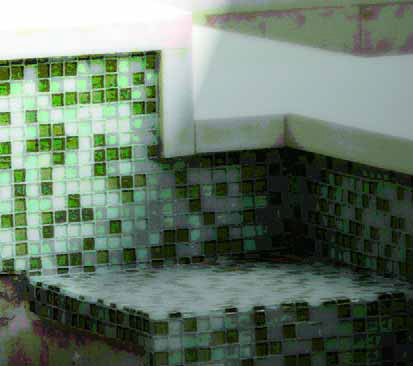
When I first entered the watershaping industry in the late 1970s, one of the details to which I took an immediate dislike was the practice of wrapping the tile that covered the walls of raised bond beams around the corner and onto step risers and various other vertical hardscape surfaces found around pools and spas. We've all seen it - Spanish Colonial Revivalist tiles of questionable authenticity, extra-bold in color and used to cover highly visible vertical surfaces. To me, these swaths invariably look out of place and have the effect of drawing attention to features that often don't warrant or benefit from the emphasis. It happens to this day because
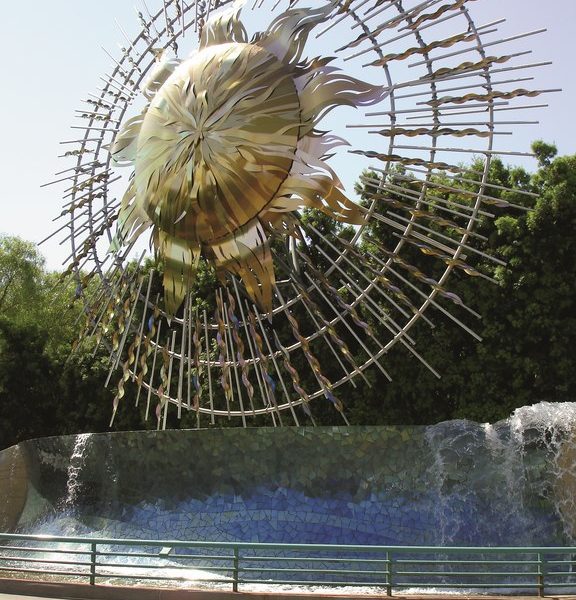
Sometimes you just know that a client is going to want something special - something nobody else has. I can think of no other entity that better fills that bill than the Walt Disney Co. Justly famed for its remarkable creativity, spirit of innovation and ultra-high standards for design and execution, I knew going in that working with this amazing organization would mean coming to the table with strong ideas, supreme self-confidence and a demonstrated willingness to test boundaries and perform beyond expectations. Our firm, Captured Sea of Sunset Beach, Calif., was founded with those exact qualities in mind and a mission to create fountain systems throughout southern California that are distinctive, unique in concept, superbly engineered and built to last. Through the past eight years, we've been fortunate to tackle several projects for Disney in southern California. In each case, they were looking for watershapes that would delight visitors while enduring the rigors of heavy-duty use and near-constant operation. The call about the fountain featured in this article came in late summer 1999 from Glendale, Calif.-based Walt Disney Imagineering (WDI), the remarkable division of the company responsible for designing its theme parks and attractions. They told us that they were