








construction
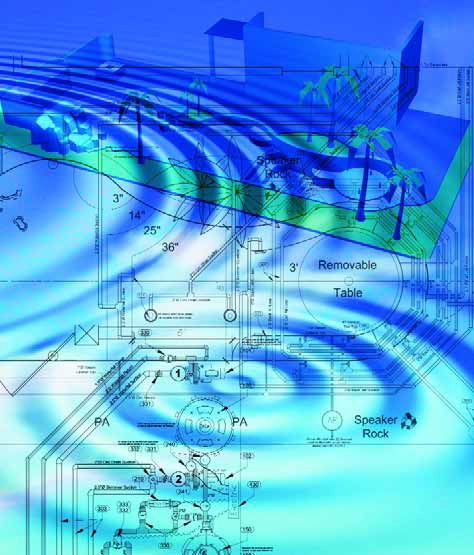
Why isn't the appropriate use of water a defining, central component in the education of landscape architects? That question has rattled around in my head for a long, long time, basically because it has no adequate or satisfactory answer. I'm a trained landscape architect and, as luck would have it, for nearly 20 years I've had one foot in the pool industry and the other in landscape architecture - and I've always felt like a rare beast moving back and forth between two entirely separate worlds. As I see it, this lack of affinity between these water-related industries has been a limiting factor in the advancement of the watershaping trades. For me, the lack of connection has always seemed nonsensical when it hasn't seemed tragic. As a watershaper, a big part of my work in recent years has been seeking ways to combine the best of both worlds and share what I know with university-level students in landscape architecture departments - students whose chairs I occupied some years ago and who still stand a good chance of graduating without ever having been taught anything at all about how water can

When I sit down with clients for our first face-to-face meeting, we discuss a range of issues that will guide me when I return to my studio and get down to designing a watershape and surrounding areas for them. We'll talk about colors, materials, the location of the pool, their preferences in art, the way they entertain and, perhaps most important of all, how they plan to use their backyard and swimming pool. Let's focus on that last point: When we talk about how a pool is going to be used, what I really want to know is how it will be used on a daily or weekly basis (for swimming, exercise, play or simply as a visual), not how it's going to be used once or twice each year when they throw a big pool party. My thought is that these clients will
When I sit down with clients for our first face-to-face meeting, we discuss a range of issues that will guide me when I return to my studio and get down to designing a watershape and surrounding areas for them. We'll talk about colors, materials, the location of the pool, their preferences in art, the way they entertain and, perhaps most important of all, how they plan to use their backyard and swimming pool. Let's focus on that last point: When we talk about how a pool is going to be used, what I really want to know is how it will be used on a daily or weekly basis (for swimming, exercise, play or simply as a visual), not how it's going to be used once or twice each year when they throw a big pool party. My thought is that these clients will

When I was a kid, the conventional part of my education in environmental design came in helping my father, Jay Stang, plant parkways and blocks of Pinus Pinea across the city. The unconventional part - the part that apparently took firmer root as I grew up - had me admiring the plate he'd made from hardwood with the dozen split avocado pits he'd carved and mounted on the surface; it also had me listening to my mother, Judy Campbell, tell me that the earth was here first, that the garden already exists and that pathways, watershapes and structures are best built around what we find there. Those unconventional lessons - one about creativity and vision, the other about respect for nature and a method for approaching it - have stayed with me through the years and have given me access to a number of incredible projects. As is the case with most intriguing and fascinating designs, the one seen here flowed from a client with whom I developed a close creative connection that resulted in a free exchange of ideas¬ - a synchronized spontaneity that became a pattern for the entire design process. She always had strong thoughts about what she wanted, but she allowed me to interpret and express her ideas based on our conversations and the nature of the site. As designers, it's not unusual for us to be called on to use our skills and figure out what a client such as this one really wants and then suggest ideas we think will work. I call this process "environmental psychiatry" because, while so many clients have a sense of what they want and a laundry list of general ideas, few have a
When I was a kid, the conventional part of my education in environmental design came in helping my father, Jay Stang, plant parkways and blocks of Pinus Pinea across the city. The unconventional part - the part that apparently took firmer root as I grew up - had me admiring the plate he'd made from hardwood with the dozen split avocado pits he'd carved and mounted on the surface; it also had me listening to my mother, Judy Campbell, tell me that the earth was here first, that the garden already exists and that pathways, watershapes and structures are best built around what we find there. Those unconventional lessons - one about creativity and vision, the other about respect for nature and a method for approaching it - have stayed with me through the years and have given me access to a number of incredible projects. As is the case with most intriguing and fascinating designs, the one seen here flowed from a client with whom I developed a close creative connection that resulted in a free exchange of ideas¬ - a synchronized spontaneity that became a pattern for the entire design process. She always had strong thoughts about what she wanted, but she allowed me to interpret and express her ideas based on our conversations and the nature of the site. As designers, it's not unusual for us to be called on to use our skills and figure out what a client such as this one really wants and then suggest ideas we think will work. I call this process "environmental psychiatry" because, while so many clients have a sense of what they want and a laundry list of general ideas, few have a

As custom watershapers, we all know that each combination of client and project presents a unique profile with respect to scope, design goals and the overall mission. In the project seen here, however, that common formulation was elevated by virtue of the fact that we were working with an accomplished architect on what was to be his own home. He came to the table with strong, distinct ideas about style and project direction, but he was also willing to collaborate with us when it came to the details and practicalities of developing a watershape composition that suited both his needs and a spectacular setting. The property - a gently sloping two-acre lot - is located in an exclusive neighborhood in San Marino, Calif., and our work there took place in concert with construction of a gorgeous new home in a classic Mediterranean style. My company, Arcadia Pools & Spas of Arcadia, Calif., had worked with the architect before on a fountain for a commercial property, so we
As custom watershapers, we all know that each combination of client and project presents a unique profile with respect to scope, design goals and the overall mission. In the project seen here, however, that common formulation was elevated by virtue of the fact that we were working with an accomplished architect on what was to be his own home. He came to the table with strong, distinct ideas about style and project direction, but he was also willing to collaborate with us when it came to the details and practicalities of developing a watershape composition that suited both his needs and a spectacular setting. The property - a gently sloping two-acre lot - is located in an exclusive neighborhood in San Marino, Calif., and our work there took place in concert with construction of a gorgeous new home in a classic Mediterranean style. My company, Arcadia Pools & Spas of Arcadia, Calif., had worked with the architect before on a fountain for a commercial property, so we

If you've been involved in major construction projects - initial work or renovations - chances are good that you've come across the need for retaining walls. In many cases, even the simple leveling of a site will require some type of retaining structure to hold back the soil - whether you're cutting fill out and need to support the slope that remains or filling an area and need to keep the new material from washing away. No matter what site we're talking about, retaining walls have one purpose: to hold something back. Whether you need to terrace a sloped yard, hold up a parking lot or

Through the years in these pages and elsewhere, I've been a persistent critic of the shortcomings of the watershaping trades in general - and especially of the pool and spa industry in which I've operated for more than 25 years. Sometimes I've been harsher than others, but my intent has invariably been to define the difference between quality work that elevates the trade and the junk that's held back our industry's reputation. I've never named names, but I've been particularly hard on practitioners who seem eternally stuck in old ways of thinking and working: Their work seldom lines up with the best efforts of which the industry is capable. Just recently, I had a long talk with WaterShapes' editor in which we discussed the development of a new approach to
Through the years in these pages and elsewhere, I've been a persistent critic of the shortcomings of the watershaping trades in general - and especially of the pool and spa industry in which I've operated for more than 25 years. Sometimes I've been harsher than others, but my intent has invariably been to define the difference between quality work that elevates the trade and the junk that's held back our industry's reputation. I've never named names, but I've been particularly hard on practitioners who seem eternally stuck in old ways of thinking and working: Their work seldom lines up with the best efforts of which the industry is capable. Just recently, I had a long talk with WaterShapes' editor in which we discussed the development of a new approach to