


Travelogues & History

Some fountains are great because they are aesthetically amazing; others are on the less-spectacular side but have great stories or commemorate worthy persons or events. Happily, still other fountains deliver the whole package: They are beautiful to behold and intricately woven into their local histories and cultures.
One watershape in that special third category is the Nicholas J. Melas Centennial Fountain in Chicago. It celebrates the lifetime achievements of its namesake, who, for 30 years from 1962 on, was a commissioner on the board of the Metropolitan Water Reclamation District of Chicago - a man doubtless worthy of the honor.
But what's cooler in my book is the Centennial part of the fountain's nomenclature: It was commissioned on the Chicago River in 1989 to celebrate the 100th anniversary of a government agency whose single greatest achievement was, around 1900, reversing the flow of the Chicago River: They turned it around to keep it from flowing into and polluting the city's Lake Michigan water supply.
Today this all sounds like ecological blasphemy, but before the water district accomplished this clever engineering feat, waterborne diseases including typhoid and cholera ravaged the population whenever the river ran high enough to flush its burden of pollution into the lake. As the historic summary linked below indicates, Chicago as we know it might not exist had this problem not been so thoughtfully addressed.
I love the fountain's rich backstory - and the way it looks, too. Designed by Lohan Associates of Chicago (now Lohan Anderson), the stacked, stepped style perfectly befits the Modernism that is so much a part of downtown Chicago's look and appeal. The composition also includes a water cannon that shoots an eight-story-high arc of water across the river - a spectacular display that (Chicago's famous winds permitting!) shoots on the hour for ten-minute stretches.
There's so much to see in Chicago - and so much of it has to do with water - that every watershaper should visit the city, probably more than once, in the course of a professional lifetime. Please do add this wonderful fountain to your itinerary the next time you go!
For a bit of Chicago River history, click here. For a brief video that shows the fountain and water cannon in action, click here.

It's been a number of years since I've managed to visit Chicago, but I want to get back sometime soon. After all, I have yet to see the Crown Fountain in person (let alone the rest of Millennium Park), and I haven't visited the Chicago Botanic Garden in more than 30 years! The last time I was in the Windy City with any time to spare, it was 2002 and I was attending

As mentioned previously, I've traveled to Seattle with fair frequency through the past few years. Mostly I'm there to visit my mother on Bainbridge Island, but I've also given myself enough time to explore the area that I almost know my way around the city and its many public watershapes. On one trip a couple years back, I took the usual ferry ride from the island back to Seattle on my way to the airport, arriving in plenty of time for a leisurely stroll from the boat terminal to the metro station a few blocks away. My semi-roundabout path took me right by Pioneer Square, a place

I hesitated in starting the New Year with a Travelogue about a class of watershape that is located beyond easy reach of most readers and is, in addition, one I've never seen personally. But I ran across a reference to these structures a couple days ago, and I just can't get them out of my mind.
Many times in the past, WaterShapes has mentioned the fact that, hundreds of years ago, Islamic architects used fountains and runnels of moving water as air-conditioning systems in enclosed spaces (the Alhambra in Moorish Spain being the usual example). Hundreds of years before that, it seems, Indian architects achieved a similar effect with what they called baolis, or step wells.
For starters, I was a bit startled to find an approach to watershaping I'd never encountered before - but what truly blew my mind was the scale of these structures and the attention their designers paid to the aesthetics of what is basically a utilitarian water source. Indeed, step wells are literally that: structures in which water is reached by descending sets of steps. Found most often in western India, they also were built in other places in southern Asia as well as Pakistan.
Basically, they serve as graduated storage tanks that enabled communities to cope with seasonal changes in water availability: They filled with ground- or well water during the rainy season and were drawn down when the dry, hot weather returned each year. Unlike a classic western fountainhead, which gave a few people access to the water at a time, some of these step wells are huge and clearly enabled whole communities of people (and sometimes their animals) to get at the water at the same time.
and there was more even in hot weather, the body of water pit well cooled air, so grand watershapes became social hubs places to beat heat commune with friends, family acquaintances an office cooler on a scale.
The only similar structure I've seen in the United States is the Fort Worth Water Gardens, which I wrote about in the January 25, 2012 edition of this newsletter (click here). But Philip Johnson's project featured cascading water, which is distinctly something a classic step well didn't offer.
In any case, this is special watershaping - on the level of the Roman aqueducts in terms of importance to their communities. I hope you enjoy this introduction and, like me, think these places might be worth a road trip.
To see the brief video that introduced me to these amazing watershapes, click here - and do what you can to ignore the narrator's attempts at humor. And if you want more information, click here to see an unusually helpful Wikipedia trove of information and images.dsc+
desce
///>/</
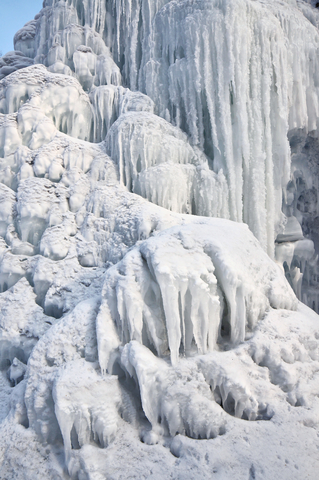
The cold snap that gripped huge parts of the country earlier this month put me in mind of one of my favorite things - and I feel deprived, because I've never lived in a place where such things happen. Back in 1984, Judy and I took a train trip across Canada from Vancouver to Banff. It was November and brutally cold by the time we reached our destination, but we braved the wind and snow to do a bit of hiking in the beautiful terrain near Lake Louise - just breathtaking, both literally and figuratively. While walking along a stream, we came across a cascade that started about ten feet over our heads. It had frozen over for the most part, and I recall the hollow resonance of the water flowing rapidly behind the waterfall's blue-white armor - a sound I've never forgotten. But the visual effect! I've always been a big fan of the Catalonian architect Antoni Gaudí, and there's something about the
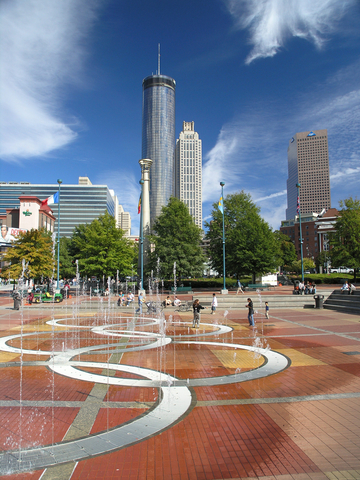
Business and pleasure have carried me to Atlanta more times than I can count through the past 30 years. On many of those occasions, I attended trade shows in the Georgia World Congress Center and found myself with enough time on my hands that I was able to enjoy Centennial Park, where people from all over the world once gathered to celebrate the Olympic Games of 1996. I'd seen this area before the Olympiad, and I must say that the degree to which the city remade itself to host this international showcase event is truly remarkable. Particularly welcomed is the abovementioned Centennial Park, a broad, open space that I've strolled through often enough that it feels a bit like home. I am persistently intrigued by the Fountain of Rings, the park's big, interactive waterfeature. Lots of times, I've seen the fountain teeming with kids running wild through varied jets of water, but on several occasions the timing's been right and I've caught one of the choreographed shows set to music of many descriptions. This fountain, some say, is the precursor to
Business and pleasure have carried me to Atlanta more times than I can count through the past 30 years. On many of those occasions, I attended trade shows in the Georgia World Congress Center and found myself with enough time on my hands that I was able to enjoy Centennial Park, where people from all over the world once gathered to celebrate the Olympic Games of 1996. I'd seen this area before the Olympiad, and I must say that the degree to which the city remade itself to host this international showcase event is truly remarkable. Particularly welcomed is the abovementioned Centennial Park, a broad, open space that I've strolled through often enough that it feels a bit like home. I am persistently intrigued by the Fountain of Rings, the park's big, interactive waterfeature. Lots of times, I've seen the fountain teeming with kids running wild through varied jets of water, but on several occasions the timing's been right and I've caught one of the choreographed shows set to music of many descriptions. This fountain, some say, is the precursor to
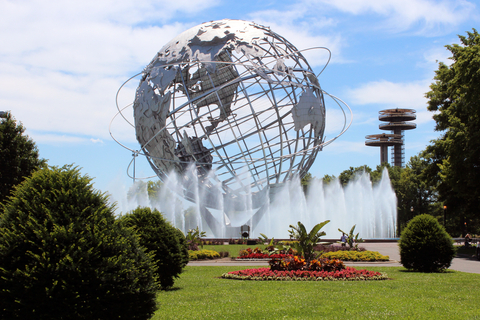
I started to appreciate the fact that my Aunt Genevieve was one of the coolest women in the whole wide world in the Spring of 1964. In the days just after the New York World's Fair opened that April - while the networks and newspapers were still agog about one pavilion or another and how amazing the whole scene was - she sent a small package to me in California containing an embossed, gold-leafed invitation, a fair ticket and a keychain with a medal depicting the Unisphere attached to it. Even at eight years old, I knew my aunt was
I started to appreciate the fact that my Aunt Genevieve was one of the coolest women in the whole wide world in the Spring of 1964. In the days just after the New York World's Fair opened that April - while the networks and newspapers were still agog about one pavilion or another and how amazing the whole scene was - she sent a small package to me in California containing an embossed, gold-leafed invitation, a fair ticket and a keychain with a medal depicting the Unisphere attached to it. Even at eight years old, I knew my aunt was

I’ve been a student of California history for many years – and particularly of its water history. I was hooked as far back as the sixth grade, when I wrote a big report on the California Water Project and how we were, in the 1960s, just beginning to move water from the Feather River in northern California and feed it by circuitous means to