







textures

In most projects, great work requires the watershaper's personal understanding of who the clients really are, deep down. That doesn't mean we have to become our clients' best friends or marry into their families. Rather, creating watershapes at the highest level involves a different kind of relationship, one in which a shared vocabulary and common vision develop through discussions of water, stone, art, plants and the orchestration and staging of experiences that will occur in given spaces. Take the project covered here as an example: The scope of the work, an unlimited budget and a mandate for the highest possible levels of quality were enough on their own to force us to explore the limits of our skills and creativity. More important from our perspective, however, is that we

The history of residential architecture took a real turn toward mass production with the emergence of the modern suburb early in the 20th Century. Especially in the years after World War II, middleclass families increasingly left urban congestion behind and headed for open outlying areas where developers were hard at work in preparation for their arrival. Some developers put distinct stylistic stamps on the neighborhoods and communities they were building. Among the most popular and recognizable of these styles was the Spanish Colonial Revival - a look that has special prominence on the West Coast but that has surfaced throughout the United States and in places as far flung as Europe and China. This style is so popular and has been used so much in so many variations that it is, these days, tough to nail down exactly what is or is not true to early Spanish Colonial motifs and ideas. That's not surprising, because this malleable style itself represents a cobbling together of ideas borrowed from Roman, Islamic and even Native American cultures. Those deep roots, coupled with a scattering of design focus that has blurred borders and distinctions and any sense of stylistic purity, makes it tough for 21st-century watershapers and other designers to

When we first began collaborating on projects with top-flight architects, landscape architects and landscape designers several years ago, for the most part our role in terms of design was fairly limited: We'd receive requests for bids and proposals based on plans of varying detail, and our role was that of faithful installers of the design. On occasions, of course, we'd also refer our own prospective clients to those same designers, who would generate plans that we would in turn estimate and very often install. We still work that way, but as we've built our ties to these accomplished artists, we've become aware that our role in their projects has been growing, even to the point where we are now being asked in many situations to offer our own design ideas. We're also seeing that, when on-site decisions must be made, these designers are

Water moving in all sorts of different directions (but always in controlled ways) is a hallmark of one our favorite designers, architect David Tardiff. We've built the watershapes for many of his projects, and we've particularly enjoyed those that put both his vigor and special subtlety on display. Time and again, his designs have challenged us technically while rewarding our clients with results that always seem to leave them proud, amazed and thoroughly satisfied. As we've discussed in our previous WaterShapes articles, a large part of our business is about executing watershapes for architects and landscape architects in the backyards of mostly affluent clients in southern California's Orange County. Each designer has his or her own creative style and sensibility, leaving us to adapt the work we do to their "idea sets" while lending our years of practical experience in engineering and construction to the process. In working this way, we find that everyone comes out a winner: The designer creates work that is based in reality; we stretch and expand our skills to realize truly spectacular design concepts; and most important, clients gain refined spaces that hit the mark with respect to both functionality and aesthetics. The two projects we'll visit on these pages are
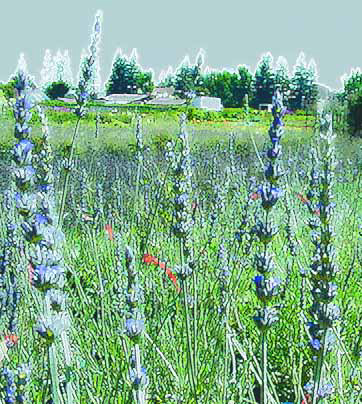
Few plants have been written about, lingered over and so passionately associated with fragrance, healing and serenity as lavender. Beyond stunning beauty of the sort seen in the vast purple fields of Provence, lavender has spread worldwide, leaving a trail of exquisite aroma and touching everything from our imaginations to our health. Some say lavender has pain-killing, antiseptic and skin-rejuvenating properties and that it's great for toning skin, fighting acne and soothing burns and cuts. This versatile plant is used as well to infuse perfumes, oils and soaps, and I know from my own experience that it makes a great marinade for lamb and adds
If you can't see potential in every backyard you walk into, then you're in the wrong business. Yes, some projects are more inspiring than others, and some spaces seem to offer you more to work with than others. Without exception, however, our clients' yards present us with opportunities to develop programs that take advantage of what's there in ways that bring balance and harmony and interest to any setting. Speaking for myself, I'm no more energized in a project than when I get the opportunity to right a wrong and replace a past mistake with a fresh, interesting design - and that was certainly the case in the project discussed in this article and in my past several "Details" columns in this magazine. The setting was special, the clients were great and I was given free rein to work with color, shape and line in vivid, interesting and even startling ways - all in keeping with their wants and desires. SETTING THE SCENE To recap information from recent "Details," this pool/spa combination with its associated decking, walls, planters, outdoor cooking facilities and private garden area are located in a narrow yard at the base of a slope in Pacific Palisades, Calif. It's a spectacular

The Getty Center is a true multi-media experience: imposing architecture, lots of people, incredible materials of construction, amazing views, diverse spaces, rich and varied sounds - and it's mostly all a bonus, because none of this has much to do with the Los Angeles center's core functions as museum and research institution. Designed by architect Richard Meier, the 750-acre campus is dominated by outsized structures wrapped in travertine, glass and enameled aluminum. It's all a bit cold (maybe time will soften the sharper edges and
In February 1999, the cover photo on the premiere issue of WaterShapes showed a steel cage for a subgrade piling being lowered into the ground. That image was taken from a feature article by designer/builder David Tisherman, the first of many that he has contributed to the magazine. In that article and in another that followed in April 1999, he detailed the design and construction of an elaborate residential swimming pool project that he