







fountain

I like a good challenge in my work, and I like to have fun making it happen. This project embodied the best of both experiences. The project displayed on these pages was built for a wealthy client who lives on a working horse ranch in the rolling green countryside near Ocala, Fla. Our company, Certified Construction, was up to the task. We build hundreds of highly customized watershapes each year for a variety of theme parks, resorts and high-end residences. Most have highly developed "themes," so we're accustomed to providing our clients with heavy doses of imagination and creativity. The basic marching orders on this job were straightforward: The owner wanted a theme park on his property for his kids - and he didn't really care about

At our firm, we treat every project and every customer as if they're one of a kind - which in truth they are. And we've been lucky in developing a high-end clientele that, on the whole, is looking for something special: They enable us to treat each project as an individual work of art; at the same time, they challenge us to stretch our own abilities and increase the variety of design solutions we bring to the drafting table. In many cases, this requires something of balancing act between what clients think they're after and the practicalities of the site itself, the architecture of adjoining structures and the views of surrounding areas. For that reason, each of our
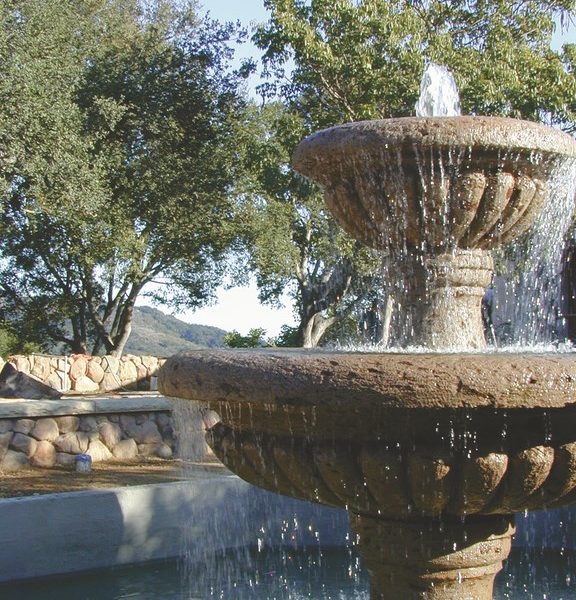
Montecito is home some of the grandest estates on the West Coast, but relatively few people know about it or where it is. A sleepy little town, it lies several miles east of Santa Barbara and some 80 miles or so northwest of Los Angeles. From the beautiful hilltop estates that dot the landscape, you can see Santa Barbara's wharf and downtown in the foreground, with sweeping vistas of the Pacific Ocean dominating the horizon. The big ranches of Montecito are dotted with hundreds of watershapes inspired by the Spanish-Colonial and Moorish architecture that surround them. Most were installed as part of the Spanish Revival movement that took hold among architects and landscape designers all over California through the first half of the 20th Century. The revivalists' octagonal and quatrefoil fountains and courtyards provide a visual link to the state's Spanish heritage. Fueled by the explosion of Hollywood's movie industry during this time, the combination of money, lots of open land and a popular architectural style resulted in creation of some of the most beautiful estates anywhere in the world - none more so than a property named Cima del Mundo, Spanish for

Through all the centuries of watershape design, the laws of physics have imposed restrictions on the watershaper's ability to extend a laminar flow of sheeting water beyond a drop of five or six feet. Go much beyond that limit and the sheet breaks up, thus impairing the aesthetic effect, causing an annoying degree of splashing and generating an abundance of undesirable, monotonous noise. Those physical laws have been seriously bent in public spaces in recent times. Indeed, special weirs and nozzles have made it possible to achieve laminar flows of 12 feet or more. Up until now, the solutions employed to achieve these effects have usually been beyond the budget of smaller commercial projects or residential clients - but that's changing. At my firm, Crystal Fountains, we've long been studying the phenomenon of falling water with an eye toward maximizing the surface tension of water and thereby extending the "laminar" effect without breaking the bank. We've had the luxury of working on some high-end projects that enabled us to perform the research and development necessary to do that stretching. By adapting some of the design ideas we

As the watershaping industry gets more involved with naturalistic bodies of water - particularly large ponds, lakes and streams intended to harbor life in the forms of aquatic plants and fish - it becomes increasingly worthwhile to understand the important role of proper aeration. Aeration is a simple process involving the injection of dissolved oxygen (DO) into water. Nature aerates by way of things such as waterfalls and rain - activities we must imitate by mechanical means in our man-made settings if fish are to be healthy and a host of water-quality problems are

Watershapes come in lots of configurations and sizes, but when you get right down to it, they mostly share two basic materials of construction - concrete and steel - that in combination have the potential to withstand generations of use. Fashioning these structures is at the heart of what watershapers do: Every-thing else, from the plumbing or the plaster to the tile or the decking, is really secondary. Sure, the pool won't function without plumbing or look pretty without tile, but it wouldn't even exist without its skeleton of steel and its concrete flesh. For all that importance, however, most people tend to give the steel in particular little thought or care. It's invisible once the gunite is in place, so there's a tendency even among those who know better to blow it off and save a few bucks by using too little steel or by doing quick, sloppy work. And why should you care? No one will ever see what you've done, right? Actually, given the role that steel plays in the durability and viability of the concrete structure, this should be the last place to
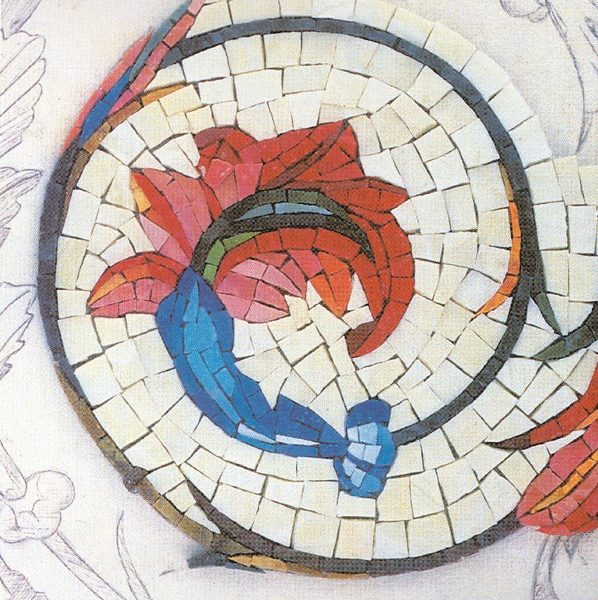
It's an art form that connects modern craftspeople to those of the distant past. In fact, the roots of mosaic tiling can be traced to Mesopotamia in the third millennium B.C., where temple walls were decorated with simple earthenware fragments. Centuries later, the ancient Greeks decorated their courtyards with large and small pebble mosaics, and sophisticated examples of mosaic work are found later in everything from Turkish mosques to Italian basilicas. The Romans, however, probably pushed mosaics about as far as any culture could in the first few centuries A.D. They adorned baths, pools, spas, floors and walls of important buildings as well as humbler residences with intricate mosaics made up of ceramic, stone, glass and marble. Recent years may have seen a revival of this ancient artistic technique, but as can be seen in the accompanying photographs, what many of today's designers are doing with classic forms is a real step forward - a departure from tradition that has made today's mosaics a thoroughly modern form of

Not every upscale pool contractor has to be working with his or her own designs to be successful in building beautiful pools. Our company, for instance, has established its reputation by excelling at making the ideas of others come to life. Examples of this can be found in the work we did at One Ford Road, a development where we were asked to follow through on designs prepared by three of Southern California's best-known landscape architects. We've found here and elsewhere that when you work with highly creative people (including those who designed the pools, spas and waterfeatures pictured on these pages), the process can be truly rewarding, exciting and even

Long before the Bobcats show up, most watershape designers will have used some sort of two-dimensional artwork to excavate their customers' imaginations. Perhaps it starts with old photographs in a portfolio, but it almost always ends up with new drawings that encourage precise, detailed communication between designer and client in a way that can never be fully achieved with verbal descriptions or written proposals. If done with appropriate detail and skill, a drawing gives designer and client the opportunity to explore the

This waterfall could've been built in either of two ways: A system of internal reservoirs and a long, narrow nozzle could've been formed as part of the structure itself, a task that would've placed huge burdens on the forming crew and the person shooting the gunite; or a manufactured fixture could be used to create the desired effect. Sensibly, the folks at Tango Pools in Las Vegas chose to pursue the latter option, deciding it would be better to