








finishing
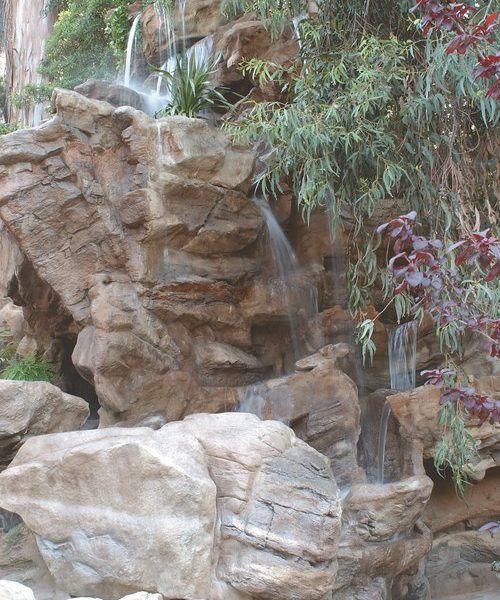
In designing and constructing naturalistic projects for residential clients, I keep two thoughts uppermost in mind: First, the only way to create a successful, natural-seeming illusion is to base my work on the observation and study of nature; second, the only way to build fun into such an environment is to fill it a child-like sense of wonder that draws old and young alike to the natural beauty. For the project pictured in these pages, those two thoughts were always front and center. The homeowner first contacted us about his desire to place a dramatic waterfall in front of some striking, 120-foot-tall eucalyptus trees. That vision soon expanded to include additional watershapes now woven through the majority of the steep, terraced, heavily wooded site. Some work had already started on a set of streams and a hillside pool by the time we became involved, but when the client became acquainted with our work and saw the sort of realistic, highly detailed projects we execute, he wanted us to pick up and take the entire project to completion. Built during the unusually wet winter southern California experienced this past year, the project was challenging in logistics, scope, variety and detail. Some of the practical challenges included hand-carrying 400-pound rock panels down 100 yards of steep, switch-back paths - and occasionally dodging rogue golf balls shanked over from the adjacent Bel Air Country Club. Despite such annoyances,
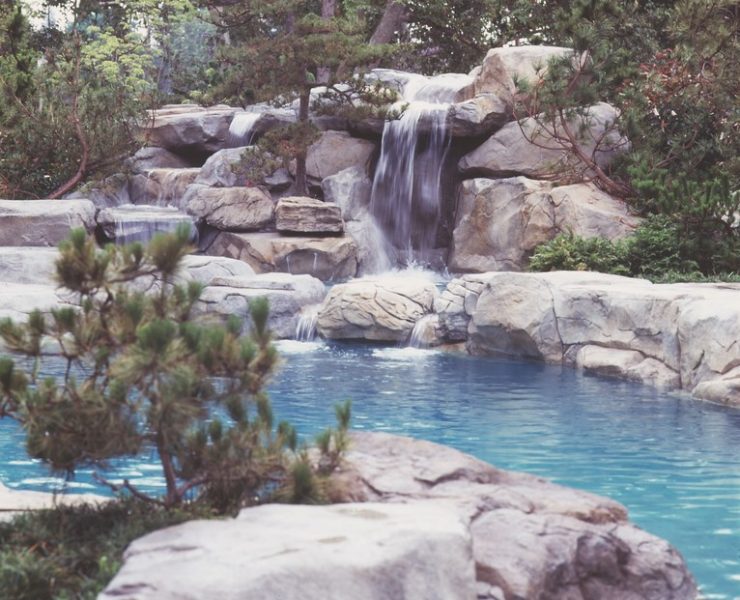
Transforming a tired, old swimming pool into an inviting naturalistic environment is always a challenge, but when the client is Playboy's Hugh Hefner, the project becomes an adventure as well. The original lagoon pool at Playboy Mansion West in Los Angeles, Calif., is still in great shape as a result of outstanding design, construction and maintenance. In expanding the property to include the estate across the street, the plan was to create a "luxury annex" for the main compound. Among the extensive renovations undertaken at the new property was the complete renovation of the backyard and its swimming pool. As was the case with the famed pool and grotto, the concept was to
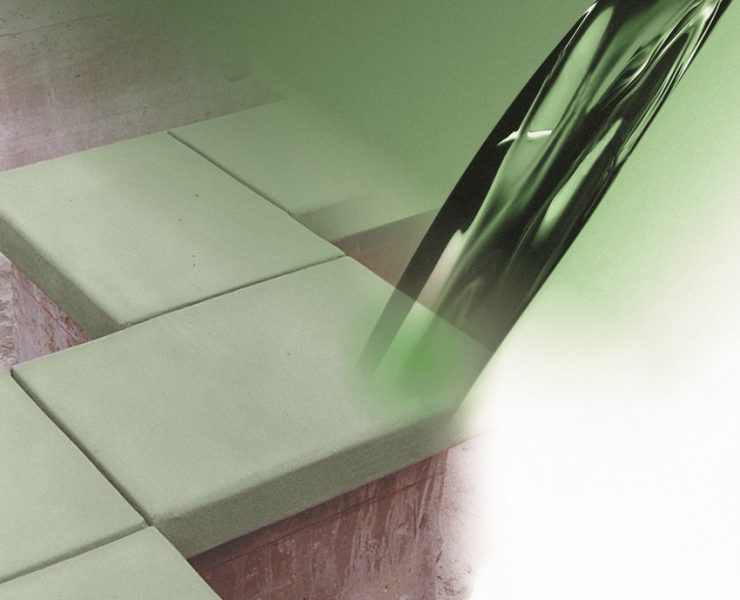
Edge treatments are important to me. They can lead the eye into the water, set up a barrier, break down a barrier. They're simply too critical to the overall impression made by a watershape to be left to chance. For the past ten years, I've found myself using one edge treatment more and more: a poured-in-place coping that uses colored concrete. I've now done it dozens of times, and my clients have always been thrilled by the results. In effect, I use the concrete to create soft and subtly colored rectangular

Some may disagree with me, but I don't see faux rockwork as a "sculptor's art form." For more than 25 years, I've made sure that Mother Nature is the one who does the detail work; what I do is take copies of her artwork to job sites and install them in creative and interesting ways. A long time ago, I developed a method of making castings of real rocks using my own formulation of fiberglass and epoxy. These are exact replicas of the real thing: Once mounted on steel structures in swimming pools or other hardscape applications, the panels are

Let's talk about really big boulders - the five- to eight-foot kind that weigh in at two to five tons apiece - and how they should be integrated into watershapes. The whole process of placing these big boulders begins with the design of the pool and relates to the kind of scale you're trying to achieve. Big boulders make other features seem small by comparison and can often overwhelm (rather than accent) a design if

Back in 1987 and particularly in California and Florida, the surfacing industry found itself in the middle of an unfortunate wave of plaster failures. Some people blamed the material, others blamed application techniques - and traces of the debate continue to this day. The situation was truly desperate in some areas, so much so that it drove many plasterers to seek new materials and techniques - anything to escape the cycle of negativity. Our firm in San Diego, for example, moved early and became the first in our county to apply exposed-aggregate finishes. Today, more than 80% of