







engineering

Helena Arahuete joined the staff of John Lautner's architectural firm in the early 1960s, at a point where he was turning out some of his most spectacular work. Indeed, Lautner can indisputably be said to have designed some of the most beautiful and unusual homes built in the second half of the 20th Century. An apprentice of Frank Lloyd Wright's who studied with the master at Taliesen, Lautner was an exponent of the philosophy and discipline known as "Organic Architecture," an approach Arahuete, now an eminent architect in her own right, has continued to use and refine while running the firm that still bears Lautner's name. She is now one of the world's leading practitioners of Wright's and Lautner's approach to creating unique structures that are intricately and intimately tied to their surroundings. She is also so firm a proponent of the integration of watershapes into those architectural forms that in April 2000, she carried her message to the first Genesis 3 Level II Design School, held in Islamorada, Fla. - and welcomed an opportunity to present some of Lautner's work here by way of defining the place watershapers have at the design table with

Some may disagree with me, but I don't see faux rockwork as a "sculptor's art form." For more than 25 years, I've made sure that Mother Nature is the one who does the detail work; what I do is take copies of her artwork to job sites and install them in creative and interesting ways. A long time ago, I developed a method of making castings of real rocks using my own formulation of fiberglass and epoxy. These are exact replicas of the real thing: Once mounted on steel structures in swimming pools or other hardscape applications, the panels are

Now comes the fun part. The final stage of building a stream is where all of the planning and close attention to the stream's earthen substructure, transitions in elevation, liner alignment and hydraulics come into play as you move to build in details that effectively mimic nature. In the first two installments of this series (click here for part 1, here for part 2), I discussed in detail how you excavate and grade the site, place the major transition stones, lay in the liner and install
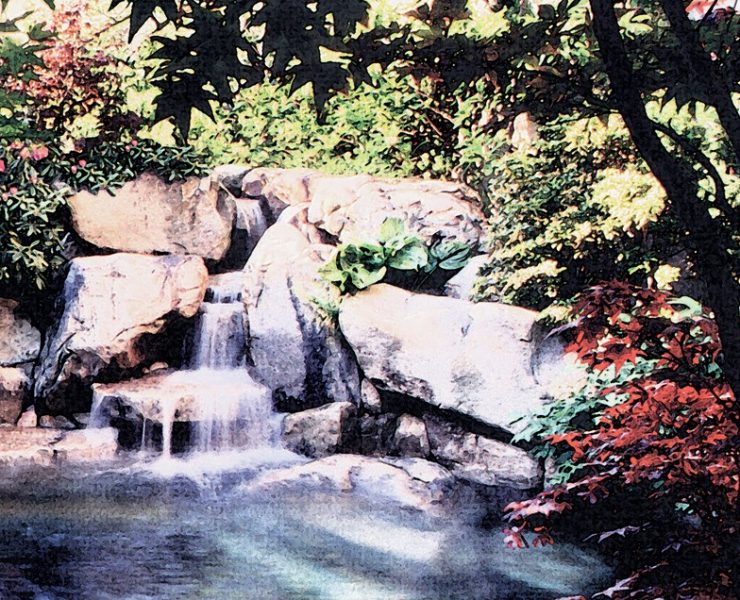
I believe that what we strive for in our watershapes is evident in the paintings and sculpture of the great masters. The harmony, the beauty, the drama, the excitement of the senses, the total captivation of the viewer create an experience we call great art. The more we can reflect on this work and use it as a lofty benchmark, the more effective our watershapes become. I've always believed that the best way to work at the highest level is to follow the tenets of

Let's talk about really big boulders - the five- to eight-foot kind that weigh in at two to five tons apiece - and how they should be integrated into watershapes. The whole process of placing these big boulders begins with the design of the pool and relates to the kind of scale you're trying to achieve. Big boulders make other features seem small by comparison and can often overwhelm (rather than accent) a design if

As customer demands continue to push the creativity of watershapers to new limits, industry professionals need to stay atop the trends - and nudge those of us on the supplier side to new levels of creativity as well. In some cases, this means learning how to construct new environments, such as the vanishing edges and beach entrances so many clients now want. In other cases, this expanded creativity comes from a need to know what products are available from manufacturers. Although once they were the product of on-site construction skills, sheeting waterfalls now fall largely into the category of

As the watershaping industry gets more involved with naturalistic bodies of water - particularly large ponds, lakes and streams intended to harbor life in the forms of aquatic plants and fish - it becomes increasingly worthwhile to understand the important role of proper aeration. Aeration is a simple process involving the injection of dissolved oxygen (DO) into water. Nature aerates by way of things such as waterfalls and rain - activities we must imitate by mechanical means in our man-made settings if fish are to be healthy and a host of water-quality problems are

This really wasn't a job for the timid. The ground was unstable, access was limited, and the customer could afford to make massive changes along the way. Other than that, of course, the project was a piece of cake. The truth is, I enjoy a good challenge. People who know me well are aware that I revel in tackling jobs that test my mettle - and this was definitely one of those cases. Ultimately, it turned out to be one of the most satisfying and beautiful projects I've been involved with in a long while. The site is located on

Believe it or not, I became involved with this project because my nine-year-old daughter, Savannah, plays tackle football. I was watching one of her games when I overheard a teammate's father talking about a renovation at the Palm Beach Zoo. Joining the conversation, I learned that he owned a general contracting company that builds large commercial projects and that he'd been hired to renovate the zoo's parking lot and utility infrastructure and build an exhibit facility for two Bengal tigers. It was, he told me, the first phase of a long-term plan to upgrade the zoo at Dreher Park, a complex that also includes a planetarium and a museum. The work at the zoo, he said, was one phase of an effort by the city to create a quality facility that ultimately could serve as a low-cost alternative to Orlando's theme parks. As part of the project, my new friend's firm also was acting as general contractor in the construction of a new tiger pen, the first of a series of new display areas planned for the modest zoo. When he talked about the watershapes involved, I jumped: The design

Is one person's trash really another person's treasure? That's a concept we tested on a recent Surprise Gardener episode, where we ran into a strange backyard "centerpiece" and, as the designer with final say, I had to decide whether to cover the thing up or make it stand out. The challenging objet d'art was an old truck chassis, abandoned and sunk into the yard many years before. Because of its location, it was something of a focal point. The homeowner had tried sticking an old whiskey barrel in the middle of the truck as a planter in hopes of