








engineering
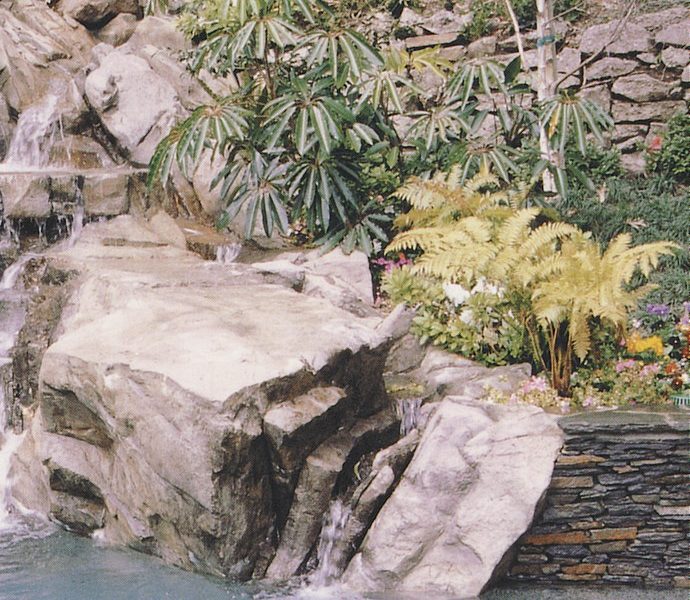
The most important use of faux rock is to make a geological statement - to provide an important accent or focal point in a landscape where none exists. My goal is to create rock formations that complement and enhance the natural setting and fit in harmoniously with their surroundings. That's a point builders who use artificial rock sometimes fail to grasp. They'll execute an ambitious scheme with lots of interesting, well-crafted rockwork, but it ultimately looks unnatural because the rocks they've created have no logical relationship to any indigenous formations or anything else in the surrounding space. I approach things in a different way - one that embraces the site and all of its features. I select, form and install faux rocks that, together, create interesting and beautiful statements in the overall landscape design. As I work, I make my installations to stand up to the question, "Is this rock formation
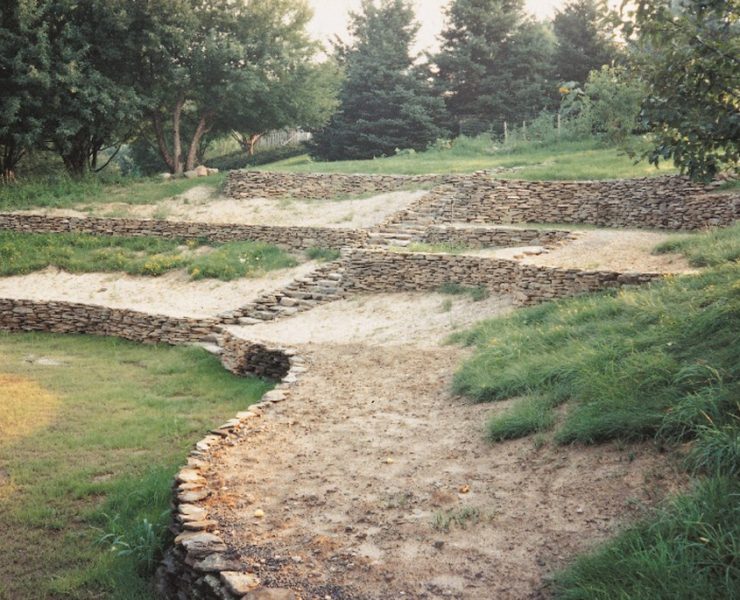
Retaining walls are used for one simple reason: to hold something back. Whether you need to terrace down to a lower yard, hold up a house on a hillside lot or provide a level area for watershape installation, these walls are indispensable when you lack the room needed to grade a sloped area gradually. Of course, this notion of holding back the forces of ground movement is no small challenge, and proper engineering and construction are critical. Do the job well, and a retaining wall will hold up indefinitely. But if you cut corners or

In conceptual terms, interactive fountains are really nothing new. In fact, fountains have featured water effects and sequencing lights since the turn of the 20th Century. What's emerged lately is a perception that these "dancing" waters are great sources of fun - a means for children to get soaked and for adults to stay dry and enjoy the show. This resurgence of interest has led designers and manufacturers to apply the knowledge and mechanics of the past in creating effects that delight the eye, capture the imagination and bring fun to

Not every upscale pool contractor has to be working with his or her own designs to be successful in building beautiful pools. Our company, for instance, has established its reputation by excelling at making the ideas of others come to life. Examples of this can be found in the work we did at One Ford Road, a development where we were asked to follow through on designs prepared by three of Southern California's best-known landscape architects. We've found here and elsewhere that when you work with highly creative people (including those who designed the pools, spas and waterfeatures pictured on these pages), the process can be truly rewarding, exciting and even

Good pool design isn't something that happens by chance. It's the product of a mental discipline applied to the entire setting, from one end of the yard to the other. It's the result of an over-arching vision that incorporates the watershape as a desirable component in a whole tapestry of textures, traditions, shapes, surfaces, highlights, spaces, contours and lines that please the eye, gratify the soul and bring a smile to the face of the observer. Perceiving this integration is often intuitive, but you can tell when it's been done right. You also can tell when the mark has been missed and can spend minutes or hours (or days) unraveling and considering everything from severe challenges and missed opportunities to lapses in focus or simple errors in taste and judgment. If your head's in the right place, you'll probably learn more from the problem pool than you will from the gem. Putting pool-industry heads in that right place is part of the thoughtful, reflective approach to pool design offered in the Genesis 3 Design School, which has convened three times and has now touched the sensibilities of more than 75 designers and builders. While school is in session, participants are immersed in an ocean of information on design principles, technical issues, presentation techniques and, perhaps most forcefully of all, on attitude and mindset. The basic message: Every pool can be special, appropriate and expressive of the

The first thing I tell myself when looking at a prospective job site is that the pool is unimportant. That may sound strange coming from one who has spent years of his life in designing and building the finest pools money can buy, but in a very real sense, I think it's absolutely true: The pool itself means nothing. What's important is the site, its prevailing geological conditions, the visual strength and influence of the house or other structures and the natural elements of landscape and physical setting. All of these directly influence the design of the pool - its shape, size, elevations, materials and position on the property. When all of these elements of the pool's physical structure come into balance with the surroundings, then the experience of someone entering the area can be utterly transforming: They will draw impressions of beauty, elegance, relaxation, tranquillity and even a distinct connection with nature. You're off to a good start simply by recognizing this potential. To maximize it, however, you need to

It was one of those projects where aesthetics, technology, function and history all came together. Installed on a pier on the waterfront in Hoboken, N.J., right across the river from the Manhattan skyline, the dry-deck fountain pictured on these pages was part of a civic development movement aimed at creating new public areas on both the New York and New Jersey shores. Our company, Roman Fountains of Albuquerque, N.M., first became involved in the project in 1996, when we

As I see it, there are six main types of watershapes: pools, spas, fountains, ponds, waterfalls and streams. Although there is tremendous variety within each category, I think most of us in the business would put pools, spas and fountains in one sub-group and ponds, waterfalls, and streams in another. Obviously, there's room for overlapping here - waterfalls installed with pools, for example, or fountains in the middle of ponds. The key distinction for me, however, is the closeness with which a pond, waterfall or stream must imitate

Waterfeatures may well be the hottest thing in landscaping today, and the reason is simple: No other landscape detail captures all the senses the way moving water does. I don't get the impression that people sit around for hours watching their tulips grow, for example, but I know for a fact that people who have ponds in their yards will sit for hours, with others or in solitude, drinking in the scene and communing with the koi and the water lilies. In that sense, ponds have more to offer than the average waterfeature: A pond's live component adds interest and touches of tranquility that work in countless settings, from backyards and corporate offices to dining terraces and the common areas in apartment complexes. The possibilities are

These aren't our parents' public pools. Whether run by a city or by a county, these recreational facilities are now subject to a new set of rules in response to evolving consumer demand and the growing popularity of elaborate waterparks. The inert, rectangular pools of years past - ten or 12 feet deep at one end, three or four feet deep at the other - are fast being replaced by multi-faceted, multi-purpose, quasi-organic forms that appeal to users of all ages and abilities. The new designs incorporate large