








engineering

It began as the playful vision of Bob and Kat Tudor, husband-and-wife philanthropists and founders of The Smokebrush Theatre in Colorado Springs, Colo., who decided one day to donate a unique fountain to the children of their city. Now that vision, fully realized, belongs to the citizens of this sprawling town at the foot of the Rocky Mountains in the form of a dazzling water display and a folksy character named Uncle Wilber. Multi-talented artists in their own rights, the Tudors developed the aesthetic and creative concepts but knew from the start that they would need to enlist advanced technical expertise to

The process of designing a watershape or garden usually requires the designer to answer a number of questions - the vast majority of them having to do with seeing the water and the landscape. Indeed, from considerations of color and scale to managing views and ensuring visual interest within the space, much of the designer's skill is ultimately experienced by clients and visitors with their eyes. But what if your client is blind or wheelchair-bound or both? How do you design for them? What colors do you use in your planting design? Would you even care about color? How will they move through the space and what experiences will await them? What would be the most important sensory evocation - sound, fragrance or texture? These are the sorts of special questions we asked ourselves after being approached by clients who had the desire to create a sensory garden for visually impaired and physically handicapped people. The experience shed a whole new light on the power of non-visual aesthetics and prompted me to

It's truly a diamond in the rough: a huge, sparkling blue pool set in the middle of nowhere in a country that is probably best known for being the gateway between two grand oceans. For a time before I arrived on the scene, however, the enormous rectangular swimming pool at Palabra de Vida, a Christian missionary camp in Chame, Panama, was anything but shimmering. The mission operates a camp for the region's underprivileged children, who visit the facility in shifts that stretch across several months each year. There are times when
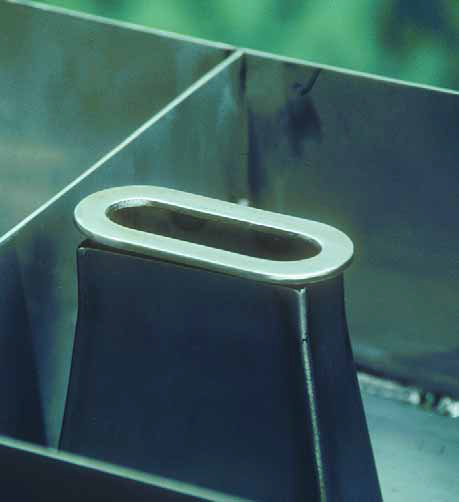
If you've been following this column for the past several issues, you already know a good bit about the magnificent (and magnificently difficult) project I completed late last year in the Malibu Colony. Many times in those columns, I mentioned (mostly in passing) a system of four deck-level laminar jets we planned on installing. As was the case with just about everything else on this project, incorporating the system of jets into the courtyard environment turned out to be far more complicated and challenging than we ever thought it would be. When all was said and done, however, we all agreed that meeting this particular challenge was

The people who once inhabited modern-day Mexico's Yucatan peninsula were remarkably sophisticated. Their civilization was based on a deep-rooted knowledge of astronomy, mathematics, hydraulics and engineering. They quarried stone and moved it hundreds of miles on rollers, using this raw material and incorporating it into highly refined buildings, temples, roads and monumental works of art that rival those of the better-known cultures of ancient Europe, Africa and Asia. In 2001, I traveled extensively in the Yucatan to experience the region's culture and view masterworks from many centuries past. What I found was a sense of form, line and pattern in the ruins of

Of all the concepts of hydraulic-system design, there are few that have more importance than the correlation between water flow (that is, capacity expressed as gallons per minute) and line velocity (the speed at which the water travels). As water travels through a pipe, its increase in speed (that is, its line velocity) results in an increase in resistance (expressed as feet of head) and in a reduction of end pressure, which is measured in pounds per square inch (psi). In other words, an increase in friction losses and a drop in pressure is the result of increased water velocity at a given flow. If that makes sense to you without further explanation, then you know much of what you need to know when it comes to selecting pipes and fittings and setting up a watershape's plumbing system. If it doesn't, this article will cover the basics - from selecting pipes and sizing lines to

One advantage of building pools in the affluent Chicago suburb of Lake Forest is that many of our prospects have seen inspiring landscapes, pools and waterfeatures in neighboring backyards or at quality resorts around the world - and, as a result, come to the design process with plenty of ideas. With all of that experience and thoughtful exposure to the possibilities of water, quite often they're already visualizing the way they want their backyards to look. Such was certainly the case with the project seen in this article: The homeowner came to us with an armload of photographs and knew exactly what she wanted from the outset. And the canvas for her imagination was plenty big, with a backyard measuring more than two acres and including a

Teaching children about the science associated with the natural elements of earth, air, light and water in an imaginative, fun and engaging way is one of the key missions of modern museums of science. Conveying those concepts through a landscape, however, is a unique and ambitious goal - one we suggested to the directors of Montshire Museum of Science of Norwich, Vt., as a way of transforming the museum's grounds from ordinary exhibit space into a true laboratory for learning. During all of the early discussions of types of natural phenomena Montshire wanted us to explore, museum representatives always seemed most excited about those associated with water. They agreed with us that water exhibits could teach children about wonders as diverse as stream erosion and deposition, the reflection and absorption of light, how the pattern of water currents and flow velocities are affected by the size and shape of the water's container, how the pressure of water increases as its depth increases, and how the air temperature cools as one
It's impossible to know why some people change their minds the way they do or to predict exactly when it might happen, but in working with opinionated clients who demand the extraordinary, it's a fact that accommodating their changes in direction can come to define and redefine a project more than once as you move from start to finish. In many ways, our ability as watershapers to adapt and adjust midstream is at the heart of what we do - and no one says it's easy! The Malibu Colony project I've been writing about in several recent columns is absolutely

To make a pond or stream successfully "natural," the designer and installer must know what it takes to produce a convincing illusion that the end product is actually a naturally occurring body of water. It's no secret in the trade that this illusion is made or broken at the edges, where the physical boundaries between waterway and the hardscape and plantings must be both precisely controlled and completely concealed. Necklaces of stone won't cut it, nor will waterlines sharply defined by lines of terrestrial plants. In fact, the challenge here is to make visually linear boundaries disappear, and that's a tall order for even the best pond/stream designers and builders. In my own projects, I work almost every day in tweaking and refining my approaches to these margins and edge treatments, and I've come up with many ways to enhance the natural appearance of my ponds and streams. In recent years, I've been honing a technique for landscaping in and around the water that's given my work an entirely new dimension: It's a type of planting container I call a "dirt pocket" - a simple structure that lets me plant a broad range of non-aquatic plants directly in contact with