







engineering

To residents of St. Louis, Forest Park is a civic treasure on the order of New York's Central Park - which, locals are quick to point out, is smaller than their favorite park by 500 acres. Established in 1876 at the heart of the city, Forest Park has a similarly grand and glorious history, including service as the site of the renowned 1904 Louisiana Purchase Exposition & World's Fair, which drew more than 20 million visitors from across the globe. Through the years, the park's 1,370 acres have become "home" to such major attractions as the world-famous Saint Louis Zoo as well as the city's art museum, science center, planetarium, history museum and The Muny, the nation's largest outdoor theatre. Forest Park is also home to the

It's one of the most horrific things that can happen to anyone who enters a pool or a spa: One moment you're having fun or relaxing, and in a terrible instant you're caught in a devastatingly painful and potentially fatal situation. Most people who become entrapped by pool, spa or wading-pool plumbing do survive, but all too often they suffer life-altering injuries. As with any aquatic safety issue, we all agree these incidents should be prevented, and a great many talented people from government, trade associations, research institutions, equipment manufacturers and consumer-safety groups have invested a tremendous amount of time in examining suction entrapment. For all of that effort, however, seeing our way to
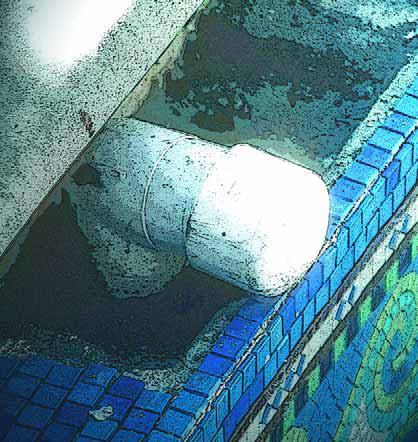
Now we come to the finishing touches - little details that make a big difference in the ultimate appearance of the renovated pool we've been watching develop here for the past several months. Through those many months, we've taken a pool that's more than 70 years old, rerouted all of its plumbing through cores cut in the old shell, added a circular spa in the shallow end, raised the floor in the deep end, reshaped the steps, added lights in a new, pool-long bench, installed all-new equipment and laid down gorgeous glass tile throughout - all without disturbing the beautiful limestone decking that surrounded the pool. As the project came to a close, we turned to a final

Even compared to other spectacular facilities established by Silicon Valley's high-flying software industry, Oracle's corporate campus is truly impressive. The mirrored-glass architecture and warm, meticulously maintained grounds are only the start of the story. As you dig deeper, you find a range of employee-oriented amenities both inside and outside the buildings that make it tough to do anything but admire the audacity involved in creating such a workplace - and envy the people who work there. The management at Oracle makes no bones about it: All of the opulence is designed to attract and retain employees capable of developing cutting-edge software systems. That's why you'll see designer furniture in the offices, international cuisine in the restaurants and beautiful artwork throughout the compound. It's an amazing place, and one that has been scrupulously maintained since construction was completed in the early 1990s. The watershapes reflect the management's lofty sensibility and are an integral part of an overall scheme of plazas, rolling lawns, pathways and places to relax, meet or socialize with fellow workers. Our role since 1998 has been to

Whether a spa is concrete or portable, custom or mass produced, sound hydraulics and good plumbing are needed if the spa's jets are to give clients the hydrotherapeutic action they crave. The manufacturers of portable spas do this work for their dealers, observes hydraulics expert Steve Gutai, putting watershapers who work in concrete at a disadvantage that must be addressed if a concrete spas are to compare favorably with a client's portable options.

I've always believed that great projects require three key elements: a beautiful design, knowledgeable and careful construction, and a good client. For the project pictured here, all three of those pieces were in place, and the result has become a significant point of pride for our firm. The site consists of three sloping acres in the upscale community of Mill Neck on the north shore of Long Island, N.Y. The home sits at the highest elevation of the property, which reaches down to a large, brackish pond fed by the waters of nearby Mill Neck Bay. The swimming pool and surrounding hardscape and landscape were

In 1997, the City of Palm Springs Arts Commission held a national competition for a sculpture to be placed in a prominent public space, the Frances Stevens Park. I was intrigued by the site's high visibility - and by the fact that the California city wanted a sculpture that used water in a desert setting. Working from my studio on the East Coast, I put together an initial proposal that included a number of ideas - provocative to me, but not yet fine-tuned. It wasn't until I actually visited the site in Round Two of the selection process that I knew just how perfect a setting was being offered - a wide-open space in the center of town, ringed by tall palm trees and low-lying buildings with the stunning

The resort opened in 1994 with completion of Phase I of a program that emerged once developer and entrepreneur Sol Kerzner bought the property from Merv Griffin in 1992. Phase II saw another round of construction that was opened to the public in 1998 - and ever since, Atlantis, Paradise Island, Bahamas, has been known around the world as a prime vacation spot for couples and families. The original pre-1992 property consisted of three buildings that had been built about 30 years previously along with one swimming pool and 27 tennis courts. Today, the facility occupies about 70% of Paradise Island's 826 acres on the northern edge of Nassau and is the unabashed expression of
The resort opened in 1994 with completion of Phase I of a program that emerged once developer and entrepreneur Sol Kerzner bought the property from Merv Griffin in 1992. Phase II saw another round of construction that was opened to the public in 1998 - and ever since, Atlantis, Paradise Island, Bahamas, has been known around the world as a prime vacation spot for couples and families. The original pre-1992 property consisted of three buildings that had been built about 30 years previously along with one swimming pool and 27 tennis courts. Today, the facility occupies about 70% of Paradise Island's 826 acres on the northern edge of Nassau and is the unabashed expression of
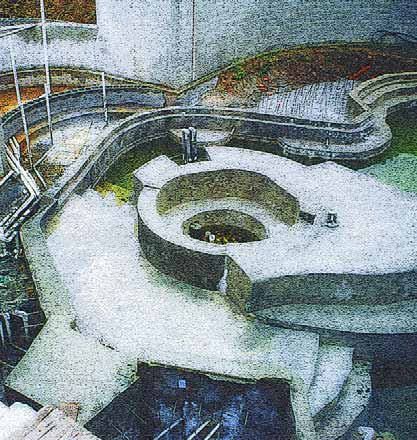
The project I've been working on in the hills outside Hanover, Pa., has just about every feature, bell and whistle one can imagine. That inclusiveness of detail at every level has translated to an unusually intricate construction process, as I mentioned last time in discussing the excavation, forming, plumbing and steel phases. Now we get to the gunite. Where a garden-variety backyard pool involves placement of maybe 30 to 50 yards of concrete and some larger projects may run in the 50-to-70-yard range (and where most of mine tend to fall in the 90-to-130 yard range) - this project needed two gunite rigs shooting for two solid days, 12 to 13 hours each day. The pool shell alone (excluding the waterfall, the grotto and several other features we'll get into later) required a staggering 300 yards of concrete. That's about