








cascade

It’s not every day you get the chance to work on a project that’s going to be seen around the world by millions of people for decades to come. That was exactly the opportunity that came our way in October 1999, when we were asked by the Denver Broncos to construct an elaborate waterfeature at Invesco Field at Mile High, a brand-new stadium that

The last time I visited Dallas on business, I kept a crucial side trip in mind: I just had to see the Fort Worth Water Gardens with my own eyes. Designed by New York architects Philip Johnson and John Burgee and completed in 1974, the space has been iconic since day one. The way the space lures you in, drawing you past

It certainly doesn't happen very often, but sometimes the addition of a watershape can completely redefine the way a property is perceived. In the case seen here, a nine-acre estate in the mountains above of Malibu, Calif., was zoned for agriculture. The owner's intention in buying it was quite appropriate: He wanted to turn it into a working vineyard brought to life visually by a big stream, pond and waterfall system. Once the watershape took form, however, the owner was so inspired by what he saw that his vision for the property changed and he recast the place as a venue for weddings and other events that would be enhanced by the bucolic, utterly romantic surroundings. In a very direct way, in other words, the watershapes served to increase both the aesthetic and financial value of the property. I'm a romantic at heart, so the notion that the work on display here will be a backdrop for special, memorable occasions has made the big, complicated project even more

Think of it: Just below the surface of our ponds and streams is a wonderful potential for beauty, an amazing opportunity to open observers' eyes to an entire submerged "landscape" made possible by virtue of completely clear water. I like to picture it as an "underwater garden," which is why, to me, water clarity is an essential component of my ponds and streams. Too often, however, I run into settings in which it simply has not been a priority for the designer or installer. I'm further distressed when the subsurface views I treat as key design elements are left partially or wholly unconsidered. I think back to my family's trips to the seashore, where we would spend hours observing rocky tidal pools. Peering into the water and seeing a world of oceanic plants and animals at close proximity was a profound source of fascination and excitement. It is for me still – and, I believe, for most other people as well. What I see in tide pools is a perfectly balanced, utterly natural underwater garden filled with beautiful stone colors, textures weathered by the action of the waves and tides and a plethora of pebbles and sand mixed with bits of seashell. It is here that we may

When I first walked the four acres of wooded ravines of what would later be christened "The Garden of Wind and Pine" at the heart of the Garvan Woodland Gardens in Hot Springs, Ark., I was both delighted and daunted by the experience. The delight came in the site's sublime natural beauty, which reminded me of tromping through the woods as a child - an activity I enjoy to this day. As for my sense of unease, I don't know which was more significant: the expansiveness of the dry drainage ravines that were to be converted to ever-varying cascades and streams, or the omnipresence of ticks and poison ivy. When I made my first visit in the fall of 1999, the site was part of an undeveloped 210-acre woodland parcel on the shore of Lake Hamilton given to the Department of Landscape Architecture at the University of Arkansas in Fayetteville by Verna Garvan. She had long seen the peninsula as the ideal setting for a botanical garden and had spent two decades developing her vision, planting camellias and azaleas and a rose garden and commissioning a pavilion by the architect Fay Jones and his partner, Maurice Jennings. I had worked in Fayetteville before, crafting a

Tucked into a small cove in the mountains behind La Quinta in California's lower Coachella Valley, The Quarry Golf Club is hidden, ultra-private and basically unknown to all but members of the golfing elite and the wealthy few who play the course. First conceived by entrepreneur Bill Morrow and designed by renowned golf course architect Tom Fazio, the course is a prime example of just how beautiful golf courses can be - and of how critical a role landscaping and watershapes can play in defining their character and aesthetics. Our challenge was to embroider the course's 18 PGA-sanctioned, championship-caliber holes with

The avant-garde composer John Cage once said, “Art exists to make us aware of the very life we’re living.” I’ve always loved that statement because, as someone working to create works of art, the experiences of my own life have naturally been transferred into the way I’ve chosen to express myself – and, I hope, have enabled me to succeed in bringing other people to an awareness of experiences in their own lives. For me, water is the key in these transferences: Even though I’m probably more often described as a sculptor of natural stone rather than as a watershaper, the dialogues I have with the materials I use and with those who observe the outcomes have always begun with the way I work with water. I grew up in the Midwest on the banks of the Mississippi. As a child, I lingered on the untamed shores of the creeks, streams and rivers that laced across an otherwise developed and thoroughly mechanized landscape. I would read or draw, stroll idly along a stream, or spend hours building a raft or dam. This was well before I’d begun to think about my relationship with water in any sort of artistic way, but there’s no question that those experiences remain at the heart of my passion for working within this
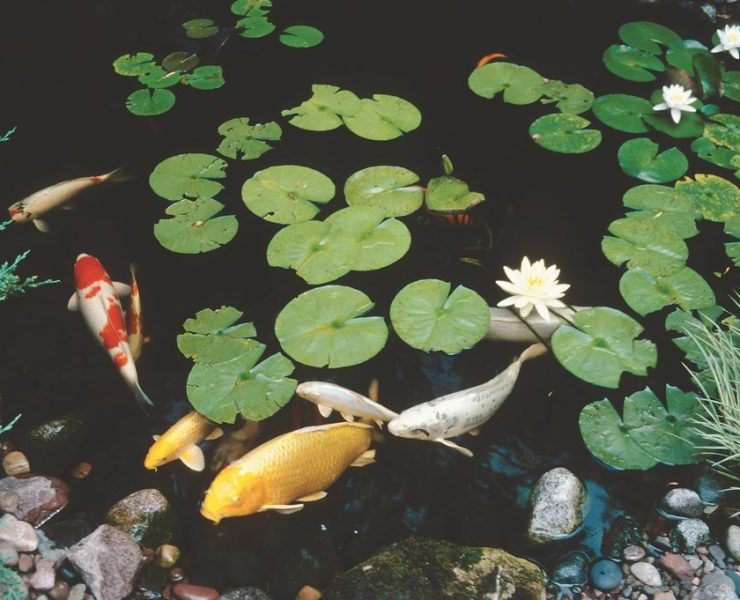
The watergardening business has exploded in North America in the past few years - so much so that it's easily the fastest-growing segment of the watershaping industry. This wave of interest in naturalistic watershapes means that hundreds of people new to the craft of pond and stream building are now out there, working on all sorts of residential and even a few commercial projects. Some of these are landscape contractors working with water in a significant way for the very first time. Others are pool contractors who've

This waterfall could've been built in either of two ways: A system of internal reservoirs and a long, narrow nozzle could've been formed as part of the structure itself, a task that would've placed huge burdens on the forming crew and the person shooting the gunite; or a manufactured fixture could be used to create the desired effect. Sensibly, the folks at Tango Pools in Las Vegas chose to pursue the latter option, deciding it would be better to