







waterfall

Take the world’s most prolific consumer technology company on one hand and, on the other, its desire to augment its corporate headquarters with a natural exterior environment intended to capture geological processes that span millions of years: It’s a collision of
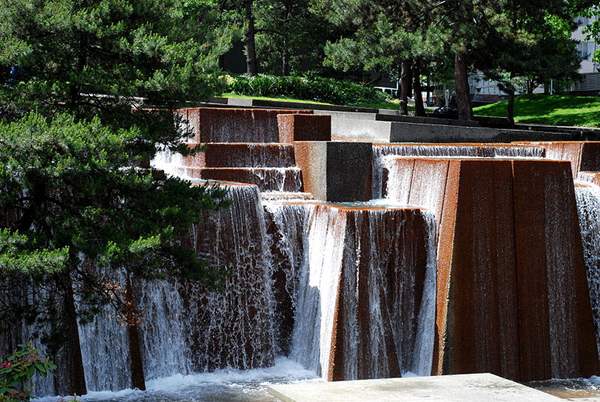
Back in a time before I had anything to do with watershaping, I lived for a few years in Eugene, Ore. – a smallish college town that always left me craving more-urban spaces. Portland was up the road by a couple hours, and in the days before our first child appeared, my wife and I would make fairly frequent trips to visit the closest real city we had available. We loved
Please note: All of the issues listed below are available online, free of charge. Printed…

Compiled and Written by Lenny Giteck New Way to Make Pools Green: Fill Them Up with Apple’s Billions!
The Getty Center is a true multimedia experience: imposing architecture, lots of people, incredible materials of construction, amazing views, diverse spaces, and rich and varied sounds. Designed by architect Richard Meier, the 750-acre campus is dominated by

Oddly enough, this story takes place in a down economy and shows how, despite perceived financial limitations, something surprising and wonderful can happen when people put their minds to it. For years now, my work at Aquascape (St. Charles, Ill.) has largely focused on developing, designing and installing systems that in one or more ways are environmentally sound and beneficial. In early 2009, I began working on a plan for a prototype community designed around optimal use of its resources, especially water. I imagined a town filled with rainwater-capturing systems, permeable surfaces and efficient irrigation. It included nothing but indigenous plants, was organized with minimal turf areas and set aside space for composting and cooperative organic farming. As for the homes, all of them boasted various resource- and energy-efficient features. The overall concept was so

Last month, we began our discussion of a large pond, stream and waterfall system for a historic upper Midwest estate found on the forested shore of a scenic lake. As related there, the project was to include three major ponds and a series of complex waterfall structures connected by streams rising close to the top of the gently sloping property. To sum up, the space we were working with measured approximately 300 feet wide and 800 feet long – a large section of a 35-acre estate marked by scores of mature trees that largely governed the watershapes’ configurations. Moreover, as there were no natural rock formations or outcroppings on site, we faced the need to

For years, pond/stream specialist Bob Dews has sought perfection in the art of creating naturalistic bodies of water. Just last year, however, a client challenged him to reconsider his usual approach to pond design and develop one expressly for swimming. The result seen here is a composition in rock, plants and water that, rather than serving as a home for fish and aquatic life, is instead a safe environment for people – and lots of aquatic fun. It’s no secret that many homeowners who have ponds on their properties use them to cool off or even for swimming. These bodies of water are seldom intended for such purposes, but because of humankind’s affinity for water, the fact is that ponds often become “swimming holes” in which people are happy to

I see gardens as entire worlds unto themselves - as complete and alive and distinct rather than as simple decorative extensions of architecture. Whatever form they might take, these spaces should carry us back into the peaceful parts of ourselves and to the calm, clear realms of our minds and spirits. This outlook has, in my role as founder and principal of Marpa Design Studio of Boulder, Colo., led me to consider landscapes as integrated wholes rather than as cobbled assemblies of solutions to various problems. It's a positive philosophy and design approach that is fully on display in the project depicted on these pages. I was recommended by the architect, who was working with the owners of this sprawling Rocky Mountain estate on a major renovation of both the home and the surrounding land. From the start, I was told there was just one major theme in mind: The home and its surroundings were to look as natural as possible - as though everything had arisen organically from the roots of the mountains. Neither house nor grounds possessed that spirit at the time, and the landscape was particularly deficient. Indeed, the only pre-existing feature was a cracked