








rocks
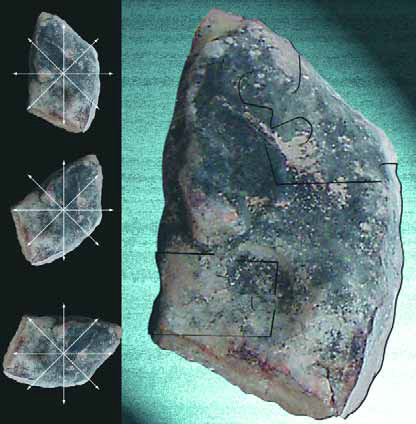
To me, setting natural stone has always seemed something like assembling a very large jigsaw puzzle: All the pieces have to fit together, and there's definitely a right way and a wrong way to make it happen. I start the process systematically by laying stones out in an adequately large area and then just looking at them. As I go, I visualize how each will work as part of the overall composition and identify stones with either convex or concave contours that might fit together in some visual way. I'm constantly asking myself, "If I put this stone here and this other one right next to it, how will it work? Should I pick another stone and use a different combination?" Nature helps me in coming up with the answers, because

So often, design comes down to an ability to see patterns. I first learned this from my mother, a dressmaker who had an uncanny ability to look at garments for which there were no sewing patterns and then sit down and make them from scratch. I seem to have inherited this talent, taking in a barren landscape and quickly visualizing how it will look with plants, rocks and water. For this, I am happily in her debt. Not everyone comes across such a gift by birth, but I believe that the ability to visualize is something most any watershaper can develop through experience and by taking the time to learn the "language" of any

When I first walked the four acres of wooded ravines of what would later be christened "The Garden of Wind and Pine" at the heart of the Garvan Woodland Gardens in Hot Springs, Ark., I was both delighted and daunted by the experience. The delight came in the site's sublime natural beauty, which reminded me of tromping through the woods as a child - an activity I enjoy to this day. As for my sense of unease, I don't know which was more significant: the expansiveness of the dry drainage ravines that were to be converted to ever-varying cascades and streams, or the omnipresence of ticks and poison ivy. When I made my first visit in the fall of 1999, the site was part of an undeveloped 210-acre woodland parcel on the shore of Lake Hamilton given to the Department of Landscape Architecture at the University of Arkansas in Fayetteville by Verna Garvan. She had long seen the peninsula as the ideal setting for a botanical garden and had spent two decades developing her vision, planting camellias and azaleas and a rose garden and commissioning a pavilion by the architect Fay Jones and his partner, Maurice Jennings. I had worked in Fayetteville before, crafting a
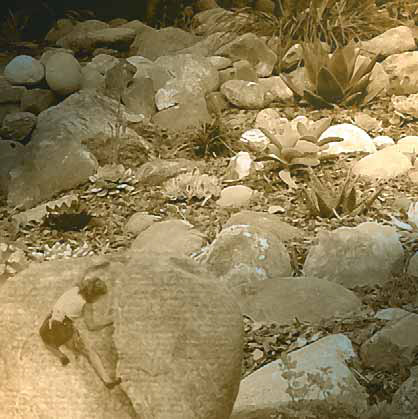
If I were to ask the average watershaper to name the most versatile element in any landscape, he or she would probably reply by talking about water or plants or some other equally prominent component. If you asked me the same question, however, I'd almost always say rocks. Some of you might be thinking I have a few too many of them rolling around loose in my head, but there's a good explanation for my response. First, rocks come in an infinite number of forms, shapes, compositions, colors, textures and sizes. Second, they can be used to sit on, walk on, retain hillsides or create small mounds. Third, they add dimension to designs and contribute in countless other ways to the

As I see it, there are six main types of watershapes: pools, spas, fountains, ponds, waterfalls and streams. Although there is tremendous variety within each category, I think most of us in the business would put pools, spas and fountains in one sub-group and ponds, waterfalls, and streams in another. Obviously, there's room for overlapping here - waterfalls installed with pools, for example, or fountains in the middle of ponds. The key distinction for me, however, is the closeness with which a pond, waterfall or stream must imitate

If you love rock, New England is a great place to work. A special combination of geology and the glaciers of the last Ice Age left behind a spectacular legacy of granite formations and scattered countless tons of boulders of all types and descriptions across the landscape from Maine through Massachusetts. It's the indigenous rock, so it's not too surprising that affluent New Englanders have long chosen granite and other local species to accent their landscaping. And this is especially true in