








rocks
Aquascape (St. Charles, IL) manufactures landscape fountain kits that come with all the necessary components…

'If I were to ask the average watershaper to name the most versatile element in any landscape,' began Stephanie Rose in her January 2004 "Natural Companions" column, 'he or she would probably reply by talking about water or plants or some other equally prominent component. If you asked me the same question, however, I'd almost always say
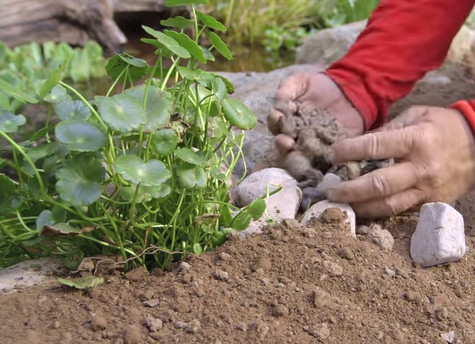
We've come to the part of the installation process that's my personal favorite: finishing up the plant placement and setting the edges. This is, of course, part of every pond-installation project on one level or another, but with a frog pond, my approach is a little different. As you'll see in the video linked below (and may have noticed in previous installments), the profile of this frog pond is
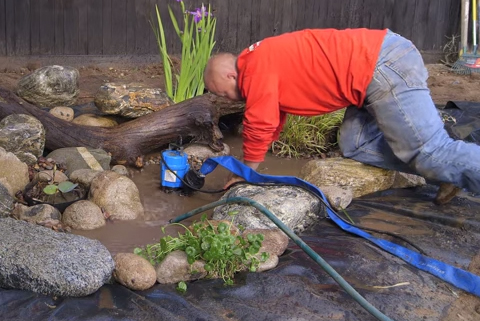
No matter how firm a focus you maintain on making a pond into a safe, comfortable home for frogs, there's always the need to keep at least one eye (if not both) on the way the pond looks. My goal, as I discuss in some detail in the video linked below, is to make every watershape I produce look as though it belongs where I've put it, as though the pond
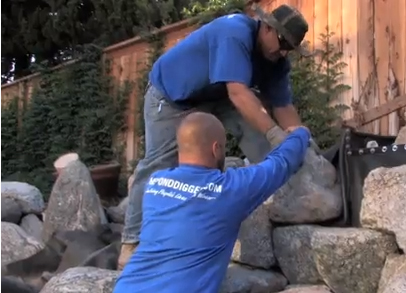
I’m generally a low-key guy, but I love almost everything about building waterfalls. I like discussing a site’s potential with my clients. I like going to the supply yard and selecting stone. And while I don’t mind letting others take the lead with the digging, I do like laying out shelves and setting the pond’s interior contours in ways that will maximize

We recently completed a project that truly thrilled a pair of well-traveled, highly educated clients: It was a large, complex waterfall-and-pond composition in the sloping backyard of an upscale home in an affluent southern California neighborhood. There were a number of reasons why the project worked so well, but if I had to break it down to one thing more than any other, it had to do with the range of edge treatments we used within the available space. On the side nearest the house, we established a clean lawn-meets-water detail – very disciplined in appearance and obviously man-made. Directly across the pond was a set of rugged waterfalls – much wilder and basically untamed. Bracketing those features, we filled shallow areas with emergent plants and hiding places for fish and frogs. It was a well thought out plan, certainly right for the space. But I know for a fact that

Creating watershapes and landscapes that are natural in appearance is always a challenge, says Ken Alperstein of Pinnacle Design, a firm that specializes in high-end projects related to top-flight golf courses. For this project in Shady Canyon, however, the ante was upped considerably by the site's location in an environmentally sensitive coastal canyon in southern California - a design challenge intensified by regulatory scrutiny every step of the way. It was a job that forced everyone involved to be on exactly the same page at all times. The landscapes and watershapes at the Shady Canyon Golf Club in Irvine, Calif., were developed by the Irvine Company as the heart of an upscale residential community. The wilderness area set aside for the course and its immediate surroundings had a subtle, bucolic charm all its own - a character the design team needed to

It certainly doesn't happen very often, but sometimes the addition of a watershape can completely redefine the way a property is perceived. In the case seen here, a nine-acre estate in the mountains above of Malibu, Calif., was zoned for agriculture. The owner's intention in buying it was quite appropriate: He wanted to turn it into a working vineyard brought to life visually by a big stream, pond and waterfall system. Once the watershape took form, however, the owner was so inspired by what he saw that his vision for the property changed and he recast the place as a venue for weddings and other events that would be enhanced by the bucolic, utterly romantic surroundings. In a very direct way, in other words, the watershapes served to increase both the aesthetic and financial value of the property. I'm a romantic at heart, so the notion that the work on display here will be a backdrop for special, memorable occasions has made the big, complicated project even more

Think of it: Just below the surface of our ponds and streams is a wonderful potential for beauty, an amazing opportunity to open observers' eyes to an entire submerged "landscape" made possible by virtue of completely clear water. I like to picture it as an "underwater garden," which is why, to me, water clarity is an essential component of my ponds and streams. Too often, however, I run into settings in which it simply has not been a priority for the designer or installer. I'm further distressed when the subsurface views I treat as key design elements are left partially or wholly unconsidered. I think back to my family's trips to the seashore, where we would spend hours observing rocky tidal pools. Peering into the water and seeing a world of oceanic plants and animals at close proximity was a profound source of fascination and excitement. It is for me still – and, I believe, for most other people as well. What I see in tide pools is a perfectly balanced, utterly natural underwater garden filled with beautiful stone colors, textures weathered by the action of the waves and tides and a plethora of pebbles and sand mixed with bits of seashell. It is here that we may