







rills

One thing I can safely say about the California city where I grew up is that it's a lot different from what it was like when I was a kid. Back in the 1960s, the area across from Santa Monica's City Hall was a mass of parking lots, office buildings and other hard, unattractive surfaces. The famed Civic Auditorium was at one end of the street, and a Moderne-style

More than three years ago, I was approached by a talented landscape architect (and good friend) to look at project with an interesting twist: the celebration of the agricultural history of a well-known California city. I’ve long been fascinated by history and have taught the history of art and architecture in a variety of settings, so when Lance Walker (then principal at The Collaborative West, San Clemente, Calif.) called me, I was keenly motivated to hear more about his plan to pay homage to those who had jump-started a major modern community by harnessing a natural watercourse to
By Fu-Tung Cheng I’ve never been entirely comfortable with the term “decorative concrete.” To me, the pairing of the words has always implied that one merely applies material over a substrate in the way a baker might apply icing to decorate a cake. Instead, I see concrete as inherently profound. More than appliqué, it is a medium that has long been used functionally as well as expressively. In my own case, I feel far more creatively engaged in my work when I merge my thinking about those dual potentials of function and art. Historically, in fact, I believe that when the two become an inseparable one, we recognize and celebrate these works as rising to the level of great design. In my own case, I began using concrete as an expressive medium a few decades back, when I was among the pioneers in designing and installing concrete countertops in contemporary kitchens. As both designer and builder, by the year 2000 I had

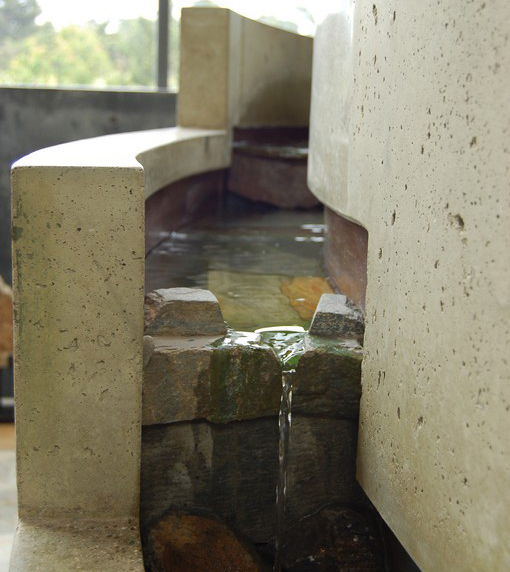
My dictionary defines a rill as a small stream cut by erosion. In the practice of watershaping, however, that colorful little word has been stretched to cover manufactured channels in which we artfully move water from one place to another. These often-subtle effects have a history dating at least to the 5th Century BC, when Persian kings demonstrated their power over nature by using rills to bring water – a symbol of fertility as well as a practical means of cooling architectural spaces – from rivers and aqueducts to their palaces. These early rills were observed and adopted by Muslim designers and engineers who rose to eminence in the Middle East more than a millennium later and were carried along as Islamic influence spread through India, North Africa and, eventually, Spain, where signature elements of Moorish architecture are still seen today in the famous

Teaching children about the science associated with the natural elements of earth, air, light and water in an imaginative, fun and engaging way is one of the key missions of modern museums of science. Conveying those concepts through a landscape, however, is a unique and ambitious goal - one we suggested to the directors of Montshire Museum of Science of Norwich, Vt., as a way of transforming the museum's grounds from ordinary exhibit space into a true laboratory for learning. During all of the early discussions of types of natural phenomena Montshire wanted us to explore, museum representatives always seemed most excited about those associated with water. They agreed with us that water exhibits could teach children about wonders as diverse as stream erosion and deposition, the reflection and absorption of light, how the pattern of water currents and flow velocities are affected by the size and shape of the water's container, how the pressure of water increases as its depth increases, and how the air temperature cools as one

No matter how it's used - as a focal point in a design or as just another feature balanced among many - the thoughtful use of water offers landscape architects and other watershape designers a huge range of aesthetic opportunities. Indeed, the water's texture, reflectivity, sounds and sculptural qualities can all be used to enhance the observer's experience as he or she moves through an environment, and in a near-infinite number of ways. Regardless of how familiar one becomes with these attributes and using them in built spaces, the presence of water in a design often yields something new, interesting and even unexpected. Whether you use it as a visual transition, a physical destination, an expression of nature or an architectural statement, water is