








rebar

Lots of pools built in the 1960s and '70s and even through the '80s were surrounded by ribbons of concrete decking of uniform width, all the way around. Frequently, those decks were too narrow to make them of much use for more than walking around the pool: lounge chairs are too long to be set up facing the water, and a poolside table and chairs cover far too much ground to be included. The solution that runs through the heads of lots of homeowners is simply to

Working on a large-scale project is a challenge when it happens even ten miles from your home base: Big jobs are just plain tough. But building that same project 150 miles away? That takes the difficulty to another level - and when you mix in an extremely difficult, environmentally sensitive site, it can feel as though you're operating on another planet. A case in point can be found in our participation in a design/build project on a remote cottage estate in the stunning

I had a college professor who was fond of saying, "There are only two types of concrete in this world: The first is concrete that is cracked, and the second is concrete that is going to crack." That's a good laugh line, but the tough thing about it is that it's also true. This is why the engineering design procedures for all reinforced concrete (pursuant to ACI 318 and 350, which are the key American Concrete Institute standards for concrete structures) allow for

In a great many of the renovation projects I come across, one part of the program involves raising the floor in the deep end of the pool to create the classic play-pool contour with a deeper area in the middle and shallower sections on both ends. This retrofit brings these pools into line with one of the most popular features of today's new pools, so many of which are set up for pool volleyball and other vigorous games. The great thing about these sporty pools is that the shallower ends have a

Through the past 20 years or so, the vanishing-edge look has become perhaps the most recognizable hallmark of high-end, custom swimming pools. In that time, these vessels have gone from relatively rare to remarkably common. These days, in fact, it's a rare builder who doesn't have at least a handful of these projects in his or her portfolio. Unfortunately, this growth in the popularity of vanishing edges has been attended by a dramatic increase in problems with these structures, particularly on the outside surface of the freestanding wall that creates the elegant edge detail. The problems manifest themselves as cracks, surface delaminations, efflorescence and, in severe cases, as leaks. These are issues that have led to scores of dissatisfied homeowners and numerous potential
Through the past 20 years or so, the vanishing-edge look has become perhaps the most recognizable hallmark of high-end, custom swimming pools. In that time, these vessels have gone from relatively rare to remarkably common. These days, in fact, it's a rare builder who doesn't have at least a handful of these projects in his or her portfolio. Unfortunately, this growth in the popularity of vanishing edges has been attended by a dramatic increase in problems with these structures, particularly on the outside surface of the freestanding wall that creates the elegant edge detail. The problems manifest themselves as cracks, surface delaminations, efflorescence and, in severe cases, as leaks. These are issues that have led to scores of dissatisfied homeowners and numerous potential

The combination of concrete and steel is the currency of most modern construction, and there's a simple economic explanation for that fact: The affordability and availability of the basic ingredients of cement, aggregate, water and rebar have made their combination viable for use in countries the world over. Used together, especially when the cementitious product comes in the form of pneumatically applied concrete, reinforced concrete is incredibly flexible and can be used to create almost any shape we might imagine. And in the case of pneumatic application, those shapes can largely be created without the use of traditional concrete forms. Indeed, it's a construction matrix that can be used in such a way that the contours of the soil dictate the shape of the structure, giving the watershaper almost unlimited flexibility. It's even fair to say that
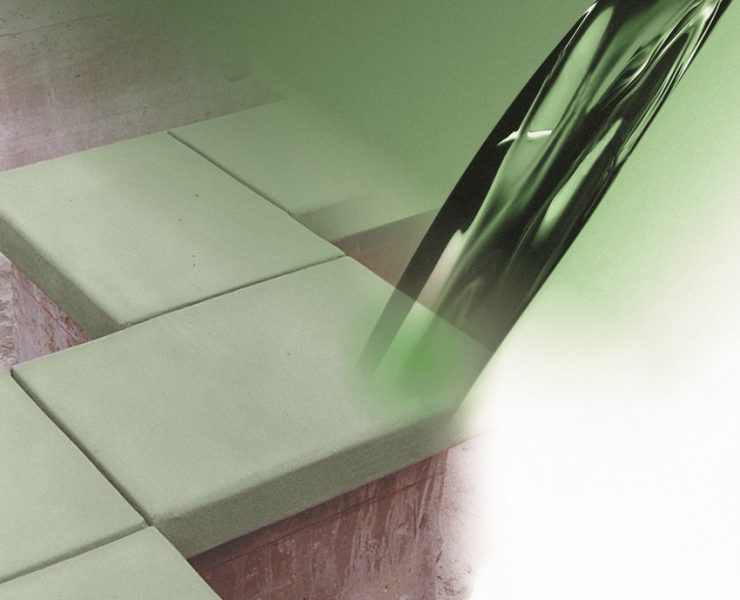
Edge treatments are important to me. They can lead the eye into the water, set up a barrier, break down a barrier. They're simply too critical to the overall impression made by a watershape to be left to chance. For the past ten years, I've found myself using one edge treatment more and more: a poured-in-place coping that uses colored concrete. I've now done it dozens of times, and my clients have always been thrilled by the results. In effect, I use the concrete to create soft and subtly colored rectangular

Watershapes come in lots of configurations and sizes, but when you get right down to it, they mostly share two basic materials of construction - concrete and steel - that in combination have the potential to withstand generations of use. Fashioning these structures is at the heart of what watershapers do: Every-thing else, from the plumbing or the plaster to the tile or the decking, is really secondary. Sure, the pool won't function without plumbing or look pretty without tile, but it wouldn't even exist without its skeleton of steel and its concrete flesh. For all that importance, however, most people tend to give the steel in particular little thought or care. It's invisible once the gunite is in place, so there's a tendency even among those who know better to blow it off and save a few bucks by using too little steel or by doing quick, sloppy work. And why should you care? No one will ever see what you've done, right? Actually, given the role that steel plays in the durability and viability of the concrete structure, this should be the last place to