








garden design
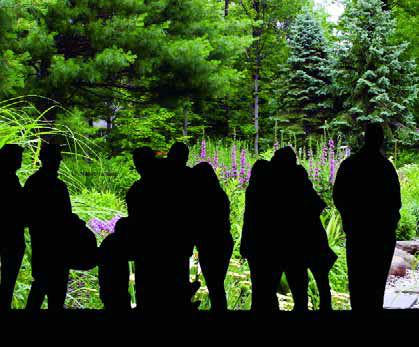
With spring upon us, calendars of local events are filling up with garden tours of all shapes and sizes. From large estate tours and special events at botanical gardens to tours of wonderful neighborhoods staged by local garden clubs, there's much to be seen while wandering through the grounds and yards and viewing the work of other designers and architects. I've always enjoyed these tours and learn something from each and every one, whether it's about a new plant or plant combination or an installation technique shared by a generous designer or installer who's on hand for that purpose. On a completely business note, I also have to say that some of my best-ever

The fact that the vast majority of our landscapes exist on the ground floor has posed a challenge as city dwelling has become more popular: Relatively few urbanites are lucky enough to have ground-floor garden spaces to work with, but that in no way diminishes their desire to include garden spaces as components of their upper-floor environments. Even without land for plants, people still want to come home to attractive gardens at day's end. Although the first roof gardens date back to the Hanging Gardens of Babylon, city dwellers with only rooftop and balcony spaces at their disposal have been forced to get innovative, developing creative and sometimes highly unusual solutions. Hence the emergence of "roof gardens," which often combine spectacular distant views and dramatic cityscapes with creative hardscape and planting treatments - works of art that expand livable space as well as the

‘Any time that you can introduce water or the sound of water into an environment, the space is instantly transformed.’ – Geoffrey Lew Rausch, FASLA, 2006 recipient of the Henry Shaw Medal for his work at the Missouri Botanical Garden During the past three decades, the Missouri Botanical Garden has undergone a wonderful transformation, and much of it has been about water. In that span, more than a dozen fountains and waterfeatures have been added to the 79-acre grounds of what many have long been considered to be one of the top three public gardens in the world – and happily, our firm, Hydro Dramatics of St. Louis, has had the privilege of working on all of them as project leaders. These installations have ranged from the simple to the complex. Whether serene or splashing, barely bubbling or shooting skyward, our work has added a unique spirit and drama to many already-beautiful sites. In addition, they’ve involved us in memorable collaborations with the garden’s creative staff, generous sponsors and the more than 850,000 people who come to the garden annually. For our part, the diversity of the watershapes

We live in a multi-dimensional world. Most people understand that space has three dimensions: height, width and depth. But relatively few people look at color in the same way - that is, as a three dimensional phenomenon. Understanding these three dimensions of color can become the key to unlocking your creativity as a designer. We began our study of color in LandShapes' May/June issue ("Designing in Color," click here), where we explored the scientific nature of color and its first dimension - hue, the name of a color (red, yellow, blue, orange, green or violet) - and learned that each hue has a temperature range (from warm to cool). We also learned that all six hues may be organized and better understood through the use of a helpful tool developed by color scientists called the color wheel. We will now continue our study of color by exploring the second and third dimensions of color and then by discussing contrast, analogous and complementary colors and color harmony. This will enable us to begin applying these fundamentals as landshapers and see in practical terms how understanding these fundamentals can help us become better

It has always bothered me a bit that designers tend to restrict their thinking to just the physical area that fits the definition of their design specialty. Landscape designers stick to outdoor spaces and interior designers work on interior ones - and seldom the twain shall meet. To my way of thinking, that's shortsighted - which is just one of the reasons I'm both a landscape designer and an interior designer. I would argue that, when it is appropriate, professionals on both sides of the divide need to open their eyes and work with the visual flow through and between clients' interior and exterior spaces to achieve optimal design results. As landscape professionals, we already accept the importance of the "borrowed view," a wonderful term used to describe the deliberate capturing of other properties' assets by creating living or artificial frameworks that make them an artistic component of our clients' landscapes. If we are good at capturing neighboring views for our landscapes, I'd suggest it's a short step to make certain that we achieve the same sorts of wonderful views between the

As designers, we learn to evaluate landscapes and watershapes with critical eyes, deciding if we like a plant palette, for example, or if a hardscape makes sense or a watershape is sited properly in a yard. These critical skills are important, because clients hire us to pull all of those elements together and develop solutions that suit their needs as well as those of the setting. On rare occasions, a design/build project will stay on a straight course from initial concept to execution. Usually, however, I know that any ideas or biases I carry onto a job site will change and become more complex as I get to know my clients' wants, needs and desires. In other words, my critical skill - my designer's point of view - is consistently

Inspiration - literally, the breath of an idea - can come from any number of sources. While studying the work of 20th-century designer Beatrix Farrand at Dumbarton Oaks in Washington, D.C., for example, I spotted the planting combination of climbing pillar rose and Wisteria and thought her brilliant for having covered the woody Wisteria stems with rose flowers and

For centuries, the Mediterranean gardens of Italy, France, Greece and Spain have put sun-thriving plants on beautiful display in dry environments. The Greek isles flourish with wildflowers whose colors become more vivid against the bleached background, while Spanish gardens combine the fragrant blossoms of citrus trees and the fragile pink blooms of Almond trees with open, arid landscapes. Italian and French gardens present more formal atmospheres, incorporating boxed and trimmed trees with trellises and pergolas draped with vines. Each area has its distinct style, but the main elements of these gardens are the same, with the hot sun being the primary common factor. As is revealed, however, in Designing and Creating a Mediterranean Garden by the English artist Freda Cox, it is possible to cultivate

As is true of many things we savor in our lives, our perception of texture is filled with subtlety and nuance. This is particularly true in gardens, where space, form, color and texture dance together to create our experience of a living entity and, for designers and installers, of the envisioned entity as well: We start by defining the entity's function and style - make it an outdoor room, a neoclassical knot garden or a meditative space - then layer hardscape and plant materials to engage the five senses one by one or all at once. Texture plays a large role in creating this sensory engagement: It's the lure that invites observers to pause and linger, to breathe deep and compose themselves within the environment. In that sense, texture is the twin of form and the companion to color in the triad of basic garden relationships. Texture also involves an

A well-conceived garden that has endured through many decades can teach us all a multitude of lessons. In the case of the Virginia Robinson Gardens, however, even getting to the point where those lessons might be recognized and appreciated has taken years of research, study and painstaking restoration. In the nine years I've been associated with the gardens, I've done all I can to determine the original design intent of those who owned and established it, stripping away generations of alterations, additions and miscalculations while interpreting the site and uncovering clues that point to the sense of mission and the creative spirit that influenced its creation and further development early in the 20th Century. I've done so with a recognition that the Virginia Robinson Gardens are important as an emblem of southern California history and an era gone by. I've also come to perceive the complexity, artistry and beauty of the space, seeing it as a blueprint that, examined closely, can serve to inspire and inform the work we all do today. The current gardens occupy most of the grounds of the former estate of Harry and Virginia Robinson, heirs to a department store fortune. My charge has been to restore and manage these six-and-a-half acres in the heart of Beverly Hills, Calif. - a graceful setting in the midst of