








engineering

Our discussions in the last two issues have been about excavation, which leaves us this time with a big, literal void that serves as a relatively exact dimensional representation of the vessel we're building. After we've installed the forms - a subject I've covered in great detail in a number of past columns - it's time for the installation of the plumbing and steel. Before we jump into that process, however, let me make a key point: Although I am a knowledgeable builder who has paid attention through the years and can work his way through lots of watershaping projects without assistance, I am not
Our discussions in the last two issues have been about excavation, which leaves us this time with a big, literal void that serves as a relatively exact dimensional representation of the vessel we're building. After we've installed the forms - a subject I've covered in great detail in a number of past columns - it's time for the installation of the plumbing and steel. Before we jump into that process, however, let me make a key point: Although I am a knowledgeable builder who has paid attention through the years and can work his way through lots of watershaping projects without assistance, I am not

Through the past 20 years or so, the vanishing-edge look has become perhaps the most recognizable hallmark of high-end, custom swimming pools. In that time, these vessels have gone from relatively rare to remarkably common. These days, in fact, it's a rare builder who doesn't have at least a handful of these projects in his or her portfolio. Unfortunately, this growth in the popularity of vanishing edges has been attended by a dramatic increase in problems with these structures, particularly on the outside surface of the freestanding wall that creates the elegant edge detail. The problems manifest themselves as cracks, surface delaminations, efflorescence and, in severe cases, as leaks. These are issues that have led to scores of dissatisfied homeowners and numerous potential
Through the past 20 years or so, the vanishing-edge look has become perhaps the most recognizable hallmark of high-end, custom swimming pools. In that time, these vessels have gone from relatively rare to remarkably common. These days, in fact, it's a rare builder who doesn't have at least a handful of these projects in his or her portfolio. Unfortunately, this growth in the popularity of vanishing edges has been attended by a dramatic increase in problems with these structures, particularly on the outside surface of the freestanding wall that creates the elegant edge detail. The problems manifest themselves as cracks, surface delaminations, efflorescence and, in severe cases, as leaks. These are issues that have led to scores of dissatisfied homeowners and numerous potential

When it comes to the myriad specialties of the world of watershaping, it's tough to think of any as broad as the one occupied by floating fountains: It's a category of systems that encompass flotation, illumination, spray systems, submersible pumps, connecting devices and land-based controls. On the one hand are the huge systems installed near the shores of lakes and rivers. These fountains can be monumental in size and visually dramatic - the sorts of popular landmarks that become tourist attractions and, often, community icons. On the other, there are the countless smaller floating fountains and aerators located in golf-course ponds and water hazards, in municipal-park and stormwater ponds, on private estates and institutional campuses and in the bays of larger bodies of water, either as single features or as groups. For 45 years now, our firm has been fortunate enough to have designed (and at times installed) floating fountain systems across this full spectrum, from the large and spectacular to the small and surprisingly subtle. Some have been purely decorative, while others have been totally
When it comes to the myriad specialties of the world of watershaping, it's tough to think of any as broad as the one occupied by floating fountains: It's a category of systems that encompass flotation, illumination, spray systems, submersible pumps, connecting devices and land-based controls. On the one hand are the huge systems installed near the shores of lakes and rivers. These fountains can be monumental in size and visually dramatic - the sorts of popular landmarks that become tourist attractions and, often, community icons. On the other, there are the countless smaller floating fountains and aerators located in golf-course ponds and water hazards, in municipal-park and stormwater ponds, on private estates and institutional campuses and in the bays of larger bodies of water, either as single features or as groups. For 45 years now, our firm has been fortunate enough to have designed (and at times installed) floating fountain systems across this full spectrum, from the large and spectacular to the small and surprisingly subtle. Some have been purely decorative, while others have been totally
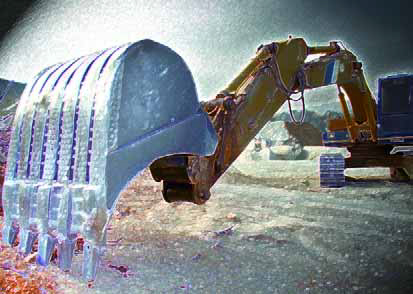
One would like to think that if there was anything all watershapers were good at doing, it would be digging holes. As with many other watershaping activities, however, it is apparent that some are better at it than others and that the excavation portion of a project either does a good job of setting the stage for great things to follow - or involves errors that can project themselves all the way through to the finished product. In my view, getting things right at this stage is as important as any other step in the design, engineering or construction process and is actually
One would like to think that if there was anything all watershapers were good at doing, it would be digging holes. As with many other watershaping activities, however, it is apparent that some are better at it than others and that the excavation portion of a project either does a good job of setting the stage for great things to follow - or involves errors that can project themselves all the way through to the finished product. In my view, getting things right at this stage is as important as any other step in the design, engineering or construction process and is actually

I've seen many changes in the 38 years I've been installing vinyl-liner pools. When I started out, we worked mostly with wooden walls, and I even recall some made with asbestos. We always did our best, but I'll concede that in those early days the construction techniques were relatively unsophisticated. These days, we at The Pool & Spa Doctor (Wall, N.J.) work mostly with galvanized-steel construction and, in a smaller percentage of projects, with either modular polymer or fiberglass systems. We've been at it long enough in our market that, through the years, we've gone in and replaced many of the old wooden walls with modern modular systems - an experience that always drives home for us the fact that the
I've seen many changes in the 38 years I've been installing vinyl-liner pools. When I started out, we worked mostly with wooden walls, and I even recall some made with asbestos. We always did our best, but I'll concede that in those early days the construction techniques were relatively unsophisticated. These days, we at The Pool & Spa Doctor (Wall, N.J.) work mostly with galvanized-steel construction and, in a smaller percentage of projects, with either modular polymer or fiberglass systems. We've been at it long enough in our market that, through the years, we've gone in and replaced many of the old wooden walls with modern modular systems - an experience that always drives home for us the fact that the