








Currents

I think we can all agree that design communication between architects, engineers, designers and contractors should be clear and concise. If that’s the case, it follows that plans and other construction documents should be uniform in their organization and layout – in other words, that they should follow a set of standards to which everyone in the design/construction community can and will adhere. Why the bother? The plain fact is that any given project involves a cast of characters that will be different – sometimes completely so – from just about any other project. This is why I’m such a strong advocate for

It’s an unfortunate fact that landscape architects receive little or no formal education in watershaping while they’re in school. As a result, where the typical landscape architect’s irrigation plan will show every pipe, fitting, wire and component for a given project, that same project’s pool plan will carry almost no detail at all. This phenomenon begs the question: Why don’t our colleges and universities do more to educate landscape architects about watershaping? The answer to this question causes me double pain, because I know full well that
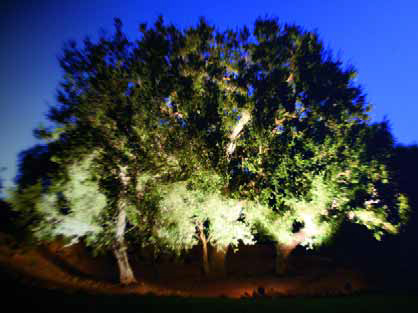
Although the eye is commonly drawn to structures and other architecture elements found in any given exterior environment, very often it is trees that serve as visual anchors in modern landscapes. Indeed, they tend to be the largest objects on most properties and will often become focal points even in settings in which they might have started out in supporting roles. This dominance or even potential for dominance is why, as a lighting designer, I believe that trees should always receive

Think of it: Just below the surface of our ponds and streams is a wonderful potential for beauty, an amazing opportunity to open observers' eyes to an entire submerged "landscape" made possible by virtue of completely clear water. I like to picture it as an "underwater garden," which is why, to me, water clarity is an essential component of my ponds and streams. Too often, however, I run into settings in which it simply has not been a priority for the designer or installer. I'm further distressed when the subsurface views I treat as key design elements are left partially or wholly unconsidered. I think back to my family's trips to the seashore, where we would spend hours observing rocky tidal pools. Peering into the water and seeing a world of oceanic plants and animals at close proximity was a profound source of fascination and excitement. It is for me still – and, I believe, for most other people as well. What I see in tide pools is a perfectly balanced, utterly natural underwater garden filled with beautiful stone colors, textures weathered by the action of the waves and tides and a plethora of pebbles and sand mixed with bits of seashell. It is here that we may