








Currents

For more than 10 years now, outdoor rooms have been growing steadily in both popularity and complexity. That’s great, because it enables designers – architects, landscape architects, landscape designers and pool builders alike – to bring interiors outside and provide living spaces where activities previously associated strictly with indoor spaces can move comfortably into the great outdoors. It’s a fantastic way to expand living areas and create useful spaces while also adding entirely new types of experiences to the lives of homeowners. Among this trend’s many implications is that it has challenged landscape lighting designers to think in all-new ways about how we light exterior spaces. For starters, we need to be aware that most homeowners will enjoy these spaces exclusively after dark – and also be conscious of the fact that these environments require much more complicated lighting schemes than classic suburban patios ever did. The differences are so profound that I believe lighting designers need to talk to clients in new ways that
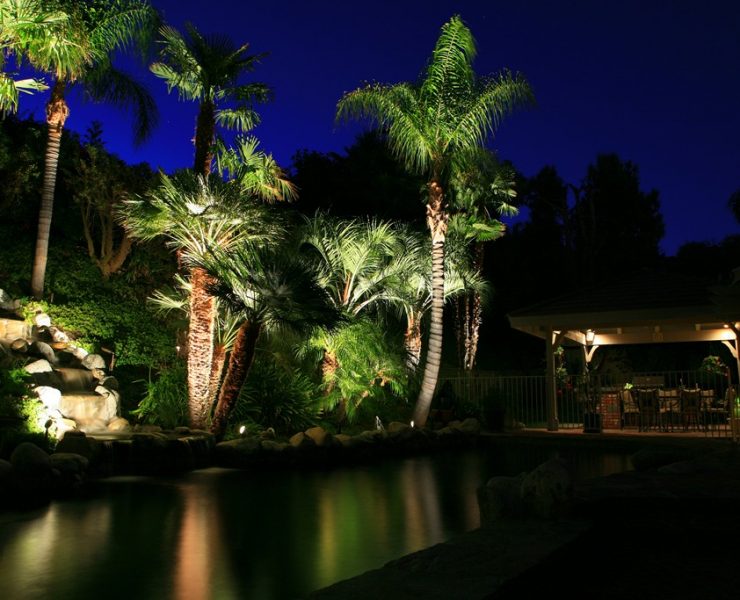
If there’s ever been such a thing as a match made in heaven, swimming pools and landscape lighting lay a strong claim to that perfection. Separately, they take little-used spaces and transform them to all-day hubs of activity and sources of constant beauty. Together, however, the magic starts, with pools and landscape lighting systems accentuating each other’s virtues in ways that are tough to quantify or adequately describe. To landscape lighting designers and installers, pools offer a

Have you had just about enough of the current chatter about the environment? Have the terms “global warming,” “carbon footprint” and “sustainable landscape” become more irritating to you than they are inspiring? If so, all I can say is that I don’t think you’ll like the future. Indeed, for those of you who’ve spent the last little while waiting for the Green Revolution to fade away need to set aside any hope that it’s just a fad – just some trumped-up, pop-culture phenomenon that will go away as suddenly as it came to prominence. In fact, the green movement – or whatever you want to call it – is rapidly on its way to

In most watershapes, we circulate and treat water through use of pumps and filters – and although we still don’t think about it much these days, we do so because fresh water is in precariously short supply and we can’t simply fill and dump it as we please. Yet even a perfect watershape – that is, one devoid of leaks, never subject to splash-out and never in need of backwashing – occasionally requires the addition of new water if only because evaporation will carry it away, bit by bit. In fact, there’s no way to cut Mother Nature out of her share, or to keep her from

In my last “Currents” column (June 2009), I began a discussion of Project Manuals with an overview of these written specifications and other construction documents and how they are formally bound and made part of a project’s contract documents. This time, we’ll dig inside the manuals and take a closer look at what they contain. Let me start with a simple recommendation: If you don’t already work with Project Manuals in some form, now is probably a good time to get started – especially if you’re a watershaper who prepares designs to be

I’m always surprised when I run into clients or prospects who don’t appreciate or fully accept the fact that landscape-lighting systems require routine maintenance. These are people who easily recognize the need for upkeep when it comes to their swimming pools or landscapes, but this perception simply doesn’t extend to the lighting systems that frequently go along with them. I suspect this is so because dealing with lighting inside a home is so simple – basically just a matter of changing burned out bulbs as the need arises. Some also believe that landscape light bulbs should and will last forever, which is

“I’m mad as hell, and I’m not going to take it anymore.” Those words (originally uttered by the fictional newsman Howard Beale, for those of you who remember the movie “Network”) reflected the frustration of a man overwhelmed by the forces that governed his working life and the society in which he lived. His declaration became the rallying cry of a movement that formed around his sense of outrage. I’m in that same sort of outraged mode right now and find myself on a similar quest for allies: I want the watershaping industry to change now and for the better, but

Through the past year and a half, I’ve dedicated four “Currents” columns to the subject of drawing practices and the National CAD Standards. But construction documents consist not only of drawings, but also written specifications – so now I’ll shift my attention to Project Manuals – key communication tools used by architects and engineers to uphold quality and establish performance requirements for all of a given project’s contractors. Basically, a Project Manual is a bound book of construction documents prepared to define

From my perspective on the design and installation side, I see bringing landscape lighting to a property as a process that includes careful planning and execution as we compose the different scenes and lighting elements; count and select fixtures; lay out the power-distribution system; install everything properly; and, finally, fine-tune it all before turning things over to our clients. Looking at it from the other side, it’s been my observation that clients approach these projects with an equivalent level of deliberation: Even among relatively affluent clients, landscape lighting represents a significant



Tomorrow’s Advocates