








contours

It's no secret among those who've been in my segment of the watershaping industry as long as I have that vinyl-liner pools weren't as attractive as their gunite counterparts in the old days: The finishes weren't very interesting, options in colors and patterns were limited, the only type of coping we used was made of aluminum and most liners were only available in rectangular configurations in a limited number of standard sizes. Despite those shortcomings, however, vinyl pools caught on, and in a big way, and I have watched every stage of that development for the more than three decades I've
It's no secret among those who've been in my segment of the watershaping industry as long as I have that vinyl-liner pools weren't as attractive as their gunite counterparts in the old days: The finishes weren't very interesting, options in colors and patterns were limited, the only type of coping we used was made of aluminum and most liners were only available in rectangular configurations in a limited number of standard sizes. Despite those shortcomings, however, vinyl pools caught on, and in a big way, and I have watched every stage of that development for the more than three decades I've

Successful design is, I think, most readily achieved by linking a landscape to the architecture it accompanies. During my years as a landscape designer, however, I've seen far too many places where the landscape was apparently designed in a vacuum, displaying little to no connection to the home or any other structures on site. To the contrary, our job as landshapers is to
Labels are often deceiving: They don't always tell the whole story. In the green industry, for example, most of us identify ourselves as either designers or contractors, but after 18 years of landshaping, it's clear to me that a majority of us are really to varying degrees both designers and contractors. The very best designers understand
With a first glance at last month's cover of LandShapes, a colleague of mine said he thought it more properly belonged on the cover of an architecture magazine instead of on my landscape publication. It was beautiful, he said, but he felt that the dominance of the wall in the image made him wonder if he'd received the right magazine. In defending the choice of this photograph, I found myself flooded by all sorts of thoughts and considerations, many of them having to do with

When you work with any type of concrete, there are right and wrong ways to do things - basic issues of workmanship that really do determine whether a structure will be reliable or not. In the case of swimming pools and spas built using pneumatically applied concrete - either shotcrete or gunite - there's a presumption in structural design that the concrete will cure to the strength specified, which, in the case of pools and spas, is typically 2,000 pounds per square inch. If that's not the case, these structures do not meet their specifications and may be subject to failure as a result. To achieve that desired level of strength, the concrete must be
Beautiful gardens make us happy. When we walk through or by them on the way to our daily activities; when we happen upon them while driving from one place to another; when we deliberately make them our destination - whatever the circumstances, beautiful gardens bring smiles to our faces and a sense of balance and serenity to
Welcome to the premiere edition of LandShapes, a magazine for professionals who design and install exterior environments. With this first issue, we begin a journey that will take us deep inside the landscaping professions to meet the needs of landscape contractors, designers and architects as well as excavators, soil-retention specialists, hardscape installers, lighting designers, arborists - just about
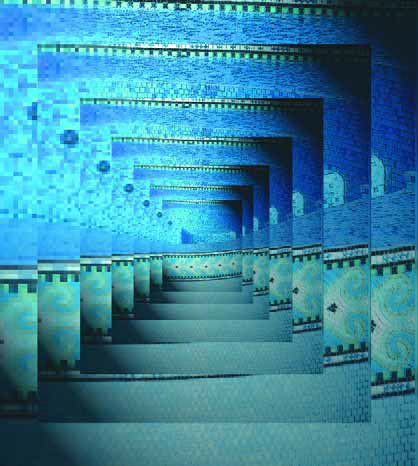
A great many wonderful things can be said about all-tile pool finishes once they're done, but you can't lose sight of the fact that that such finishes require lots of planning, are difficult to apply and, as your clients will tell you, are far from inexpensive. And by "far from inexpensive," I mean that the price tag will usually give pause even to people of great means. This is all especially true with glass tile, which is applied using different (and generally more complicated) techniques than is ceramic tile and costs proportionately more. But that cost brings with it a great and stunning beauty that

Whether it's done using only a tape measure and a pair of experienced eyeballs or requires the help of satellites orbiting the planet, every construction project is surveyed before the work begins. In fact, surveyors have been plying their trade for thousands of years, and their services have been valued for one simple reason: It's really a good idea to measure the size and shape of the ground before you try to build on it. In today's terms, surveying is defined as the process of taking accurate measurements of the land on the X-, Y- and Z axes (that is, in three dimensions) and then translating that data into a usable (usually printed) format. There are several different surveying methods used to measure, process and communicate this critical information, and choosing the right one is essential to getting any watershaping project off to a sound start. So how do you determine the level of detail required and communicate your need to the surveyor so he or she can give you the appropriate level of information? Let's take a look at the different types of surveys in common use and review what those options mean in terms of creating a truly useful array of