


Face Value
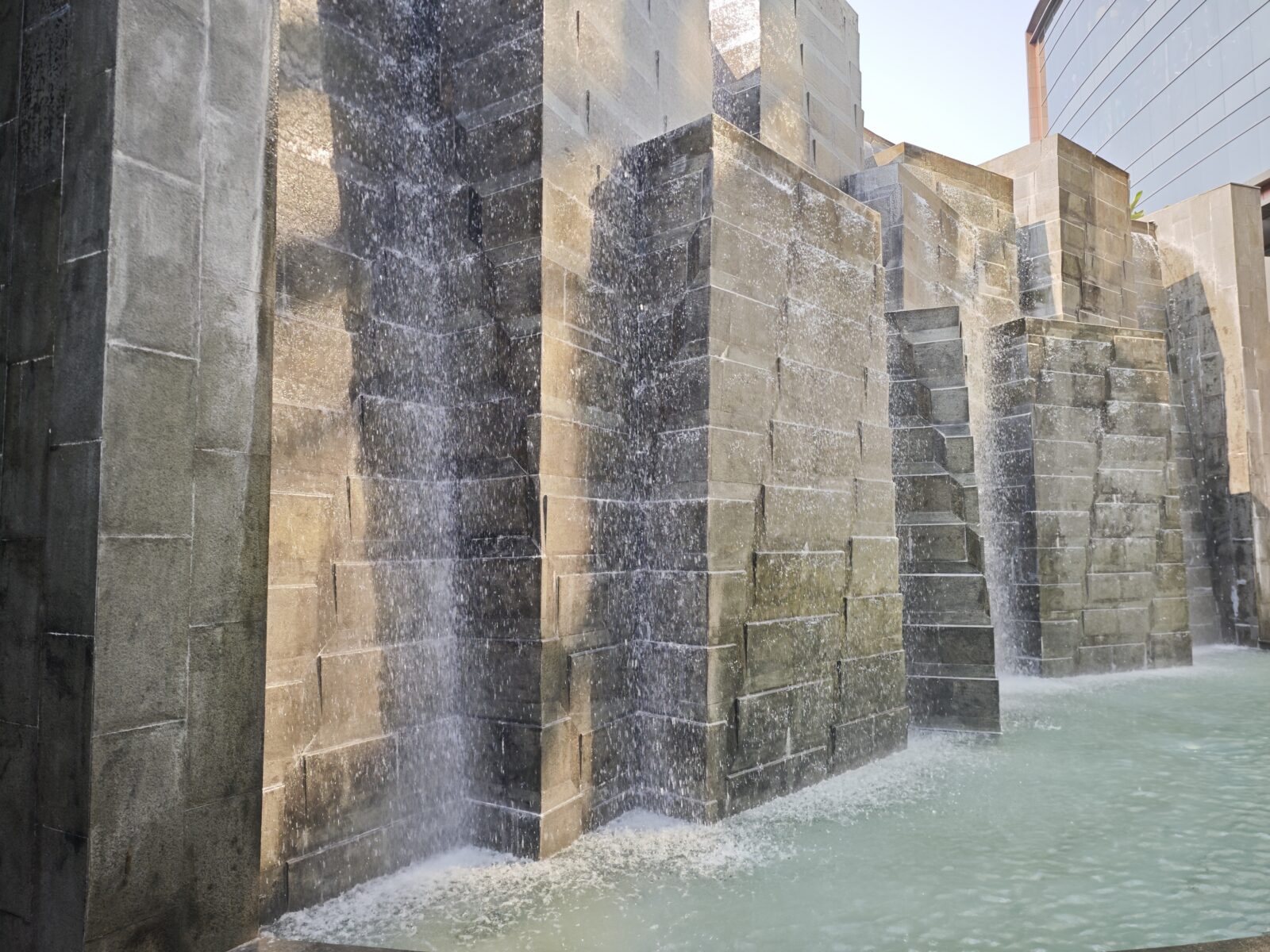
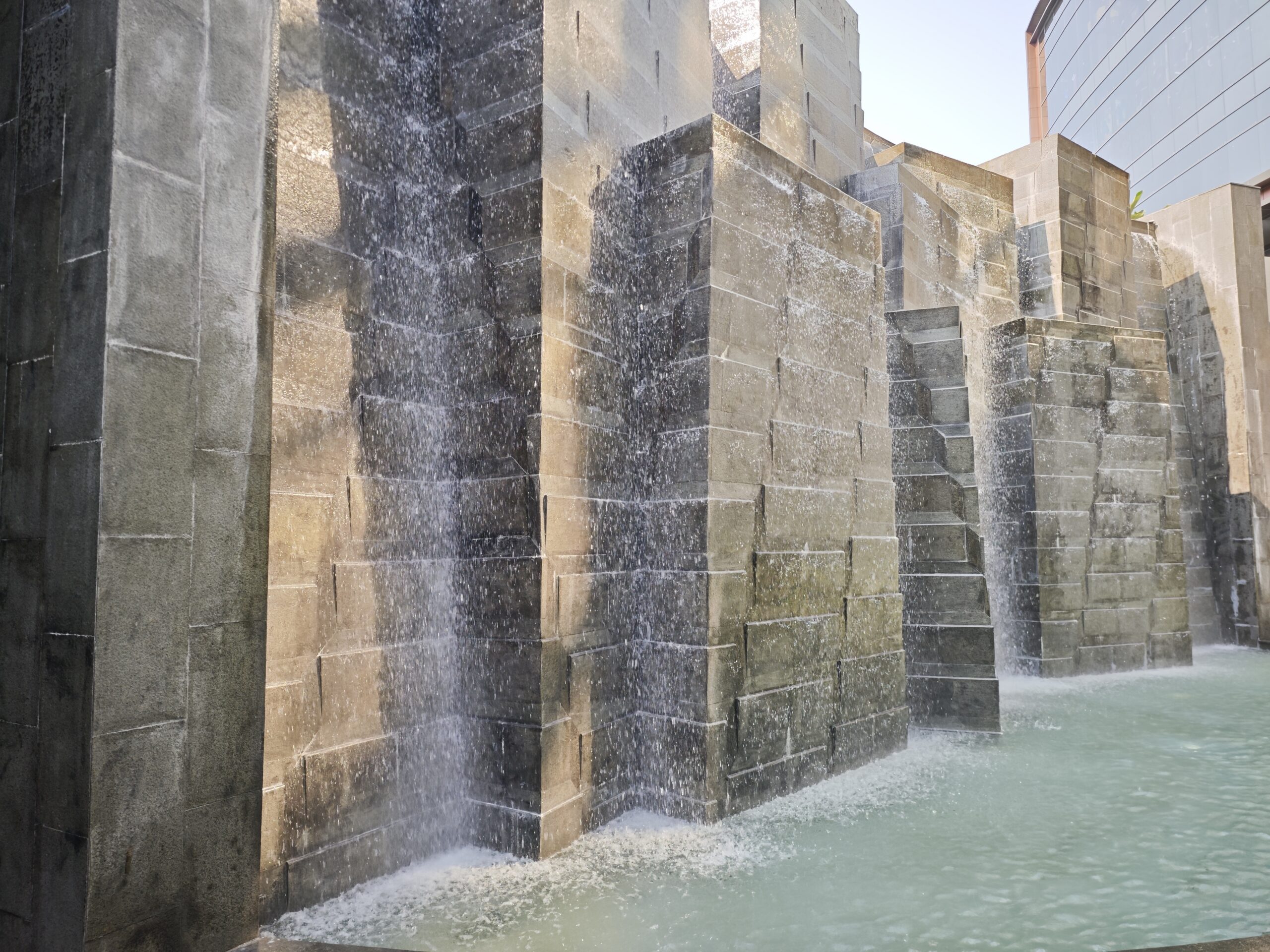
Stone for a water wall or spillway is usually judged dry, yet it spends its working life wet. Its finish shapes the flow, constant wetting changes its color, and the work behind the veneer determines whether the stone stays put. Kareem Klisharo explains how each factor can be evaluated before the stone is cut.
By Kareem Klisharo
Once the pumps start, the water-wall or spillway face stays wet for as long as the pumps run. Its finish helps determine how the water behaves: whether it sheets cleanly, breaks into white water or throws spray beyond the basin. Constant wetting also changes the stone’s appearance, while the work behind the veneer determines whether it stays securely in place.
WS has for many years examined these characteristics and functionality from the design and hydraulic sides and we’ll look back at some of those articles here. For example, in his “Detail: A770” (November 2020), Dave Peterson traced excessive splashing on an 8-foot resort waterwall partly to texture in the stone veneer, which created “splash blocks,” and partly to excess flow. The weir was out of level, and the pump had been run harder to wet the entire wall. This article examines the same surfaces from the stone supplier’s perspective.
Note: I supply natural stone, so what follows is my reading of published sources rather than a collection of project stories.
Finish Under Flow
Common finishes include sawn, honed, flamed, split-face and natural cleft. Joe Nolan covered these in “A Stone Primer” in 2007, noting that granite and some quarzitic sandstones can be flamed. For a water feature, the key consideration is how much surface relief each finish leaves.
Paul L’Heureux, writing in these pages in 2000, put the thickness of a falling sheet just past the weir at 0.2 inch at 10 gallons per minute per linear foot. A 2021 laboratory study measured the average peak-to-valley roughness (Rz) of flamed granite at about 0.005 inch (130 micrometers). By my calculation, that relief is about one-fortieth the thickness of the sheet at the weir, the only point for which I found a published thickness.
On that rough comparison, I would expect honed and flamed faces to affect the water’s texture more than its path. Split-face and cleft relief is another matter. I found no published measurement of it, and Peterson did not name the finish on his wall, only that its veneer had too much texture. Mark Holden noted in 2007 that flagstone needs more flow than honed granite to give the same sheet.
Texture is not inherently a problem. Peterson sometimes designs splash blocks into a feature for added texture, sound and visual interest, and Rick Chafey described a split-faced basalt wall operating at just 6 gpm per linear foot to produce a textured flow. The question is whether the finish suits the intended effect and the catch basin. Peterson’s basin was only about 18 inches wide.
The lip needs its own decision. Skip Phillips, quoted by Steve Gutai in 2006, holds that a sharper edge needs less flow and a larger radius at the crest needs more. In Detail A825, Peterson’s team argued that a stone edge would be easier than steel to grind and polish, though the architect chose steel.
The Wet-Offcut Test
No standard requires designers to run water over a stone sample, but mock-ups are well established. In 2023, Mostafa Fawzi wrote in WS that mock-ups “can be one of the most valuable steps in a design process.” On one project, his team built six weir edges and tested them side by side, then tested three textured glass panels under flow before selecting one. Pool & Spa News noted in 2008 that water walls can be particularly challenging because designers may not know the required flow per foot or how the water will interact with the surface.
Ask for an offcut from the same lot, in the exact finish and thickness, at least a foot wide. Position it at the intended wall angle over a tub and feed it from a trough with a level lip. Measure the flow with a bucket and stopwatch, then scale it to the sample’s width. At 10 gpm per linear foot, a 12-inch-wide offcut needs 10 gpm, or roughly a gallon every six seconds. Watch where the sheet breaks, where white water develops, how far droplets travel and what the flow sounds like. Let the water run until the color stabilizes, then allow the stone to dry and inspect the margins.
An offcut has limits. It shows how the surface handles water, but it cannot reproduce the full drop. L’Heureux wrote that falling water breaks up after a drop of five or six feet; Peterson attributed breakup at about six feet to wind shear. Outdoor breezes can add to the effect.
Color Under a Running Sheet
Most stone looks darker when wet. In a 1988 optics paper, J. Lekner and M. C. Dorf explained that a water film sends more scattered light back into the surface, where more of it is absorbed. The Brick Industry Association notes that a stone’s true color becomes apparent only after moisture evaporates, and that evaporation rates vary with a wall’s exposure to sun and wind. On a water wall, the wet center, damp margins and dry returns may therefore appear to be different shades of the same stone.
Some designers select stone specifically for this effect. In 2001, Mark Holden chose cantera fountain bowls because they blended with the site’s sandstone when wet, rather than dry. He had the mostly dry exterior of the basin treated to match the wet bowls. Evaluate a wet offcut beside the coping and deck materials it will meet, both in daylight and under the planned nighttime lighting.
In freezing climates, remember that absorption alone does not prove frost resistance. A 2020 study of an oolitic limestone found freezing strain rose once its pores were more than 70 to 80% saturated, a level a face that never dries may well reach. Ask for a freeze-thaw test, its method and its cycle count.
White Lines on Dark Stone
Pale lines on a wet stone face usually have one of three causes, each requiring a different solution.
Efflorescence is a white powder of salts carried out of the stone or its backing by water and deposited as the water evaporates. The salts dissolve in water. The Natural Stone Institute recommends removing efflorescence while dry, since washing can temporarily conceal it, and locating the moisture source if it returns. In his 2017 article, “Edge Wall Essentials,” Paolo Benedetti has traced efflorescence on vanishing-edge walls to water moving through the mortar bed and escaping through cracked grout.
Lime run forms a white or gray crust from calcium in mortar and other cement-based materials. According to the Brick Industry Association, once the deposit fully hardens, it no longer dissolves. It will continue to form along the same path until the source of the water is stopped.
Scale comes from the feature’s own water. Evaporation removes nearly pure water and leaves minerals behind; each refill adds more. Kenneth Howard, writing in Pool & Spa News, notes that water crossing an edge gives off carbon dioxide, which raises its pH and encourages scale on surfaces it touches. David Tisherman wrote here in 2004 of calcium patches building up on dam walls soon after completion.
My reading of that chemistry, not a measured finding, is that water evaporates in place and leaves its load wherever the sheet thins, tears or stops: at margins, dry spots and splash zones. A face under a full, moving sheet gives it less chance. One paver maker notes that white haze shows most on dark units and seems to vanish while the surface is wet. That is why a dark face can look clean with the pumps on and lined once they stop.
Keep the entire face wetted, or direct the water clear of it, as Tisherman did with his spillways. Maintain balanced water chemistry. Test deposits with water first: if they dissolve, investigate behind the stone; if they do not, they may be scale or lime run. Avoid acid cleaners on limestone, marble and other calcium-based stones, which acids can etch.
Behind the Veneer
In 2013, Donato Pompo wrote in Construction Canada that most natural-stone failures are generally related to installer error. The work behind the veneer deserves as much scrutiny as the visible face, and anchoring decisions belong with the engineer. ASTM’s guide to dimension stone attachment systems (C1242) says some conditions require professional expertise to select and plan the anchoring system, and the Mason Contractors Association of America says anchored stone veneer must be designed by a licensed engineer.
Masonry Magazine reports that the 2022 edition of TMS 402/602 limits the prescriptive adhered-veneer path to manufactured units unless shear bond is demonstrated. Whether veneer provisions apply to a free-standing water wall at all is for the engineer and building official to say.
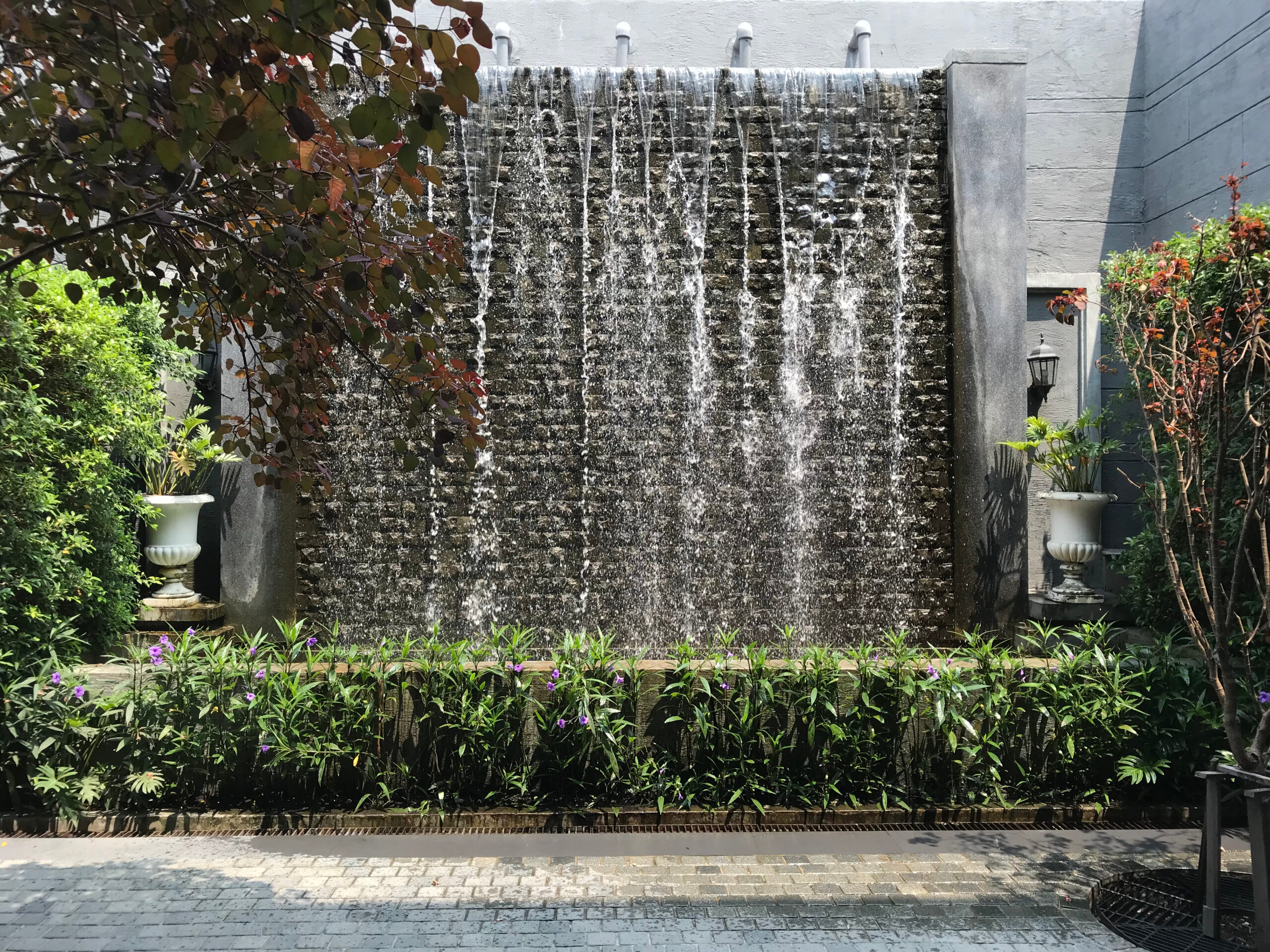
These are the questions I would settle in writing:
Adhered or held mechanically? Stone Federation Great Britain’s pool code says mechanical fixings cannot be used where stone is submerged or partly submerged, so the backing must be true and the adhesive bed full. Clips are not ruled out everywhere: Peterson’s Detail A825 hung 2-inch-thick limestone slabs on a clip system, in place of mortar, under the stainless-steel cap of a vanishing edge. Whether a given face counts as partly submerged is a question for the engineer.
Where is the waterproofing? Behind the stone, and over more than the wet face: Benedetti waterproofs the whole wall and basin, with extra protection on both faces of the wall, because there is no knowing which path water will take. The UK code adds that when a pool is drained, pressure from water held in a saturated backing is believed in many cases to make finishes debond. A water repellent on the face is no substitute; repellents are not meant to resist water pressure inside fountains.
Where does water that gets behind go? The stone industry’s wet-area guidance, written for showers, calls for solid-setting stone and weep holes to drain any voids. Benedetti carries dry-side tile or stone down to and beyond the basin’s minimum operating level, because the band above it wets and dries constantly.
Where do the joints go? The tile industry’s EJ171 guideline makes the design professional responsible for showing movement joints on the drawings. In Detail I510, on glass waterline tile, Peterson found 8- and 12-foot spacings unworkable because those joints start 3/8 to 1/2 inch wide; to keep movement joints the same width as the 1/8-inch grout joints, he set them every 24 to 36 inches. I found no test data on how joints or lippage split a sheet, but I would expect a proud edge to act as a small splash block. Settle how flush neighboring pieces must be and where joints fall relative to the lip.
How level is the lip? Mike Farley works to 1/32 inch on perimeter-overflow edges, and Pool & Spa News reported in 2024 that, for many builders, 1/16 inch has become the norm on vanishing-edge walls. These are practitioner figures, not code.
When does the water go in? The UK code suggests waiting about three weeks after completion and filling no faster than about 30 inches (750 mm) a day.
A dry sample tells you whether you like a stone. A wet offcut tested at the design flow, along with clear answers from the engineer, helps determine whether it will perform as intended on the wall.
Wet-Face Checklist
- Get an offcut in the final finish, thickness and lot, at least 12 inches wide.
- Run it at the design flow (gpm per linear foot), set at the wall’s angle. Watch the sheet, the spray and the sound.
- Look at it dry, running and dried again, in daylight and under the planned lighting, next to the coping and deck stone.
- Check the dried margins for pale lines. Test any deposit with water: if it dissolves, look behind the stone.
- In frost country, get freeze-thaw results in writing, naming the method and the number of cycles. A low absorption figure does not settle it.
- Check how hard the fill water is, and plan to keep it balanced.
- Agree with the engineer, in writing: anchoring method, waterproofing, drainage, movement joints, lip tolerance and fill schedule.
Kareem Klisharo is the founder and CEO of Citadel Stone, a natural stone supplier that ships across the USA, Canada and the Caribbean. He writes about choosing and installing stone, with articles in IFMA’s FMJ, Environment+Energy Leader, Stone Update Magazine and Stone Galleria, and a paper forthcoming in IIBEC Interface. Learn more at citadelstone.us.