


Fountains

As watershape design expands beyond the mostly recreational traditions of the recent past, more of us are being asked these days to design water elements that work more decoratively and serve to frame, reflect and otherwiseaccentuate or accompany art pieces. In these situations, a pool, fountain or basin design is visually driven by the artwork, and whether the project is done for a private residence or a commercial complex, the results can be wonderfully dynamic. In most cases, requests for this design approach come from an owner who has a particular piece in mind; in a few other cases, the artist will commission a watershape to accompany a main attraction of his or her devising and becomes a key participant in the design process. All in all, I see this as another manifestation of a trend in which

In December 2004, WaterShapes introduced ‘The Platinum Standard,’ a registry of projects that embodies watershaping…
In December 2004, WaterShapes introduced ‘The Platinum Standard,’ a registry of projects that embodies watershaping…
In December 2004, WaterShapes introduced ‘The Platinum Standard,’ a registry of projects that embodies watershaping…

Sometimes finding just what you need is as easy as looking in your own backyard. That’s what happened for Greg Whittaker of Whittaker Homes, one of Missouri’s largest home builders, when he began searching for the right partner to provide dramatic watershapes for New Town, an innovative community in St. Charles, Mo., a suburb of St. Louis. Situated on the site of what had been a farming community, New Town is intended to invoke and embody a comfortable lifestyle for the 21st Century. Parklands filled with water were the key to Whittaker’s vision not just for aesthetic and thematic reasons, but also for stormwater management. While visiting St. Louis’ Forest Park, a venerable civic treasure, Whittaker saw the
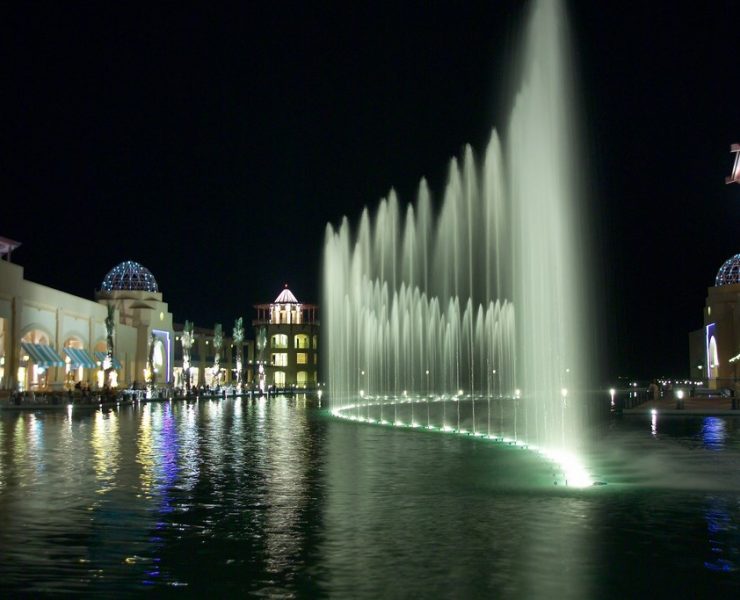
Throughout ancient times, water was central to the thinking of Arab, Persian, Moorish, Moghul and Turkish architects and designers, with largely anonymous representatives of each civilization preparing elaborate spaces with fountains, reflecting pools and other watershapes at their hearts. In the past, these societies' greatest architectural works almost invariably featured elaborate watershapes that bespoke their technical skills as well as a general love affair with the beauty, luxury and necessity of water. With new developments burgeoning across much of the Middle East these days, fountains and watershapes of all varieties are once again playing important roles in design as
Throughout ancient times, water was central to the thinking of Arab, Persian, Moorish, Moghul and Turkish architects and designers, with largely anonymous representatives of each civilization preparing elaborate spaces with fountains, reflecting pools and other watershapes at their hearts. In the past, these societies' greatest architectural works almost invariably featured elaborate watershapes that bespoke their technical skills as well as a general love affair with the beauty, luxury and necessity of water. With new developments burgeoning across much of the Middle East these days, fountains and watershapes of all varieties are once again playing important roles in design as

Who took the water out of watershapes? That may seem a ridiculous question, but it's also an obvious one when you see as many plans as I do - and by that I mean plans intended to indicate and initiate the watershaping parts of a wide variety of projects. Indeed, in my long experience in running an engineering-oriented firm, I've repeatedly been asked by designers to flesh out their watershape "ideas" (although in most cases vague inklings would probably be a more accurate way to describe them) and provide working drawings that reflect their "thinking." In my estimation, more than three-quarters of these plans lack any real indication of what the designers expect the water to do or how they want it to look. Instead, what I get is the typical overhead views with the ubiquitous "blue ghosts" or, in some cases, rudimentary sections of structures designed to contain water. It's left to me to probe and ask questions and determine what expectations they have about how the water is to appear and what it is to do. I've endured these common plan shortcomings for more years than I care to count, always wondering
Who took the water out of watershapes? That may seem a ridiculous question, but it's also an obvious one when you see as many plans as I do - and by that I mean plans intended to indicate and initiate the watershaping parts of a wide variety of projects. Indeed, in my long experience in running an engineering-oriented firm, I've repeatedly been asked by designers to flesh out their watershape "ideas" (although in most cases vague inklings would probably be a more accurate way to describe them) and provide working drawings that reflect their "thinking." In my estimation, more than three-quarters of these plans lack any real indication of what the designers expect the water to do or how they want it to look. Instead, what I get is the typical overhead views with the ubiquitous "blue ghosts" or, in some cases, rudimentary sections of structures designed to contain water. It's left to me to probe and ask questions and determine what expectations they have about how the water is to appear and what it is to do. I've endured these common plan shortcomings for more years than I care to count, always wondering

When it comes to the myriad specialties of the world of watershaping, it's tough to think of any as broad as the one occupied by floating fountains: It's a category of systems that encompass flotation, illumination, spray systems, submersible pumps, connecting devices and land-based controls. On the one hand are the huge systems installed near the shores of lakes and rivers. These fountains can be monumental in size and visually dramatic - the sorts of popular landmarks that become tourist attractions and, often, community icons. On the other, there are the countless smaller floating fountains and aerators located in golf-course ponds and water hazards, in municipal-park and stormwater ponds, on private estates and institutional campuses and in the bays of larger bodies of water, either as single features or as groups. For 45 years now, our firm has been fortunate enough to have designed (and at times installed) floating fountain systems across this full spectrum, from the large and spectacular to the small and surprisingly subtle. Some have been purely decorative, while others have been totally