








river

Sometimes finding just what you need is as easy as looking in your own backyard. That’s what happened for Greg Whittaker of Whittaker Homes, one of Missouri’s largest home builders, when he began searching for the right partner to provide dramatic watershapes for New Town, an innovative community in St. Charles, Mo., a suburb of St. Louis. Situated on the site of what had been a farming community, New Town is intended to invoke and embody a comfortable lifestyle for the 21st Century. Parklands filled with water were the key to Whittaker’s vision not just for aesthetic and thematic reasons, but also for stormwater management. While visiting St. Louis’ Forest Park, a venerable civic treasure, Whittaker saw the
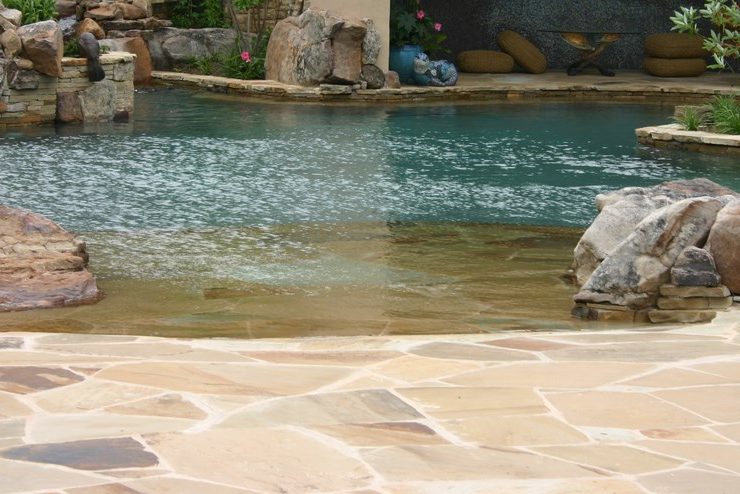
As milestones go, the project depicted in these pages has been a big one for me - and for lots of other people as well. The grand estate with its outsized home is located in the countryside near Hanover, Pa., a remote setting that offered a set of challenges that has in many ways redefined what is and isn't possible in a whole region when it comes to watershape design, engineering and construction. A full two-and-a-half years in the making (a period broken up, of course, by stretches in which there was no activity on site), this stands as one of

It's one of the most famous buildings in the world, but few people know that Frank Lloyd Wright designed Fallingwater in a matter of hours. In 1935, when Wright first received the commission to design and build a vacation home for Pittsburgh retail tycoon Edgar J. Kaufman and his family in Mill Run, Pa., he didn't get to the project right away. After several months of preliminary discussions and delays, Kaufman decided to force the issue, telephoning the architect and saying that he was going to visit Wright's studio to see what had been done. It was at that point Wright decided he'd better design the house. He had a weekend. The construction process was no more direct, but it took longer. Work began in 1936 and was completed by 1939 in a series of costly fits and starts. The project was originally set to cost in the neighborhood of $40,000, but the final tally rose to nearly ten times that amount - not inconsiderable in post-Depression America. The result of the dramatic (and, at times, traumatic) process of design and construction is nothing less than one of the greatest achievements in American architecture, a work so compelling that it never stops
It's one of the most famous buildings in the world, but few people know that Frank Lloyd Wright designed Fallingwater in a matter of hours. In 1935, when Wright first received the commission to design and build a vacation home for Pittsburgh retail tycoon Edgar J. Kaufman and his family in Mill Run, Pa., he didn't get to the project right away. After several months of preliminary discussions and delays, Kaufman decided to force the issue, telephoning the architect and saying that he was going to visit Wright's studio to see what had been done. It was at that point Wright decided he'd better design the house. He had a weekend. The construction process was no more direct, but it took longer. Work began in 1936 and was completed by 1939 in a series of costly fits and starts. The project was originally set to cost in the neighborhood of $40,000, but the final tally rose to nearly ten times that amount - not inconsiderable in post-Depression America. The result of the dramatic (and, at times, traumatic) process of design and construction is nothing less than one of the greatest achievements in American architecture, a work so compelling that it never stops

I live in the Rocky Mountains of Colorado on the banks of the Arkansas River - a beautiful place and a beautiful river. Within easy reach of my home, the Arkansas flows swiftly in certain spaces, cascading over rugged terrain, then slows down in others to form deep pools that reflect brilliant skies and create a diversity of aquatic habitats. As I watch the river flow, sometimes I can't help thinking back to my days at a trout hatchery and recognizing that if we'd had such a volume of moving water available to us in our operation, we could have produced millions more pounds of healthy fish. I'm simply amazed by the power and complexity of the water I watch, and especially by its ability to
I live in the Rocky Mountains of Colorado on the banks of the Arkansas River - a beautiful place and a beautiful river. Within easy reach of my home, the Arkansas flows swiftly in certain spaces, cascading over rugged terrain, then slows down in others to form deep pools that reflect brilliant skies and create a diversity of aquatic habitats. As I watch the river flow, sometimes I can't help thinking back to my days at a trout hatchery and recognizing that if we'd had such a volume of moving water available to us in our operation, we could have produced millions more pounds of healthy fish. I'm simply amazed by the power and complexity of the water I watch, and especially by its ability to