








retaining walls
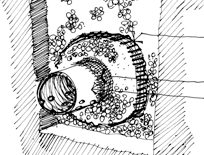
Most everyone assumes that French drains have their name because engineers in France were way ahead of the curve in figuring out how to deal with the hydrostatic pressure that

Reading WaterShapes' 100th issue brought back memories of when I first discovered the magazine and my early conversations with its editor, Eric Herman. I remember thinking at that time - or at least hoping - that there really were lots of other people out there in the design/build world who truly aim to do things right, first time, every time. In looking over the poster included with the issue, I spotted the one from January 2000 with a photograph I'd taken of one of our projects - a retaining wall under construction. I don't know quite why, but that image made me think of a site I visited last year where a retaining wall built by inexperienced hands was in the process of collapsing. And not only was the wall falling apart, but it was also compromising the fence atop it as well as a concrete patio, a storage shed and an inground pool it was intended to bolster. I couldn't help thinking that, as far as our industry has come in the past decade, there are always going to be those who

If you've been involved in major construction projects - initial work or renovations - chances are good that you've come across the need for retaining walls. In many cases, even the simple leveling of a site will require some type of retaining structure to hold back the soil - whether you're cutting fill out and need to support the slope that remains or filling an area and need to keep the new material from washing away. No matter what site we're talking about, retaining walls have one purpose: to hold something back. Whether you need to terrace a sloped yard, hold up a parking lot or

In discussing my role as a "forensic landscaper" a few months back, I expressed my disappointment in the quality of some of the work I was seeing in my local marketplace - and if the e-mail I've been receiving is any indicator, I am not alone in this experience. Indeed, questionable workmanship may be more prevalent that I ever could have imagined. As a result of this revelation, I will be using this space from time to time to demonstrate the fact that failure is often a better teacher than success and that, by exploring the nature and causes of failed projects, we can all come to a better understanding of the principles and practices that lead to good results. Before I begin, however, I'd like once again to salute

It may seem an odd source of inspiration, but I've always been interested in retaining walls. Even as a child, I'd see photographs of terraced hillsides rich with crops and wonder, "How did they do that?" I've since done my homework and have found historical evidence indicating that the skills needed to build these structures goes back many hundreds of years. I'm now applying those same skills today in devising soil-retaining systems for my clients. Whether it's farmers creating flat spaces on which to

A grand California estate deserves a grand pool, and Cima del Mundo is certainly no exception. The new pool is part of a project that involves the complete renovation of a classic estate in the hills of Montecito, a prosperous enclave just south of Santa Barbara, Calif. In keeping with the overall theme of the project, which was described in detail in "The Crest of the World" (WaterShapes, January/February 2001, page 32), the pool has been outfitted with thoroughly