








foutain

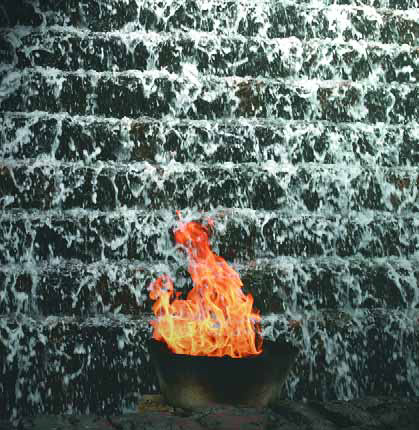
When I was a kid, the conventional part of my education in environmental design came in helping my father, Jay Stang, plant parkways and blocks of Pinus Pinea across the city. The unconventional part - the part that apparently took firmer root as I grew up - had me admiring the plate he'd made from hardwood with the dozen split avocado pits he'd carved and mounted on the surface; it also had me listening to my mother, Judy Campbell, tell me that the earth was here first, that the garden already exists and that pathways, watershapes and structures are best built around what we find there. Those unconventional lessons - one about creativity and vision, the other about respect for nature and a method for approaching it - have stayed with me through the years and have given me access to a number of incredible projects. As is the case with most intriguing and fascinating designs, the one seen here flowed from a client with whom I developed a close creative connection that resulted in a free exchange of ideas¬ - a synchronized spontaneity that became a pattern for the entire design process. She always had strong thoughts about what she wanted, but she allowed me to interpret and express her ideas based on our conversations and the nature of the site. As designers, it's not unusual for us to be called on to use our skills and figure out what a client such as this one really wants and then suggest ideas we think will work. I call this process "environmental psychiatry" because, while so many clients have a sense of what they want and a laundry list of general ideas, few have a
When I was a kid, the conventional part of my education in environmental design came in helping my father, Jay Stang, plant parkways and blocks of Pinus Pinea across the city. The unconventional part - the part that apparently took firmer root as I grew up - had me admiring the plate he'd made from hardwood with the dozen split avocado pits he'd carved and mounted on the surface; it also had me listening to my mother, Judy Campbell, tell me that the earth was here first, that the garden already exists and that pathways, watershapes and structures are best built around what we find there. Those unconventional lessons - one about creativity and vision, the other about respect for nature and a method for approaching it - have stayed with me through the years and have given me access to a number of incredible projects. As is the case with most intriguing and fascinating designs, the one seen here flowed from a client with whom I developed a close creative connection that resulted in a free exchange of ideas¬ - a synchronized spontaneity that became a pattern for the entire design process. She always had strong thoughts about what she wanted, but she allowed me to interpret and express her ideas based on our conversations and the nature of the site. As designers, it's not unusual for us to be called on to use our skills and figure out what a client such as this one really wants and then suggest ideas we think will work. I call this process "environmental psychiatry" because, while so many clients have a sense of what they want and a laundry list of general ideas, few have a

Watershaping advanced by leaps and bounds from 1999 through 2004 – a journey of artistry…
As watershape designs become ever more creative and adventurous, there's an increased need to help clients and other project participants visualize our plans. Indeed, presentation is a topic of great importance these days for designers from both the pool/spa industry and the landscape trades, so much so that it's become a fixture on educational calendars and one of the cornerstones of the Genesis 3 curriculum. What has everyone excited about upgrading the way they present their ideas is that there are various good ways to get the job done. To be sure, having the ability to draw is a tremendous asset - some would say an absolute necessity - but fortunately for those who are